Om Namo Bhagavate Sri Ramanaya
Saranagati Banner
SARANAGATI
SRI RAMANASRAMAM
Bhagavan Sri Ramana Maharshi
SEPTEMBER 2026
Vol. 20, No. 9
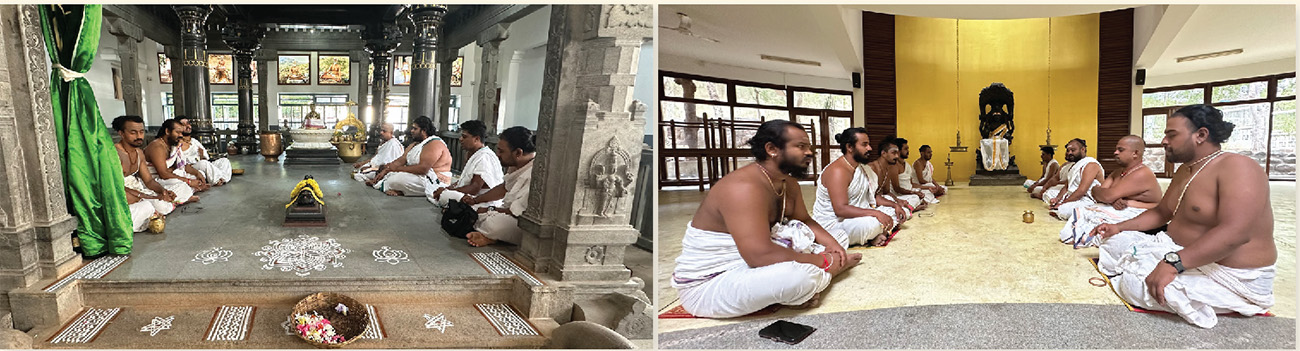
Saranagati September 2026 cover — photo collage of Bhagavan’s 130th Advent Day observances at Sri Ramanasramam
Saranagati September 2026 — Vol. 20, No. 9

Dear devotees,

In this issue, we continue the life story of K.K. Nambiar, who came to Bhagavan in 1932. In this segment, we see how the government sent him abroad for further engineering training so that he could assist in construction projects underway in India at the time (see In Profile).

In Ramana Reflections: Vichara in Real Time—The Clarifying Power of a Portable Enquiry Practice, we look at taking up enquiry in a most natural way, allowing it to lead us through the difficulties that come with daily living. Vichara need not be confined to formal meditation; once cultivated, it may become transferable, accompanying us throughout the day. Because the sense of a separate self must continually be regenerated, everyday thoughts, moods, impulses, behaviours and motivations provide a rich field for enquiry practice (see Ramana Reflections).

For videos, photos and other news of events: https://gururamana.org or write to us at: saranagati@gururamana.org.
For the web version: https://sriramana.org/saranagati/September_2026/.

In Sri Bhagavan,
Saranagati


Calendar of Ashram Events

Calendar of Ashram events from September to November 2026
1st Sep (Tue) Bhagavan’s 130th Advent Day
11th Oct (Sun) Navaratri Festival begins
7th Sep (Mon) Punarvasu/Samvatsara Abhishekam
20th Oct (Tue) Saraswati Puja
10th Sep (Thu) Muruganar Day/Amavasya
21st Oct (Wed) Vijayadasami
14th Sep (Mon) Ganesh Chaturthi
25th Oct (Sun) Full Moon
25-26th Sep (Sat-Sun) Full Moon
31st Oct (Sat) Punarvasu
4th Oct (Sun) Punarvasu
8th Nov (Sun) Deepavali
In Profile

K.K. Nambiar (Part II)

Audio: IN PROFILE
0:00 / 0:00
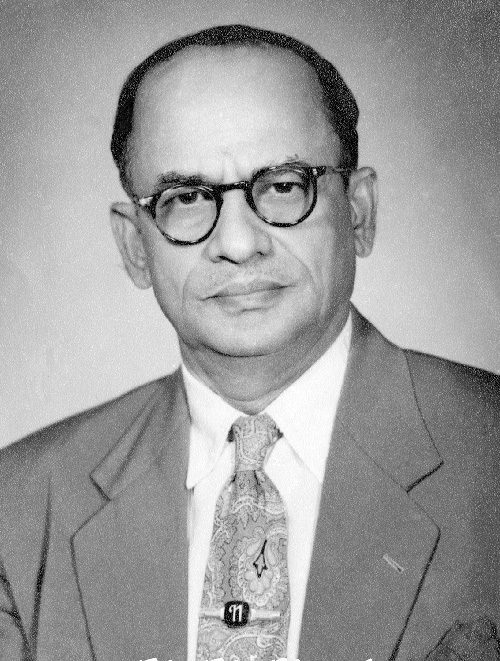
Portrait photograph of Sri K.K. Nambiar
Sri K.K. Nambiar

About the time Bhagavan completed the Malayalam translation of Ramana Gita in the notebook Nambiar had brought to him following the remarkable dream we heard about in part one, Bhagavan added several appendices on the unused pages, which included Skandasapthakshari Mantra, Sri Arunachala Pancharatnam, Sri Ramana Chatvarimsat and Sri Ramana Vibhaktyashtakam.1

Nambiar offered to have the Malayalam text printed at Vidyavilasam Press in Tellicherry in northern Kerala at his own expense and donate the copies to the Ashram. Bhagavan suggested that he write a preface. Being inexperienced in editorial work, Nambiar sought advice from Paul Brunton and composed a three-page preface which he showed to Bhagavan for approval.

Bhagavan then raised an unexpected concern. If the original notebook were sent to the printer, its pages might be separated during typesetting. Since the notebook itself had come about through the unusual circumstances of Nambiar’s dream, Bhagavan felt the book had to be preserved in the Ashram Archives as it had a history behind it. He asked Madhavan, the attendant, to get another notebook or just a writing pad. A new writing pad was brought and Bhagavan again carefully copied in his beautiful, almost print-like handwriting all that was written in the notebook of Nambiar’s dream.

When this second manuscript was handed to Nambiar for printing, a thought occurred to him. Rather than risk Bhagavan’s handwritten copy being dismantled at the press, he bought an additional writing pad and, with his wife’s help, copied the text yet again. Their copy went to the printer, while Bhagavan’s manuscript was sent to Basel Mission Press in Mangalore for fine binding in Morocco leather with gilt edges.

When the bound volume returned, Nambiar took it to Bhagavan, who examined it and returned it with his blessings. Thereafter, Nambiar preserved it as a sacred relic, bringing it out only on important occasions, while using ordinary printed copies for daily parayana.

By this time Nambiar’s attraction to Bhagavan’s teaching had deepened considerably. The conviction that God was seated within the Heart and that the real quest was inward began to overshadow his earlier emphasis on temple worship and ritual recitation. A verse attributed to Sadasiva Brahmendra was frequently on his lips:

O Lord Siva! I ask nothing new from you. Give me only my own blissful state.

Through the Floodwaters

One evening after a torrential rain, the Sarvadhikari urgently needed to travel to Vellore regarding a court case. With no bus available, Nambiar volunteered to drive his old Austin sedan.

Near Polur they reached a flooded causeway. From the guard-rails Nambiar estimated that the water might be about eighteen inches deep, but the level was rising rapidly. With darkness closing in and no one nearby to help, he decided to attempt the crossing.

As the car entered the causeway, water surged around it and threatened to reach the ignition and the air intake system. Thus, there was a real risk of the engine stalling—or even of the vehicle being swept away. A swami travelling with them chanted, Vasudeva sarvam iti, (“All of this is Vasudeva, the Supreme God,”) while T. P. Ramachandra Iyer who was also travelling with them, added, Sarvam idam aham cha Vasudevah (“All the universe and the I as well, are Vasudeva”).

Concentrating inwardly on Bhagavan, Nambiar drove steadily forward. The car reached the opposite bank safely, and the relieved party continued on to Vellore.

The journey concerned a civil suit brought by Perumalswami, a former attendant of Bhagavan, regarding Ashram property. Perumalswami sought to have Bhagavan summoned to appear in court. Devotees appealed to the Madras authorities, arguing that making Sri Ramana to attend would be inappropriate. A Gazette Extraordinary was eventually issued granting Bhagavan exemption from personal appearance in civil proceedings, and he was instead examined by a visiting judicial commission at the Ashram.

Transfers and Dreams

At the end of November, shortly after Karthigai Deepam, Nambiar was transferred to Mangalore as District Board Engineer for South Canara. As his train left Tiruvannamalai, he watched the flame and smoke of Deepam receding in the distance—a sight that remained vivid in his memory for decades.

South Canara brought him near places already sacred to him. He visited the Mookambika Temple at Kollur, where he had practised austerities in 1922, as well as Godachadri, Chitramoola Cave and the traditional Sarvajna Peetha associated with Adi Sankara. He also frequently visited Swami Ramdas at the nearby Anandashram, Kanhangad, where he received initiation into the mantra, Sri Ram, Jai Ram, Jai Jai Ram.

From South Canara he was briefly transferred to Kakinada to work on the design of a new bridge across the Godavari and later, transferred to Madurai. Wherever official duties permitted, he continued returning to Ramanasramam, as he put it, to “charge” his spiritual batteries.

At Kakinada, Bhagavan appeared in a dream and alerted him to an error he was about to make in the proposed well foundations for the Godavari bridge. Nambiar regarded this as another extraordinary indication of Bhagavan’s continuing guidance.

Appendicitis

In 1942, while stationed at Madurai, Nambiar suddenly suffered a severe abdominal pain:

During those days I used to regularly practise strenuous yogic exercises. I took an enema one day and couldn’t pass all the water. That night I felt severe pain in the abdomen and in the small hours of the morning, the family doctor was sent for. As soon as he checked my condition, I was asked to get ready to go to the Headquarters Hospital with preparations to stay overnight. My wife and I went to the hospital early morning. They were ready for an operation. Colonel Cox, the Surgeon gave me a spinal anaesthesia and performed the appendix operation which lasted longer than usual, as they had to make a large incision. In the meanwhile, the swollen appendix had burst, said the surgeon. I was all the while thinking of Bhagavan and when back in the ward after the operation, while lying in a half-dazed state, I had a dream of Arunachala Hill, or perhaps ‘Kailas’ which I had not seen as the colour of the peak was more whitish than crimson.

Some months later another dream came. Bhagavan told Nambiar that he would be transferred to Madras and that he “would be going” with me. Nambiar narrates:

When I woke up, I was confused and couldn’t believe it. I had not the faintest idea that transfer to Madras was possible where there was no place for a District Board Engineer. Anyway, I wrote a letter about the dream to Sri Ramanasramam and left it there. A few days later I came to know that the City Engineer’s post in the Madras Corporation had fallen vacant due to the then incumbent having been suspended on some corruption charges and they were thinking of posting a new engineer, with some foreign qualifications. It seems the Government of Madras had suggested my name and wanted the council to take a decision. I was thereupon interviewed by the Municipal Commissioner, and the names of all the candidates were put up to the Council for a decision. I was selected for appointment. The dream came true.

In September 1943, Nambiar took charge of the post and entered the office which had been kept locked and sealed till then.

He would be in Madras for the next fifteen years as Corporation Engineer, Chairman of City Improvement Trust, Chief Engineer of Highways—till his retirement from Government service.

Niranjananandaswami subsequently asked him to act as the Ashram’s representative in Madras, helping procure stationery and building materials, communicating with devotees and attending to printing and financial matters.

A Wager on Bhagavan’s Grace

In 1944 Nambiar’s sister, Madhavi Ammal urged him to visit Tiruvannamalai by train. He hesitated because, without a car, moving around after arrival would be difficult. Half-jokingly, he said Bhagavan would have to arrange one.

Two days later an old acquaintance, Sri Venkataratnam, then Subdivisional Magistrate at Tiruvannamalai, visited Nambiar’s office and invited the entire family to stay with him. He promised to meet them at the railway station and provide a car during their visit. When the family arrived, Venkataratnam was waiting—not with one car, but two.

During their stay, Nambiar spoke of his confidence that Bhagavan looked after his devotees. Venkataratnam teasingly proposed a test. On the return journey they would have to change trains at Villupuram late at night, where first-class accommodation was notoriously difficult to obtain. Their party numbered five. Would Bhagavan arrange berths for them?

Nambiar accepted the “bet.” At Villupuram the first Madras-bound train arrived nearly full. A helpful ticket examiner found only two upper berths in separate compartments—not enough for the family. He advised them to wait for the next train. Nambiar narrates:

I would not give up hope. I was all the while praying to Sri Bhagavan and could not reconcile myself to the idea that we would be left stranded. Musing thus within myself, I felt like walking up to the front end of the train, where there were a few closed bogies adjacent to the engine. No passenger coaches are generally connected there but, on that night, there was a brand-new looking first-class bogie next to the engine nicely done up and polished and completely shuttered and closed being towed to Madras for some special purpose. On seeing it, I ran back along the platform and spoke to the ticket examiner about it. The sceptical railway official came up with me and was surprised to find a new coach with all the doors and windows locked. On opening it with a key, we found an exquisite compartment with all the seats empty. With his permission all of us entered the compartment - six berths, all to ourselves - specially reserved! I repeated aloud “Om Namo Bhagavathe Sri Ramanaya! I have won the bet!”. Need we have any doubt whether Sri Bhagavan would answer the silent prayers of his devotees?

Mr. Venkataratnam’s assistant went back to Tiruvannamalai and narrated to him details about this incident. He was surprised and wrote to Nambiar admitting that he had lost the bet but that his faith in Sri Bhagavan had increased all the more. For Nambiar this was yet another addition to a growing list of miraculous incidents attributable solely to Bhagavan’s Grace.

Foreign Deputation

Another unexpected turn came early in 1946. A young engineer happened to mention to Nambiar that the Government of India was sending a delegation of engineers to Britain and the United States for advanced study in highway engineering. Nambiar was surprised to learn that several junior colleagues had already been selected while he, being temporarily deputed to the Madras Corporation, had heard nothing about it.

He immediately petitioned the Government of Madras. The request reached Sir Thomas Austin, Adviser to the Government, who insisted that Nambiar be included.

The arrangements were made hurriedly. Before leaving India, Nambiar sought Bhagavan’s blessings and informed Ramanasramam of his journey.

While in England he received a letter from the Ashram dated 17th April 1946. Its purpose, the Sarvadhikari wrote, was “just to make you feel that Bhagavan is with you even there in England.”

The letter mentioned an elderly English devotee, Mrs. Victoria Doe of Epsom, who had never visited India but deeply longed to meet someone who had sat in Bhagavan’s presence.

Mrs. Doe
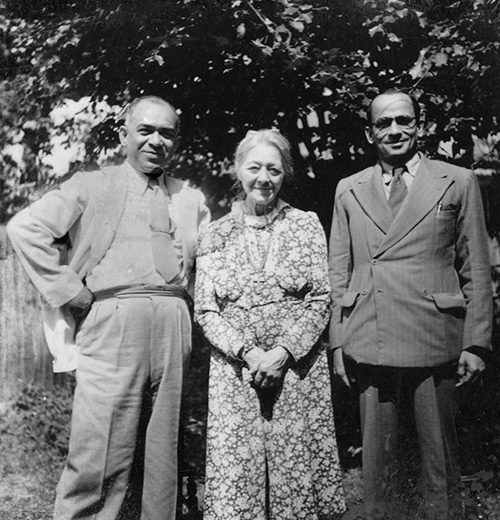
Aurobindo Bose, Mrs. Victoria Doe and K.K. Nambiar photographed together in the United Kingdom, May 1946
Aurobindo Bose, Mrs. Victoria Doe and K.K. Nambiar, UK, May 1946

On 19th May 1946 Nambiar travelled to Epsom to meet Mrs. Doe and her daughter, Leena. The encounter moved him deeply. Mrs. Doe had never seen Bhagavan physically, yet her devotion was intense. She had read his teachings, meditated upon him and maintained a long correspondence with the Ashram. Nambiar writes:

Mrs. Doe with shaking hands took from her shelves sheaves of letters received from the Ashram and after kissing them with great reverence handed them over to me for perusal. All those were letters from the Ashram and had been meticulously preserved by her for many years. She had also with her all the English publications of Sri Ramanasramam. She opened one of the books and running her shaky finger along the inscription on the first page “with Gracious Blessings from Sri Bhagavan”, burst into tears of joy and devotion.

When she composed herself, she said “Mr. Nambiar, how lucky you are to have been able to be with him, to see him and hear him speak. Here we treasure these books and letters as representing him. Now he has sent you here. I feel that he is with us now”.

Such love, such devotion to the Sage, so tenderly expressed, moved me to the depths of my being. Verily his kingdom is the Heart of the devotee, and I have always found him there enthroned.

A fortnight later Nambiar returned and found another surprise. Aurobindo Bose, also associated with Ramanasramam, had arrived in London and had independently made a point of visiting Mrs. Doe. The two men joined Mrs. Doe and her daughter for tea in the garden and sent a joint letter to the Ashram.

Months later, Bhagavan referred to their meeting in the Hall, joking that Mrs. Doe liked Nambiar because he was quiet.

Nambiar visited Mrs. Doe again in January 1947, and many years later, in 1963, visited again with his wife. Mrs. Doe, by then in her nineties, presented Mrs. Nambiar with an old copy of Maharshi’s Gospel that she had treasured for years.

Eleanor Pauline Noye

From England, Nambiar travelled to the United States. During an official tour of California, he arranged to meet another prominent devotee, Mrs. Eleanor Pauline Noye.

Unlike Mrs. Doe, Mrs. Noye had travelled to India and spent several months at Ramanasramam. She lived in the San Fernando Valley near Los Angeles and hoped to return to India when circumstances permitted.

Nambiar travelled by tram from central Los Angeles to Van Nuys Tram Terminus, where Mrs. Noye met him in her car. On seeing someone who had come directly from Bhagavan, she was overcome with emotion.

Her modest home had, to Nambiar, the atmosphere of a hermitage. They spent hours speaking of Bhagavan and wrote a joint letter to the Ashram. When the letter reached Tiruvannamalai, Bhagavan read it. Devaraja Mudaliar records in his Day by Day with Bhagavan Mrs. Noye’s joy that Nambiar had visited and how she felt as though Bhagavan himself had been present.

Two days later Mrs. Noye visited Nambiar at his hotel. After dinner he accompanied her back to San Fernando Valley. Though he had little time before catching the last tram, the two sat quietly together:

Both of us sat with closed eyes, meditating on Sri Bhagavan whose physical body was more than ten thousand miles away. All the same I felt his presence. The peace that I enjoyed during those few moments was indescribable. Mrs. Noye felt the same way. I took leave of her and hurriedly retraced my way to the tram terminus. By the time I reached my Hotel at Los Angeles, my colleagues had already left for the airport. So, I hurriedly packed up, paid my dues and proceeded to the airport just in time to board the plane. I felt Bhagavan’s help right through and when I was comfortably seated in the plane and was flying high above the clouds, I felt an urge to write to the Ashram about the air journey in the small hours of the morning, the sublime feeling and the peace that enveloped me at that time.... I was told that when this letter reached the Ashram and was handed over to Bhagavan, he read it out in the hearing of all those around him and eventually gave it to some of them for perusal.

Meeting Bose in New York

Later, while travelling in America, Nambiar received word that A. Bose had left Europe and might soon be in New York. No one, however, knew where he was staying.

When Nambiar reached New York, he checked into the Embassy Hotel. He planned to contact major travel agencies the next morning in the hope that they might help locate Bose. Nambiar recounts:

Next morning I came out of my room, and standing at the elevator shaft, rang for the lift to go down to breakfast. The lift arrived, the door opened and lo! Mr. Bose was there in the lift to travel down to breakfast along with me! It might be that it was a coincidence, but it was something very remarkable indeed, if you consider that there were at that time 516 hotels in New York City and most of them of such dimensions that even while living for weeks together in the same hotel, we could have missed coming across each other. My stay in that city during this trip was only a few days. A mere fortuitous coincidence to the unbeliever, but to me it was one of those miraculous incidents of Sri Bhagavan helping his devotees. Since then, I have had many such incidents to confirm my unquestionable faith in Sri Bhagavan.

Conclusion

Behind the notebook, the flooded causeway, the unexpected appointments, Mrs. Doe in England, Mrs. Noye in California and the chance meeting with Bose in New York City lay a single conviction: geographical distance made no difference. Bhagavan’s presence was not confined to the body seated in the Old Hall.

As Nambiar’s life increasingly demonstrated to him, the true kingdom of the Guru was the Heart of the devotee—and there, wherever he travelled, he found Bhagavan always there. —

(to be continued)
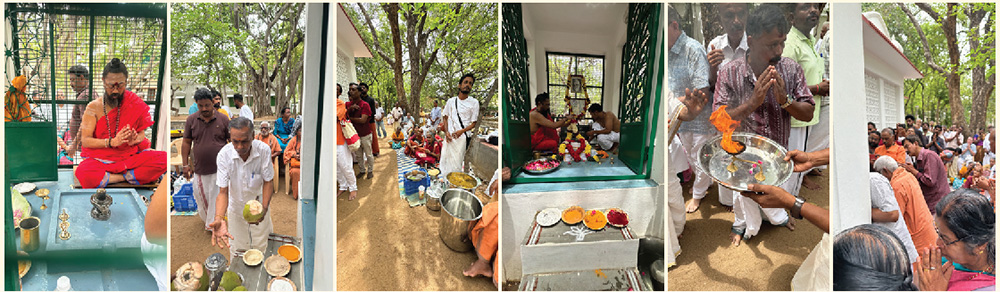
Events at Sri Ramanasramam: Kunjuswami Day

Devotees from Kerala gathered at Kunju Swami’s samadhi reciting Bhagavan’s Malayalam works, followed by puja and distribution of prasad
Kunjuswami Day at Sri Ramanasramam, 7th August 2026

On 7th August, devotees came from Kerala and gathered at Kunju Swami’s samadhi to recite Bhagavan’s Malayalam works, followed by puja and distribution of prasad. —

Similes from Bhagavan: The Deep Sea Called Mahamaya

Bearing and tending me in the world in the shape of my father and mother, thou didst enter my heart and before I fell into the deep sea called mahamaya and was drowned, thou didst draw me to thee and keep me at thy feet. How shall I describe thy wonderful grace, O Arunachala, who art Consciousness Itself?

— Sri Arunachala Nava Mani Malai, v. 9

Announcement: Advent Day Launch of <Saranagati.Online>

Saranagati’s 20th year commemorative banner, 2007–2026
Saranagati’s 20th year, 2007–2026

On the occasion of the celebrations of Sri Bhagavan’s 130th Advent to Arunachala, 1st September 2026, Saranagati e-magazine begins its 20th year. Marking this milestone, the publication is launching <https://saranagati.online/>. As there have been requests in recent years to make Saranagati articles and content more accessible, the website includes a complete PDF archive of more than two hundred Saranagati issues for free downloading. This archive will soon be Google searchable, once traffic to the site increases and the uploaded files are indexed by Google. In the near future, all sixty-two years of the Mountain Path and eighteen years of the Call Divine will become searchable as they get indexed by the various online search engines. —

Best Shot: The Langurs of Arunachala

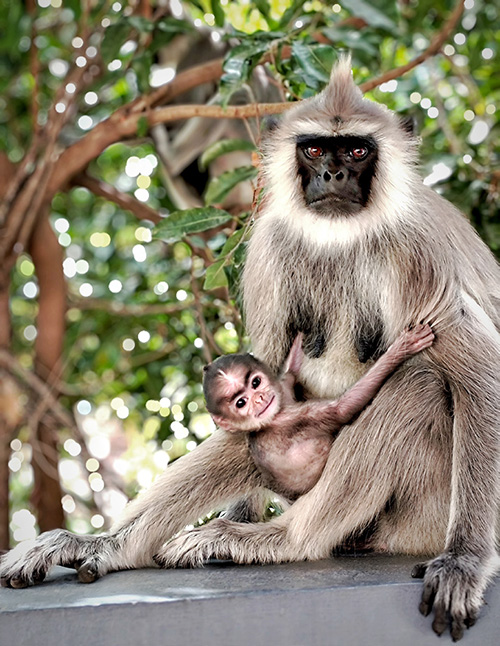
A grey langur mother and her infant taking refuge in Sri Ramanasramam during an unusually warm August
Dev Gogoi

Mother and child take refuge in Sri Ramanasramam during an unusually warm August, where hot and dry conditions have made food and water scarce on the Hill. Grey langurs feed mainly on leaves, fruits, flowers and seeds. They may refuse food offered by humans, though on this occasion a ripe guava was readily accepted.

In recent decades, Arunachala’s langurs were rarely seen near people, but they are now frequent visitors to Skandasramam, Ramana Nagar and the town. Their great leaps through trees and across buildings are striking to watch. Though generally non-aggressive, they may growl or bare their teeth when approached too closely.

Also known as Hanuman langurs, they are native to the Indian subcontinent. They are recognised by their silvery-grey bodies, dark faces, prominent brows and long, curved tails. Infants have pale faces and remain closely bonded to their mothers. Tradition associates their dark faces and hands with Hanuman, who was burned while setting Lanka ablaze in the Ramayana. —

Origins

Coming Home — Sri Bhagavan’s 130th Advent

Audio: ORIGINS — SRI BHAGAVAN’S 130TH ADVENT
0:00 / 0:00
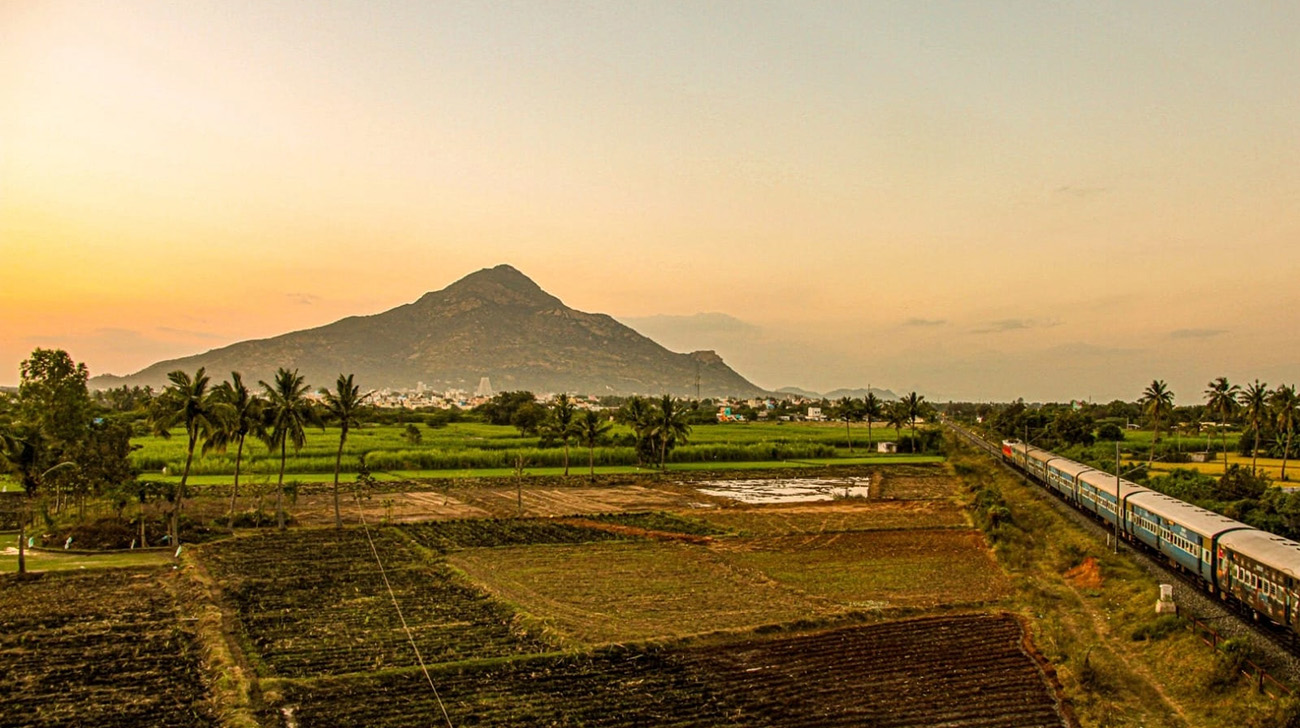
Arunachala rising beyond green fields at dusk, seen from the plain near Tiruvannamalai
D. Thiyagarajan

Young Venkataraman’s departure for Tiruvannamalai on 29th August 1896 was not an act of renunciation in the conventional sense. Having discovered the inner Arunachala in Madurai six weeks earlier, he was irresistibly drawn towards its outer form. His arrival at Arunachaleswarar Temple on 1st September confirmed outwardly what had already occurred within.

What is it that happened in the upper room of his uncle’s house on that fateful day some weeks earlier?

The fear of death rose up suddenly and compelled a young boy to examine what it was that could die. He lay down as though the body were already a corpse and, without any formal instruction, traced the sense of “I” beyond the body and mind. What remained was pure awareness, untouched by death. The body could perish, he understood, but there was something that remained that could not.

From that moment, ordinary worldly life lost its attraction. This was not born of disappointment or aversion, but of discovering an interior stillness and fullness before which the pleasures of daily life in the world appeared insubstantial. The true Advent had already taken place: the mind had come home to its source.

Soon after reaching Tiruvannamalai, young Ramana discarded his remaining money, food and clothing, had his head shaved, and surrendered himself to Arunachala. Yet even these acts were secondary. The deeper renunciation was the spontaneous withdrawal of attention from the body and the senses. He had no programme of austerity and no ambition to become a saint. He had no desires or wants whatsoever because all volitions had disappeared completely. His absorption was not cultivated for spiritual achievement, for indeed, there was no desire or want whatsoever in him. The mind, having sunk into its source, no longer emerged even to attend to bodily needs.

In the precincts of the great temple—the Thousand-Pillared Hall, Patala Lingam, Gopura Subrahmanya Shrine and the ground beneath the iluppai tree—young Brahmana Swami remained for long periods in profound samadhi. Food, sleep and bodily comfort lost their former hold. At times devotees placed food into his mouth because he was too absorbed to attend to eating.

At Patala Lingam, insects ate into the flesh of his legs and mischievous boys threw stones, yet he remained immersed in stillness. Seshadri Swami eventually discovered him in an almost corpse-like condition and helped bring him to safety.

Such a state should not be taken for unconsciousness. Bhagavan later described the condition as complete absorption where all dualities, thoughts, and distinctions had vanished. His samadhi meant that the separation between the knower, the act of knowing, and that which is known had completely dropped away. What appeared from outside as insensibility was inwardly a fullness beyond ordinary waking consciousness. In not actively seeking anything, identification with the body had lost its force, allowing the natural awareness of the Self to prevail.

At Gurumurtham, Brahmana Swami’s meditation continued without break for months. His hair became matted, his fingernails grew long, and his body weakened through minimal food. Ants crawled over and bit him, yet he scarcely moved. He instructed Palaniswami that he would open his eyes at noon to take food but did not wish to be disturbed otherwise. Eating was not a significant feature of his daily life but only a concession necessary to preserve the body.

Palaniswami’s presence became important because the young sage’s indifference to the body left him physically vulnerable. Weakness and dizziness sometimes caused him to fall when he tried to stand.

Palaniswami protected him, brought food and guarded his solitude. Yet all this remained peripheral. At the centre was the steady repose of awareness of the Self.

Tradition distinguishes savikalpa and nirvikalpa samadhi. In the former, subtle distinctions or objects of meditation remain; in the latter, dualistic perception and mental differentiation subside. Bhagavan emerged as one who had attained sahaja samadhi—the natural, permanent state where non-dual awareness is sustained effortlessly during everyday waking life, long after nirvikalpa samadhi has been mastered.

Conclusion

Thus, Bhagavan’s first months at Arunachala were not chiefly a period of travel, settlement or outward renunciation. They were the flowering of the awakening that had begun in Madurai. Tiruvannamalai became the sacred enclosure in which that realisation was embodied. Bhagavan’s geographical Advent took only a few days; the deeper Advent was the disappearance of the separate self into the stillness of the Heart. The real Advent was therefore inward.

To say that Bhagavan “came” to Arunachala is therefore to say that he came home to the Self. The Hill outside and the Self within were not two. What devotees later saw as a silent youth seated in temple corners was, in truth, Arunachala absorbed in Arunachala—the Self resting naturally in its own unbroken light. This was Bhagavan’s Advent one hundred and thirty years ago. —

Announcement: Live Streaming

The Ashram is live streaming the Sri Chakra Puja on the first and last Friday of each month. Daily live streaming Mon to Sat from 8 to 9.45am and 5 to 6.45pm IST continues and includes the Vedaparayana, puja and Tamil Parayana. (No streaming on Sundays) To access live streams, go to: <https://youtube.com/@SriRamanasramam/live>

Events at Sri Ramanasramam: Bhagavan’s 130th Advent Day Celebrations

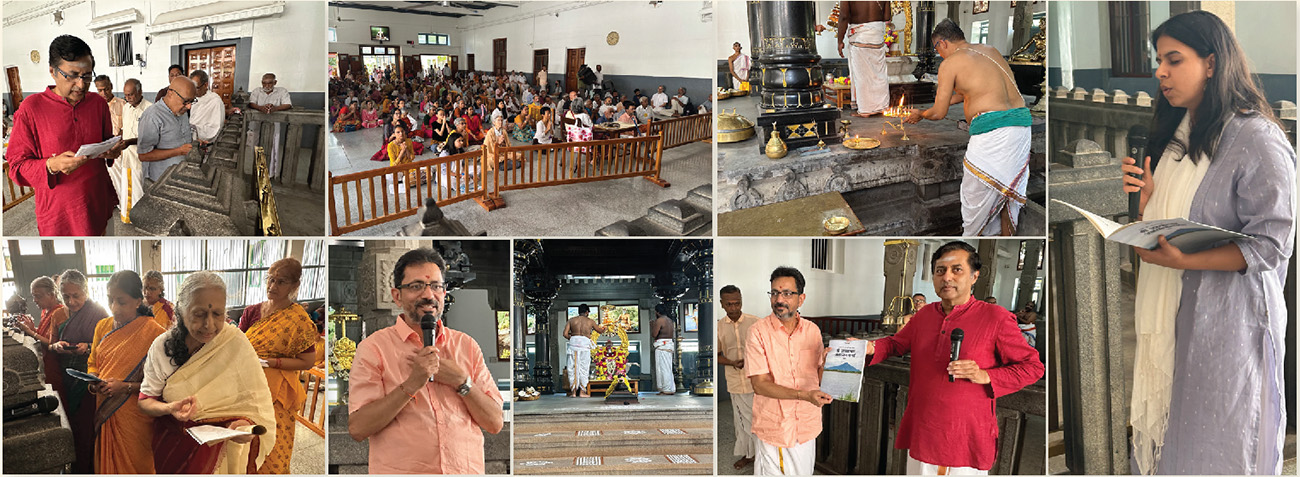
Devotees gathered at Sri Ramanasramam for Bhagavan’s 130th Advent Day celebrations on 1st September 2026, including chanting, abhishekam and the release of a chanting book
Bhagavan’s 130th Advent Day, 1st September 2026

On this day 130 years ago, Bhagavan arrived in Tiruvannamalai, never to leave again. On 1st September 2026, devotees gathered to celebrate Bhagavan’s Advent Day, with live streaming allowing devotees near and far to join the observances. In the early morning, the Ramana Mandiram group led by Somasundaram sang Aksharamanamalai according to the Madurai tradition, while Mahanyasa Rudram was chanted simultaneously in the Mother’s Shrine. Abhishekam and Veda parayana began at 7.15 am. The celebrations also included the release of a chanting book prepared by the Bhagavan Ramana Maharshi Centre of Melbourne, led by Dr Sanjay Raghav, who conducts regular satsangs. A group of 47 devotees from the Centre spent a week at the Ashram and recently completed a Hindi translation of Bhagavan’s Aksharamanamalai. Adhya, one of the group members, offered the first twelve verses between the two aratis of the Advent puja. Following puja, copies of the new chanting book were distributed freely to Hindi-speaking devotees. —

Events at Sri Ramanasramam: Pratistha Dina-Samvatsara Abhishekam

Veda Patasala students conducting Veda parayana in Ghanam mode in Bhagavan’s Shrine and the Grantalaya Auditorium
Veda parayana in Ghanam mode ahead of the Samvatsara abhishekam

In preparation for the first anniversary of the Mahakumbhabhishekam of Sri Ramaneswara and Matrubhuteswara Shrines, the Veda Patasala is conducting Veda parayana in Ghanam mode. Recitations take place in Bhagavan’s Shrine from 7–8 a.m. and 10–11 a.m., and in the Grantalaya Auditorium from 8.45-10am and 3.30–6 p.m. The annual Samvatsara abhishekam will be held on Punarvasu Day, Monday, 7th September, in the New Hall. Sankalpa and Mahanyasa japa begin at 5.30 am, followed by homa, purnahuti, procession and abhishekam in Mother’s and Bhagavan’s Shrines. —

Ramana Reflections

Vichara in Real Time

The Clarifying Power of a Portable Enquiry Practice

Audio: RAMANA REFLECTIONS
0:00 / 0:00
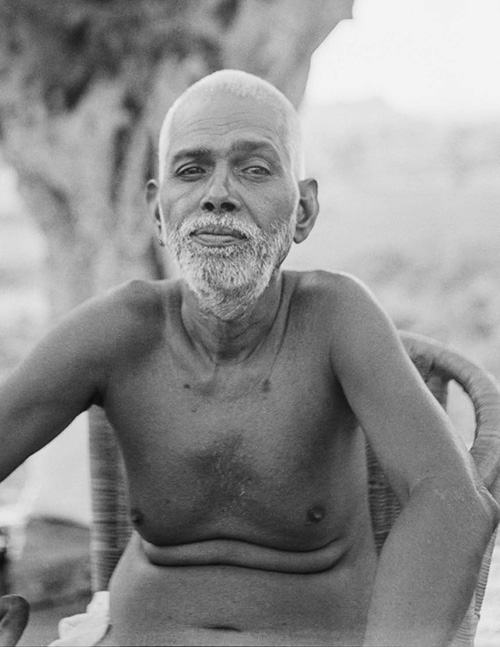
Bhagavan Sri Ramana Maharshi seated, photographed at Sri Ramanasramam
Bhagavan Sri Ramana Maharshi

In recent segments of Ramana Reflections, we have considered vichara largely in theoretical terms. But it may be useful now to ask how enquiry can accompany us beyond formal meditation and become incorporated into daily life. Indeed, this can sometimes happen so naturally and forcefully that we may not even recognise what is taking place within us as vichara.

Normally, when we speak of vichara, we mean Bhagavan’s formal practice of atma-vichara, undertaken deliberately and preferably under quiet conditions. Yet the decisive enquiry of Bhagavan’s own life arose under very different circumstances.

In the upper room of his uncle’s house in Madurai in July 1896, enquiry came unsolicited. A sudden and overwhelming fear of death arose, and instead of resisting it, the sixteen-year-old turned directly towards it: What was dying? Was he the body? What remained when the body was dead? His enquiry was spontaneous, natural and compelled by circumstance. This suggests that vichara need not remain confined to the meditation setting. Life itself can call it forth.

As devotees, we sometimes complain that our enquiry has become mechanical, routine or lifeless. But perhaps the deeper difficulty is our resistance to inward investigation. Vichara threatens the status quo of ego. It disturbs the psychological equilibrium we have constructed around our habits, identities and familiar explanations.

During periods of stillness, unassimilated fragments of the heart may call out for attention. The most common response is deflection and distraction. And yet, vichara offers an alternative, namely, looking toward that which is unresolved.

Bhagavan once remarked that suffering is the way.1 This does not mean that suffering is valuable for its own sake, but that it can function as a guide, revealing where attachment, identification and misunderstanding remain hidden.

When we consider that the egoic project is never finished—when we consider that the sense of a separate self must continually be reinforced through thoughts, reactions, moods, memories and expectations—we begin to see how extraordinarily rich everyday life is as a field for enquiry. Bhagavan comments:

If you do not practise atma-vichara, then loka-vichara creeps in.2

What does this mean? In a broad sense, we are ever choosing between outward dispersion and inward recollection—the world or the Heart, ego or Self. We seek fulfilment through the senses, possessions, relationships, reputation and the endlessly proliferating thinking mind. Vichara turns attention in the opposite direction.

Such enquiry may at times be very simple: presence, silent watching, a willingness to see what is actually taking place. Gradually we begin to recognise how identity is constructed under different circumstances, i.e. when praised or blamed, frightened, disappointed, restless, lonely, successful, ignored or frustrated. Enquiry becomes less a technique practised during designated periods and more a way of seeing throughout the day. In other words, enquiry becomes a way of living.

We might call this portable vichara. If ego is relentless in re-establishing itself, enquiry must become correspondingly persistent.

Mark Twain famously joked that his life had contained many misfortunes, most of which never happened.

The remark captures something of our predicament. Like the man grieving for the missing tenth man or the woman frantically searching for the necklace already around her neck, we suffer from overlooking what is present, seeking what was never absent, or fearing something that exists primarily in imagination.3

Bhagavan identifies the intervening factor as ignorance. Vichara is the means for exposing it.

Seeing Through the Filter

Enquiry therefore concerns itself largely with illusion and self-deception. Though the ego has no independent reality, we live as though it were real. Samskaras, karmic tendencies and habitual patterns act like filters colouring perception. The difficulty is that we do not usually see the filter. We simply see through it and assume that what appears is reality.

Narada and Maya

We may remember the story where Narada asks Lord Vishnu to show him the nature of maya. Vishnu sends him to fetch water. On the way, Narada encounters a woman, falls in love, marries, has children and lives an entire domestic life. Years seem to pass. Then catastrophe strikes: floodwaters sweep away everything he loves. Suddenly Lord Vishnu appears and asks, “Where is the water I sent you to fetch?”

The story illustrates how consciousness can become absorbed in an unfolding world of identification.

Portable vichara asks, while the dream is still unfolding, what am I presently taking to be real?

Bhagavan says, “Maya is what is not.”4 The ego too is “what is not,” yet its strategies appear convincing. Karmic tendencies operate almost as though they possessed a will of their own. “Ego” is a convenient name for this complex of grasping, resisting, imagining, remembering, anticipating and self-referencing.

Psychologically, much of egoic activity involves pursuing pleasant states and avoiding painful ones. Habit and conditioning can make this process automatic. We construct narratives that promise reassurance, validation, control or relief.

The neurophysiological mechanism5 is less important than recognising the pattern: Wanting colours perception.

When we look through rose-coloured glasses, the world appears rose-coloured. When we look through egoic conditioning, the world seems naturally organised around “me” and “mine,” “what I want” and “what I do not want”.

Penetrating this filter begins with clear seeing. We may not initially know what clear seeing looks like, but vichara enables us to notice what obscures it. Little by little, the knots of confusion, self-deception and conditioning begin to loosen.

Brahma and the Forgotten Source

Even Brahma can fall prey to egoic delusion. We recall Lord Vishnu reclining upon the serpent Ananta on the cosmic ocean. From his navel arises a lotus, and upon the lotus appears Brahma, who undertakes the work of creation. Absorbed in his creative role, Brahma forgets the deeper source from which he and his powers arise.

The image mirrors the human condition. Like a dream character imagining himself to be the hero of the dream, we appropriate capacities, actions and accomplishments whose source we have never investigated. The failure to enquire lies close to the root of human misery.

What Is Portable Vichara?

The Sanskrit vichara carries the sense of examination, investigation, reflection and enquiry. We might describe it as carefully sifting through an experience or inner condition so that what is confused becomes clear.

Classical atma-vichara concerns itself directly with the “I” and asks: Who am I? To whom has this thought arisen?

Portable vichara works alongside classical enquiry. Its immediate field includes the personality patterns, habits, moods, reactions, assumptions and feeling states through which identification continually reasserts itself.

We might call this micro-vichara—enquiry applied to the small movements of mind arising throughout the day.

It is portable because circumstances provide the material. An insult, disappointment, success, desire, fear, envy or need for recognition unexpectedly exposes something within us. Instead of simply acting from the reaction, we become interested in it.

Portable vichara need not always assume the verbal form “Who am I?” Depending upon the situation, we may ask: What is happening here? What is being defended? What am I afraid of losing?

These questions are meant to loosen identification sufficiently for attention to turn towards the apparent owner of the experience.

This requires courage. What enquiry reveals is not always flattering. We may discover resentment where we imagined generosity, vanity beneath spirituality, fear beneath aggression, or longing for approval beneath an appearance of independence.

At such times we may need to return to the intimacy and stability of formal meditation, allowing what daily life has uncovered to be assimilated in stillness.

Non-vichara

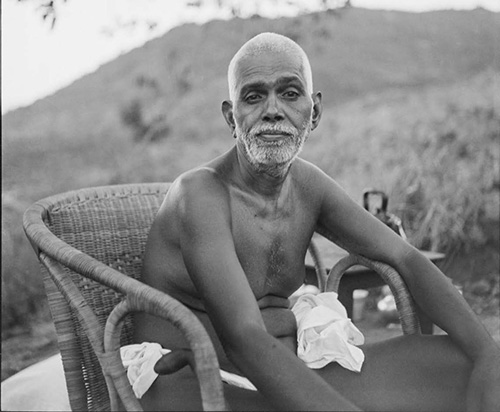
Bhagavan Sri Ramana Maharshi seated in a chair on the Hill
Bhagavan Sri Ramana Maharshi

Ego flourishes through non-vichara: insufficient inward attention and continual fascination with externals.

Portable enquiry works in two ways. First, it helps us awaken attention regarding the conditions operating within us at any given moment. Invariably, ego leaves footprints—tension, defensiveness, self-importance, fear, resentment, craving, comparison, and the urge to control. Vichara follows the trail.

Second, and more decisively, enquiry redirects the thinking mind towards its source. Instead of allowing thought to proliferate outwardly, the enquiring impulse turns towards the one to whom thoughts arise. As the ordinary movement of thought subsides, the mind becomes quiet and its veiling power weakens. What appeared to be a continuous ego begins to be seen as a succession of “I”-thoughts tied to changing mental states. Bhagavan comments:

Maya, i.e. delusion or ignorance, which cannot be destroyed by any other act, is completely destroyed by this intense activity called “silence” (mauna).6

It has been said, a mind untamed is our greatest enemy, but a mind tamed is our greatest ally. Vichara is the means by which we tame the mind. Bhagavan adds:

The mind is strong if it is free from thoughts.7

The purpose of enquiry is therefore not to become endlessly fascinated with the psychology of ego. It is to discover ego’s unreality and permit the mind to remain still. Indeed, there is nothing so satisfying in human life as uprooting regret, delusion, and self-deception.

Neutrality

For enquiry to penetrate deeply, it must be accompanied by non-judgement.

The impurities we uncover should not immediately be disparaged. If every unflattering discovery is met with self-criticism, the mind quickly learns to hide what enquiry is trying to reveal.

Moreover, being scandalised by our shortcomings is just a form of egoic identity. Behind it lies an attachment to an idealised image: I should not be the sort of person who feels this way.

Judgement directed towards ourselves or others can therefore reinforce precisely the structure enquiry is attempting to dissolve. We like to judge because it makes us feel like we are above the judged. One of the Desert Fathers highlights the delusion.

Abba Moses was once summoned to a council convened to judge a brother who had committed a fault. At first Moses refused to attend. When pressed, he arrived carrying a basket riddled with holes and filled with sand. As he walked, the sand streamed unnoticed behind him.

Asked what this meant, Moses explained that his own sins were pouring out behind him where he could not see them, yet he had come to judge another man’s faults. The monks understood and forgave the brother.

Another person’s faults lie conspicuously before us while our own conditioning remains largely unseen.

Vichara reverses the gaze: What is happening in me as I judge?

Our task is to look inward without immediately dividing what we find into grounds for self-praise or self-condemnation. Otherwise, enquiry degenerates into self-indulgence or self-flagellation and produces exhaustion rather than clarity.

We learn to become friendly towards what is uncovered—not indulgent, but honest and unafraid.

Anger, envy, fear, vanity and neediness can be acknowledged without defending or condemning them.

Non-judgement permits genuine self-acceptance, and self-acceptance allows for meaningful change.

The American psychologist Carl Rogers expressed the paradox memorably: when we accept ourselves just as we are, change becomes possible.8

In the Hall

Suppose you are sitting in Bhagavan’s Old Hall when someone nearby gets up and begins moving towards Bhagavan’s sofa. Unexpectedly, a slight sadness arises, accompanied by the thought: “I must not have been sitting very concentratedly. I have driven this person away.”

Moments later you realise that the person was merely approaching Bhagavan’s sofa to bow before leaving.

The incident is trivial, but the reaction is revealing. An old pattern has been activated, perhaps self-doubt, unworthiness or a longing for approval.

In ordinary life such a moment would probably be dismissed. Micro-vichara sees it as useful material. Something conditioned has appeared and can therefore be known.

The important thing is not to condemn the pattern or build a story around it. We simply recognise it: “Ah, this is the old pattern of self-doubt.”

Once seen without judgement, the state is no longer completely fused with identity. Sorrow may still be present, but it is seen as a conditioned state rather than as a declaration of who we are.

We should not imagine that one such encounter dissolves a deeply rooted samskara. The same pattern may need to be recognised a hundred times like a rough stone in a river bed gradually becoming smooth over time. And yet, gradual though it be, each deep glimpse can become an occasion for lucidity. When disappointment, loss or pain arise, our habitual questions may be: “Why is this happening to me?”

Such questions often strengthen the very self around which the distress is organised. Micro-vichara turns in another direction:

Who is experiencing this? What is maintaining this reaction? And finally: to whom has it arisen?

Enquiry is not intended to manipulate the state but to see it as a state and ultimately turn attention towards its supposed owner. Bhagavan says:

Whose are these passions? Find out…. The only practice is to find out “to whom these questions arise.”9

The ego repeatedly interprets restlessness as evidence that something more must be acquired: another achievement, possession, experience, recognition or spiritual attainment.

Vichara asks a radically different question:

What if the restlessness is not asking us to acquire something, but to discover what we have overlooked? After all, the lost necklace was never elsewhere. The tenth man was never missing. The Self was never absent.

Conclusion

Portable vichara therefore turns dissatisfaction into a guide. Instead of automatically obeying the urge to move outward, we become curious about the impulse itself: What is lacking? Who feels incomplete?

Daily life ceases to be an interruption of spiritual practice but rather, becomes its testing ground. Praise and blame, pleasure and discomfort, attachment and disappointment, irritation and desire all reveal where identification remains. Formal vichara teaches us where to look. Portable vichara teaches us to make our looking continuous. Eventually, perhaps, even the distinction disappears.

Enquiry becomes less something we do and more the care and clarity with which experience is met. What once served to reinforce a separate self becomes the portal through which its unreality is revealed. —

(to be continued)

1 Talks with Sri Ramana Maharshi, §106, 29th November 1935. ↩

2 Ibid., §186. ↩

3 Negativity bias means we may be hardwired to be on the lookout for threat. ↩

4 Ibid., §144, 23rd January, 1936. ↩

5 We may be hardwired to arrive at cognitive states that bring endorphin releases in the brain’s reward centre. ↩

6 Spiritual Instruction, Chap II, section 4. ↩

7 Talks, §647, 15th March 1939. ↩

8 From On Becoming a Person: A Therapist’s View of Psychotherapy, originally published in 1961. ↩

9 Talks, §252. ↩

Obituary: Smt. Maya Krishnamurthi (1929-2026)

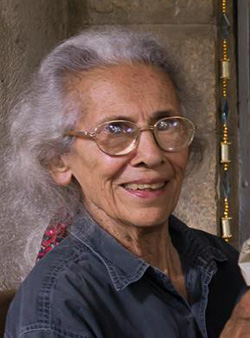
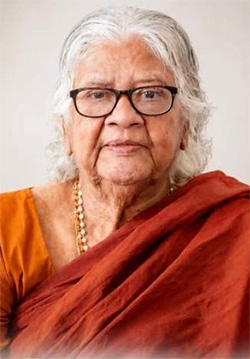
Portrait photograph of Smt. Maya Krishnamurthi
Smt. Maya Krishnamurthi

Born on 5th October 1929 in Aschaffenburg, about seventy kilometres from Heidelberg, Germany, Maya was the daughter of Aurobindo Bose (spelled “Aravind” in the Ashram literature). Her father had been employed by the Maharaja of Baroda, who sent him to Germany to study engineering shortly before the First World War. After the war, Bose worked for Deutsche Werke Kiel AG, where he was involved in the manufacture of ship engines, and eventually married the daughter of the company’s CEO. As the Second World War approached, Bose took his wife and two children on one of the last ships to leave Germany for India. Once there, he brought the family to several places that had been important to him. In Pondicherry he visited the Ashram of his former roommate, Sri Aurobindo, who told him that there was a realised soul living in Tiruvannamalai. Bose brought the family to meet Sri Bhagavan and later purchased land opposite Ramanasramam, where he built a house despite the family being principally settled in Bangalore. Coming to Tiruvannamalai during holidays, Maya vividly remembered introducing herself to Bhagavan for the first time. When she told him that her name was Maya, Bhagavan replied playfully, “No, no, not Maya—Mahamaya!”

Maya recalled accompanying Bhagavan on walks up the Hill, often following closely behind him. On other occasions, while sitting quietly in the Hall with her eyes closed, she would inwardly pray that Bhagavan might look at her. Whenever she opened her eyes, she found him looking directly at her with a gentle smile. She repeated this experiment on several occasions with the same result.

A few years after the family came to Bhagavan, Maya’s elder brother, Vikas, died of typhoid. His death caused a profound crisis for the family, and Bose came to Bhagavan who gradually assuaged his grief.

In her late teens, Maya returned to Germany to study psychology at Heidelberg University. She later worked with the US Army Service Corps, treating traumatised American servicemen, while also serving as librarian. She married an American serviceman and returned to India when her father became ill. Bose passed away in 1957.

In 1959 Maya gave birth to a son, Aaron. Tragically, her husband died two years later after being struck by a car while visiting the United States. Maya eventually remarried. Krishnamurthi was a psychologist with whom she had studied at Heidelberg.

Returning to India in the 1960s, Maya worked in several academic and educational capacities, teaching psychology and German at a university in Mysore. She also taught at the Max Mueller Bhavan, Bangalore where she served as librarian. Over the years she divided her time between Bangalore and Tiruvannamalai.

Having enjoyed good health throughout her long life, in late May, advanced age brought physical weakness. She passed away peacefully on 8th June at the age of ninety-six. Her body was brought to Tiruvannamalai and cremated the following morning. Her remains were interred in a small tomb beside those of her father, mother and brother. —

Obituary: Smt. Maddali Bala Saraswathi (1930-2026)

Portrait photograph of Smt. Maddali Bala Saraswathi
Smt. Maddali Bala Saraswathi

Born to ardent Ramana devotees, Smt. Griddaluru Venkata Subbamma and Sri Griddaluru Satyanarayana Rao, Smt. Maddali Bala Saraswathi—lovingly called “Bala” by Bhagavan—was one of four siblings. She and her three siblings—Rukminamma, Krishna Murthy, and Varalakshmi—received their names directly from Sri Bhagavan.

Since her infancy, her life was touched by Bhagavan’s grace. Bhagavan performed her Annaprasana (first rice-feeding ceremony). Once, when she was critically ill as a toddler with severe dysentery that did not respond to medical treatment, her father brought her to Bhagavan. Bhagavan requested the medicine, mixed it with honey, and placed it on her tongue with his own fingers. Within minutes, consciousness returned and the girl recovered.

When Bala was seven years old, Bhagavan gently insisted she write on a sheet of paper: “Oh, Bhagavan of Sri Chinta Deekshitulu”.

At that young age, she did not realize his divinity but after repeated prompts, she scribbled the words, handed him the paper, and ran away to play. Pondering this event at the age of 68, she recognized this divine intervention as her gyanopadesa—a spiritual initiation laying an unshakeable foundation of lifelong devotion.

Throughout her life, whenever difficulties arose, she prayed before Bhagavan’s portrait or wrote directly to the Ashram. Placing these letters on his shrine and partaking of the blessed prasadam consistently brought immediate solace.

Family Life

With Bhagavan’s explicit approval and blessings, Bala married Sri Maddali Subba Rao on 19th May 1948, in Nellore. The wedding was attended by Bhagavan’s sister Alamelu Ammal, brother-in-law Pichu Iyer, and Ashram President Sri T.N. Venkataraman with his family, who brought prasadam directly from the Ashram.

Bala and Subba Rao were blessed with four children: Jayalakshmi, Raghuram, Sivaram, and Rajya Lakshmi. Continuing her lifelong devotion, Bala visited Ramanasramam each year on her birthday until 2019 along with her brother, the late Krishna Murthy to reminisce on her childhood with Bhagavan and seek his blessings.

The Vision of Assurance

On 7th March 1996, when her husband, Sri Subba Rao was admitted to the ICU with cardiac complications, a distraught Bala prayed intensely before Bhagavan’s portrait: “Bhagavan! Only you can save him.”

Falling asleep in prayer, she had a significant dream. She saw herself sitting outside the clinic when a familiar, loving voice called out, “Bala!”—the exact affectionate inflection used by Bhagavan during her childhood. Looking up, she saw a nurse holding medical files who asked why she was sitting alone. When Bala expressed her anguish over her husband’s critical state, the nurse offered divine reassurance: “Do not fear! I am looking after your husband’s file.”

Upon waking, no one was there, but her husband made a rapid recovery. She recognized the dream as Bhagavan’s Abhaya Hastham (protective hand) appearing in the guise of a caregiver.

On 16th May 2026, surrounded by her loving family in Hyderabad, Smt. Maddali Bala Saraswathi merged in the Lotus Feet of Sri Bhagavan. She was 96. A lifetime graced by Bhagavan’s compassion and grace, her legacy remains an inspiring testament to surrender and devotion to Bhagavan Sri Ramana. —

In the Ashram: The Immortal Hymn

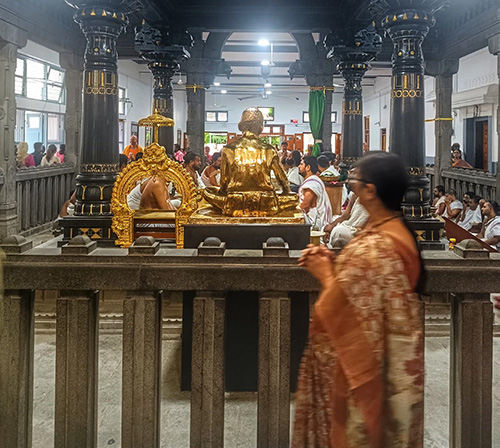
A devotee in an orange sari performing pradakshina around the samadhi shrine of Bhagavan Ramana, with polished black stone pillars and the gold-plated statue of Sri Bhagavan
The samadhi shrine of Bhagavan Sri Ramana Maharshi

They reckon ill who leave me out;
When me they fly, I am the wings;
I am the doubter and the doubt;
And I am the hymn the Brahmin sings.

— Ralph Waldo Emerson, 19th century

Dressed in an orange sari, a devotee performs pradakshina around the samadhi shrine where the mortal remains of Bhagavan Ramana are entombed. The shrine features polished black stone pillars and a prominent gold-plated statue of Sri Bhagavan seated in the meditation posture. In front of this statue, the sanctified body is enshrined in a sitting position facing Arunachala, crowned with the sacred Siva lingam. —

bsky.app/profile/ainekeenan.bsky.social

In Focus: August 2026

In Focus August 2026 video title card
In Focus: August 2026

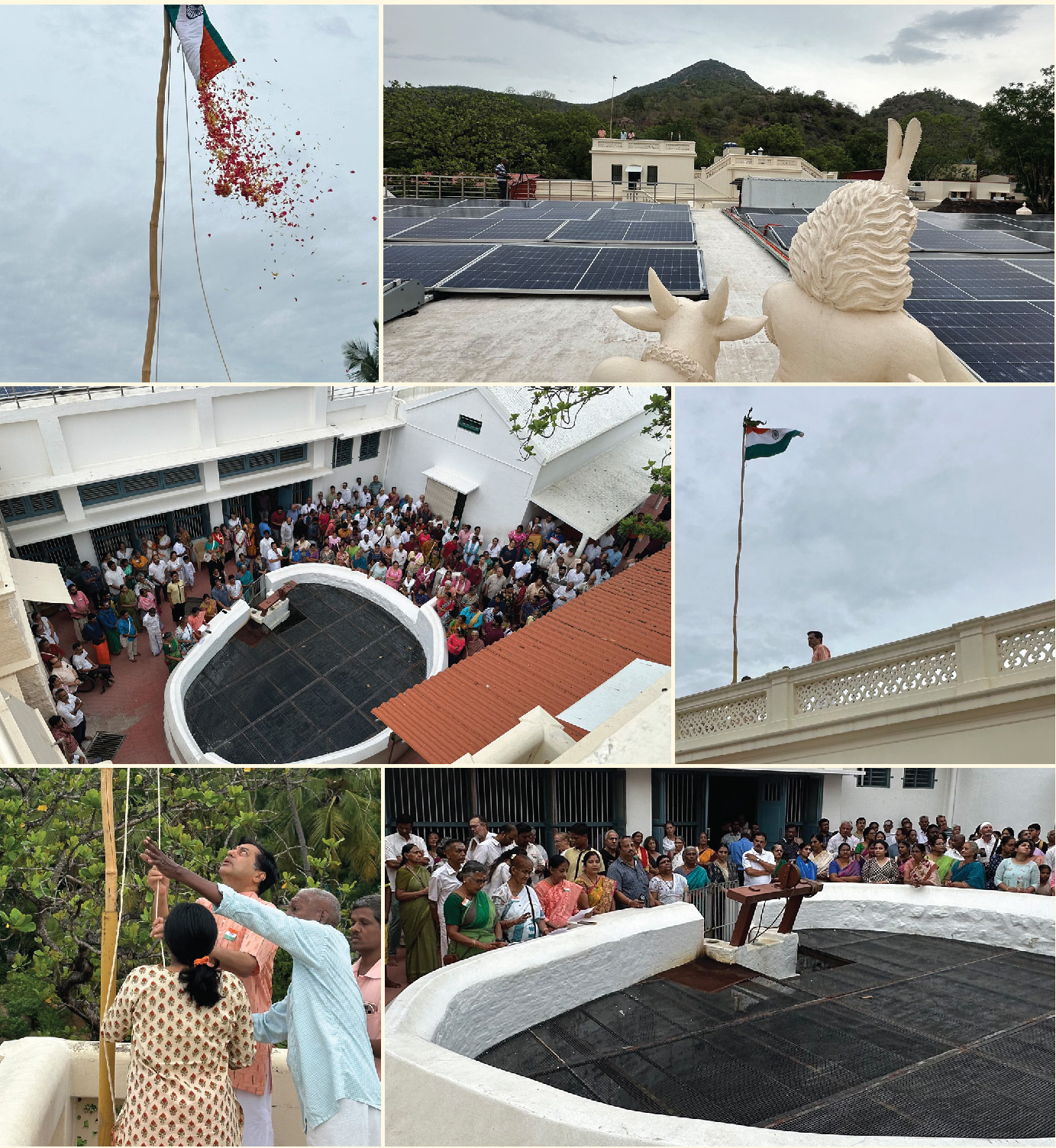
Kunju Swamy Day, the Union Home Minister’s visit, Independence Day flag-raising, and Natarajar Abhishekam with devotees gathered for worship, remembrance and celebration. See the video at: <https://www.youtube.com/watch?v=7hBlvFL1-C8>. —

Events at Ramanasramam: The Union Home Minister’s Visit

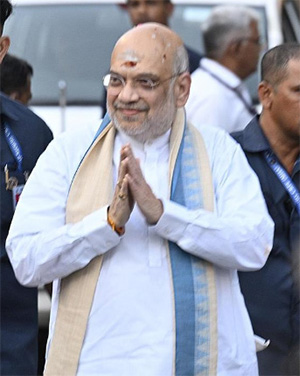
Union Home Minister Sri Amit Shah being welcomed at Sri Ramanasramam by Ashram President Dr. Venkat S. Ramanan
The Union Home Minister at Sri Ramanasramam

BJP leader and Union Home Minister, Sri Amit Shah arrived in Tiruvannamalai and was received by District Collector Vandana Garg and Superintendent of Police R. Uthayakumar, before proceeding to Arunachaleswarar Temple. Then he and his entourage made their way to Sri Ramanasramam, where he was welcomed by Ashram President Dr. Venkat S. Ramanan and Dr. Nitya Ramanan. After a brief stay, he proceeded by road to Puducherry. —