Saranagati November 2026 — Sri Ramanasramam eNewsletter
Saranagati November 2026 — Vol. 20, No. 11
Dear devotees,
October rains brought needed relief to the Ashram, not only in respect of water table needs but also as an antedote to a long spell of unusually warm weather.
In this issue, we look at the life story of Professor T.M.P. Mahadevan, who first visited Bhagavan in 1929 at the age of 18. Later becoming a renowned scholar of Advaita, the professor sat before Bhagavan in complete humility and out of reverence for Bhagavan’s greatness, never asked a single question. (See p. 3ff.)
In Ramana Reflections, we conclude this series by exploring how portable vichara helps us navigate life’s crises by broadening our perspective amid difficult circumstances. (See p. 10ff.)
Calendar of Ashram events from November to December 2026
1st Nov (Sun) Punarvasu
23rd-24th Nov (Mon-Tue) Full Moon
6th Nov (Fri) Pradosham
24th Nov (Tue) Karthigai Deepam
8th Nov (Sun) Deepavali
28th Nov (Sat) Punarvasu
9th Nov (Mon) Annamalai Swami Day
6th Dec (Sun) Pradosham
15th Nov (Sun) Flag-raising at the Big Temple
21st Dec (Mon) Pradosham
22nd Nov (Sun) Pradosham
23rd Dec (Wed) Full Moon
In Profile
Professor T.M.P. Mahadevan
Audio: IN PROFILE
0:00 / 0:00
Unable to play audio. Please check if the file exists.
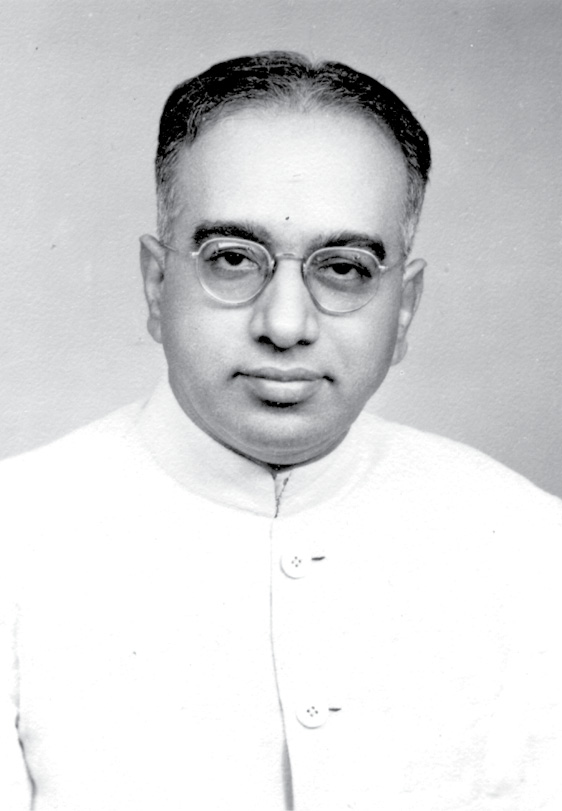
Professor T.M.P. Mahadevan
Among the distinguished scholars who came under Bhagavan’s influence was Professor T.M.P. Mahadevan, one of India’s foremost exponents of Advaita Vedanta. An internationally renowned philosopher and author of some fifty-five books, Mahadevan devoted his life to the study of non-duality. Yet for all his extraordinary learning, whenever he came into Bhagavan’s presence, he preferred to remain silent. Looking back upon those precious years, he recalled that simply sitting before the Maharshi was itself a profound spiritual education.
Telliyavaram Mahadevan Ponnambalam Mahadevan was born in Chennai on 24th August 1911. His early childhood was marked by considerable hardship. His mother died when he was five, and around the same time his father left to establish another family. TMP was then raised by his maternal aunt, a deeply pious woman who frequently attended religious discourses, visited temples and sought the company of holy people.
She often took the child with her, introducing him to such spiritual figures as Sri Karapatra Sivaprakasa Swami and Virasekhara Subbiah Swamigal. Among those he met was Swami Rajeswarananda, a devotee of Sri Ramakrishna, who was to become an important influence in TMP’s life.1
Spiritual Formation
Recognising the boy’s promise, Swami Rajeswarananda helped secure him a place at the Sri Ramakrishna Mission Students’ Home in Chennai in 1922. Mahadevan spent seven formative years there, benefiting from an atmosphere of discipline, spiritual study and close association with the monks of the Ramakrishna Order.
Through Swami Rajeswarananda, he also received initiation from Swami Sivananda, affectionately known as Mahapurush Maharaj, a direct disciple of Sri Ramakrishna. Recalling the occasion many years later, TMP spoke of the saintly presence of the aged monk and the profound impression made upon him when he received his mantra in the shrine of Sri Ramakrishna.2
Yet another momentous encounter awaited him. In 1929, when TMP was eighteen years old, Swami Rajeswarananda took him to Tiruvannamalai for his first darshan of Bhagavan Sri Ramana.
Mahadevan had first heard about Bhagavan in Chennai in 1919, at the age of eight. A decade later, he was able to meet the Sage.
First Darshan
TMP spent three days in Bhagavan’s presence during his first visit. The experience left an indelible impression upon him.
Looking back upon the occasion, he considered himself extraordinarily fortunate to have been granted the opportunity of meeting Sri Bhagavan. He regarded the encounter as the fruit of accumulated spiritual merit.
Young Mahadevan was especially struck by the extraordinary stillness that prevailed in Bhagavan’s presence. Sitting before the Master brought a quietening of the mind and a sense of inward elevation that he would remember throughout his life.3
In subsequent years, Swami Rajeswarananda accompanied him on further visits to Sri Ramanasramam. Although TMP seldom spoke publicly about his personal encounters with spiritual teachers, his later reminiscences reveal how deeply Bhagavan’s presence had affected him.
In an interview published in January 1982 in the magazine Arunachala Ramana, he narrates:
As I recall the days when I spent basking in the sunshine of Sri Ramana’s glorious presence I have no words to express the benefit I derived from that experience. To sit before him was itself a deep spiritual education. To look at him was to have one’s mind stilled. To fall within the sphere of his beatific vision was to be inwardly elevated.4
Education of Silence
For a philosopher whose professional life was devoted to investigating subtle philosophical questions, Mahadevan’s conduct in the hall was remarkable. He came not to debate, question or seek clarification, but simply to sit quietly before Bhagavan.
When asked what questions he had put to Sri Bhagavan, Mahadevan replied that he had never asked him a single question. His habit was simply to remain silent.5
Here was a scholar thoroughly versed in the Upanishads, Sankara, Gaudapada and the great tradition of Advaita Vedanta, yet in the presence of the living sage he found no need for philosophical discussion.
TMP regarded Bhagavan’s silence as a form of instruction that transcended the limitations of conceptual thought. Bhagavan’s presence was the teaching.
The distinction between intellectual understanding and direct experience was central to TMP’s appreciation of Bhagavan. He was particularly struck by the fact that the Maharshi had realised the truth of Advaita without first undertaking a systematic study of it.
As he later explained, Bhagavan became acquainted with the traditional concepts, arguments and illustrations of Advaita only after his own direct experience of non-duality. He discussed teachings principally when questions from (scholarly) visitors required clarification.6
For TMP, this reversal of the usual academic procedure was significant. Whereas the philosopher ordinarily proceeds from study and analysis towards understanding, Bhagavan’s teaching arose from direct realisation.
Bhagavan’s Affection
Although silence characterised their relationship, TMP remembered Bhagavan’s personal warmth and affectionate concern.
He described their relationship as both human and spiritual.7 He had accepted Bhagavan as his spiritual guide, and whenever he came for darshan, Bhagavan would enquire after his welfare.
These simple enquiries revealed an affection that accompanied Bhagavan’s silent influence. Yet TMP was careful not to imagine himself uniquely favoured, recognising that other devotees experienced the same loving attention.
He recalled Bhagavan’s extraordinary kindness towards animals:
Every moment of his earthly existence was filled with kindness to all beings. To him the so-called animals were as much human as humans. They conversed with him and he understood their language and moods.8
Asked about Bhagavan’s sense of humour, TMP observed that Bhagavan regarded the entire world as humorous. For TMP, Bhagavan’s silence, kindness, simplicity and sense of joy were not separate attributes but expressions of a life established in the non-dual Self.
A Lecture Before Bhagavan
TMP’s intellectual gifts soon brought him national and international recognition. After graduating with first-class honours in philosophy from the University of Madras in 1933, he pursued doctoral research under Professor S. S. Suryanarayana Sastri.9
TMP’s thesis, devoted to Advaita Vedanta with special reference to Bharatitirtha-Vidyaranya, was subsequently published in London in 1938, with a foreword by the distinguished thinker Sarvepalli Radhakrishnan.10
After teaching at Raja’s College, Pudukkottai, and Pachaiyappa’s College, Madras, TMP joined the University of Madras, where he became Head of the Department of Philosophy.
During 1948–49, he travelled to the USA as a visiting professor at Cornell University and delivered lectures on Indian philosophy and Sri Bhagavan’s teachings.
Following his return to India, an unusual opportunity arose. With the permission of Chinnaswami, the Ashram Sarvadhikari, Mahadevan was allowed to deliver one of his lectures in Bhagavan’s presence.11
The occasion was particularly significant. Having spent years silently under Bhagavan’s influence, TMP now spoke publicly on the philosophy he had studied throughout his life, seated before the very sage whose living example had deepened his understanding of Advaita.
A later recollection maintains that Bhagavan listened without offering any correction. The significance of his silence is not explained in the surviving account, but the occasion remains a memorable episode in TMP’s long association with the Ashram.
The Living Tradition
TMP regarded Bhagavan’s teaching as an expression of the timeless wisdom of the Upanishads. When asked about the relationship between Bhagavan’s realisation and that of Adi Sankara, TMP replied:
In my opinion there is no difference. The path of vichara was simplified by Bhagavan so that everyone in the modern world can practise it.12
What distinguished the Maharshi, for TMP, was the directness and accessibility with which he taught Self-enquiry.
For TMP, Bhagavan had not founded a new philosophical school or religious sect. He had made the ageless truth of Vedanta accessible through direct investigation of the sense of “I”. When asked if there was any sign for us to conclude that Bhagavan was really Bhagavan, i.e. God Himself, the professor responded succintly and to the point:
When Bhagavan was jnana itself, where is the need of showing any sign at any particular time? 13
TMP himself expressed this understanding in his writings on the Maharshi. Bhagavan, he observed, was a sage of extraordinary purity whose realisation testified to eternal Vedantic truths.
The appearance of such a luminary was a blessing not merely to individual devotees but to humanity as a whole.14 As for Bhagavan’s written compositions, TMP said:
Bhagavan did not write any book. His revelations are all equal. What we call his compositions were inspired utterances like the Upanishads. Naturally, I am attracted to all of them. If a single piece is to be selected as the quintessence of Vedanta, I would say it is Upadesa Saram.15
TMP also rejected any discrepency between knowledge, devotion and grace. In his understanding, liberation was not something newly bestowed upon an individual but the recognition of the eternal non-dual Self:
Bhagavan did not claim to be a Guru. His experience is valid for all times and for all climes... Moksha is not what is given. It is the realisation of the non-dual Self which is eternal. Grace and vichara are [thus] not contradictory.16
The Philosopher
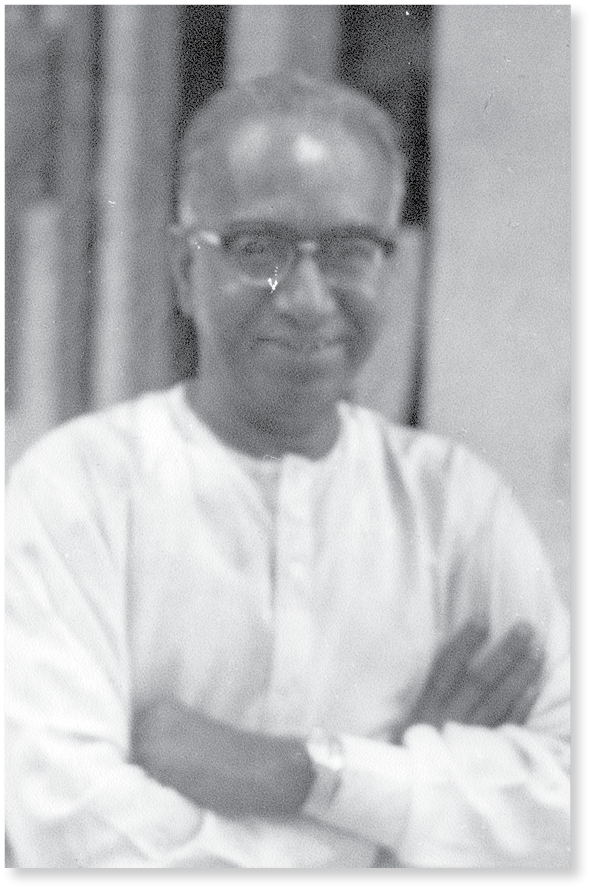
Prof. T. M. P. Mahadevan in the early 1980s
TMP’s lifelong dedication to Advaita was not confined to scholarship. Despite his many academic accomplishments, he increasingly emphasised that non-duality could not be reduced to philosophical theory.
Students who studied under Prof. Mahadevan at the University of Madras recall an illuminating incident.
One day, several students from Vivekananda College came to invite him to speak at an upcoming function.17 Mahadevan politely declined, explaining that after a lifetime spent speaking about Advaita, he wished now to devote himself more completely to seeking its direct realisation.18
The incident reveals something of TMP’s spiritual orientation. Even after decades of scholastic achievement, he remained mindful of the distinction between knowing about non-duality and realising it.
In the postscript to his autobiography, just a year before his death, TMP summed up his life’s work:
Advaita, to the exposition of which I have dedicated my entire life, is not a school of philosophy, nor can it be limited by what we now-a-days call ‘philosophy’. Advaita is a symbolic name for the principle of non-duality... To the understanding and exposition of this experience which is the culmination of all enquiry and research, I have offered all my attention, be it academic, human or spiritual. It is that which sustains me.19
TMP regarded both Bhagavan and Sri Chandrasekharendra Saraswati, the Sage of Kanchi, as contemporary witnesses to that truth.
TMP’s reverence for the Sage of Kanchi was another important feature of his spiritual life. He first saw the Acharya during a visit to Madras in 1932 and met him personally in 1953. Thereafter, he frequently sought his darshan and introduced others to him. Yet his devotion to Bhagavan remained undiminished. For TMP, both sages bore witness to the same non-dual truth.
Bhagavan’s Mahanirvana
TMP was not present at the Ashram on the evening of 14th April when Bhagavan attained Mahanirvana.
In the 1982 interview, he recalled that he arrived at the Ashram the following morning and remained there throughout the day. He was present that evening when Bhagavan’s mortal remains were interred.20
The passing of Bhagavan marked the end of those precious years in which Mahadevan could sit before the Master in the Old Hall. Yet Bhagavan’s influence continued to shape his life.
In subsequent decades, TMP became one of India’s most respected interpreters of Advaita. His numerous publications included important studies of Sankara, Suresvara and the Upanishads, as well as works devoted specifically to Bhagavan, notably Ramana Maharshi and His Philosophy of Existence and Ramana Maharshi, the Sage of Arunachala.
When the University of Madras established its Centre of Advanced Study in Philosophy in 1964, TMP became its first Director. His scholarship earned numerous honours, including the Padma Bhushan in 1967.
He later established Sankara Vihar in Madras, conducting classes on Advaita. His international academic commitments took him to universities and conferences across Europe, Asia and North America.
Yet those who knew him remembered not only his intellectual accomplishments but also his simplicity, discipline and quiet dignity.
Students recall that TMP spoke softly and precisely, avoided idle conversation and maintained a life of personal restraint. He remained unmarried, living a life of inward and outward renunciation without taking the robes of a sannyasin.21
His scholarly abilities were formidable, not only did he have an extraordinary command of Sanskrit and Tamil philosophical literature, but a profound familiarity with Western philosophy and poetry. Yet beneath this vast learning was an abiding commitment to the direct realisation of the truth he taught.
Bhagavan Himself Was the Teaching
Another revealing testimony to TMP’s spiritual understanding is found in the simple answers he gave when recalling Bhagavan.
Asked what was special about Bhagavan’s teaching, he replied:
What is special in Bhagavan’s teaching is that he does not intend to be special.
And when asked to name Bhagavan’s greatest poem, TMP answered:
For TMP, Bhagavan’s teaching was not confined to philosophical statements, written compositions or spoken instructions. It was embodied in Bhagavan’s very being—in his silence, simplicity, compassion, humour and spontaneous affection for all beings.
Professor TMP Mahadevan passed away on 5th November 1983, leaving behind a distinguished body of philosophical scholarship and a life devoted to the understanding of Advaita. Yet among his many achievements, his recollections of Bhagavan remain especially precious.
The scholar who spent a lifetime explaining the subtleties of non-duality had discovered, in the Old Hall at Ramanasramam, a form of instruction that required no words. For him, the highest teaching was not something to be mastered through argument or conceptual analysis. It was something to be received in stillness, in the presence of one who was its living expression. —
1 “T.M.P. Mahadevan,” The Mountain Path, Deepam 2007, pp. 95–96. Grimes records the death of Mahadevan’s mother, his upbringing by his aunt and the formative influence of Sw. Rajeswarananda. ↩
2 Ibid., pp. 97–98; A Philosopher Looks Back, pp. 18–22, as cited by Grimes. And “Sri T.M.P. Mahadevan (1922–1929),” Sri Ramakrishna Mission Students’ Home Centenary Volume, 1905–2005.↩
3 Grimes, “T.M.P. Mahadevan,” p. 96; Mahadevan, A Philosopher Looks Back, p. 29, as cited by Grimes. This is the source for the 1929 first visit and Mahadevan’s recollections of his three days with Bhagavan. ↩
4 “Dr. T.M.P. Mahadevan Talks to Arunachala Ramana,” Arunachala Ramana, Jan 1982; reproduced by David Godman, 12 Sept 2008. ↩
11 Introductory commentary to “T.M.P. Mahadevan,” 12 September 2008, David Godman. The exact date of the lecture and any contemporary record of Bhagavan’s response remain to be established. ↩
12 “Dr. T.M.P. Mahadevan, Talks to Arunachala Ramana,” Jan 1982. ↩
18 Grimes, “T.M.P. Mahadevan,” p. 94. John Grimes recounts the incident from his own experience as a postgraduate student at the University of Madras. ↩
22 Interview. Both remarks occur in Mahadevan’s responses to questions about Bhagavan’s distinctive teaching and greatest poem. ↩
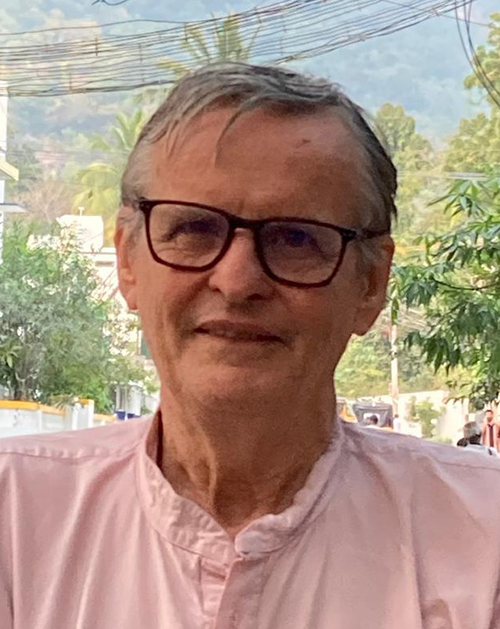
Announcement: Chris Quilkey (1953-2026)
Sri Ramanasramam is saddened to announce the passing of Chris Quilkey, long-serving editor of The Mountain Path, who merged at the Feet of Sri Bhagavan on 2nd November 2026, following a prolonged battle with cancer. Chris followed in a distinguished line of editors of the Ashram’s quarterly journal, beginning with Arthur Osborne and continuing with Lucia Osborne, Viswanatha Swami, V. Ganesan and Ramamani, who retired at the end of 2002.
Chris assumed the editorship in January 2003 and went on to oversee 84 quarterly issues over 21 years, making him the longest-serving editor in the magazine’s history. With each issue averaging 128 pages, some 10,752 pages of published material passed through his hands during his tenure. Reflecting on his legacy, Ashram President Dr. Venkat S. Ramanan remarked, “Chris Quilkey’s contribution to the Ashram is of immense significance. He is part of our history.”
The forthcoming December issue of Saranagati will feature an account of the life of this beloved devotee and his many years of dedicated service to Bhagavan. Sri Ramanasramam extends its heartfelt condolences to his family and loved ones. —
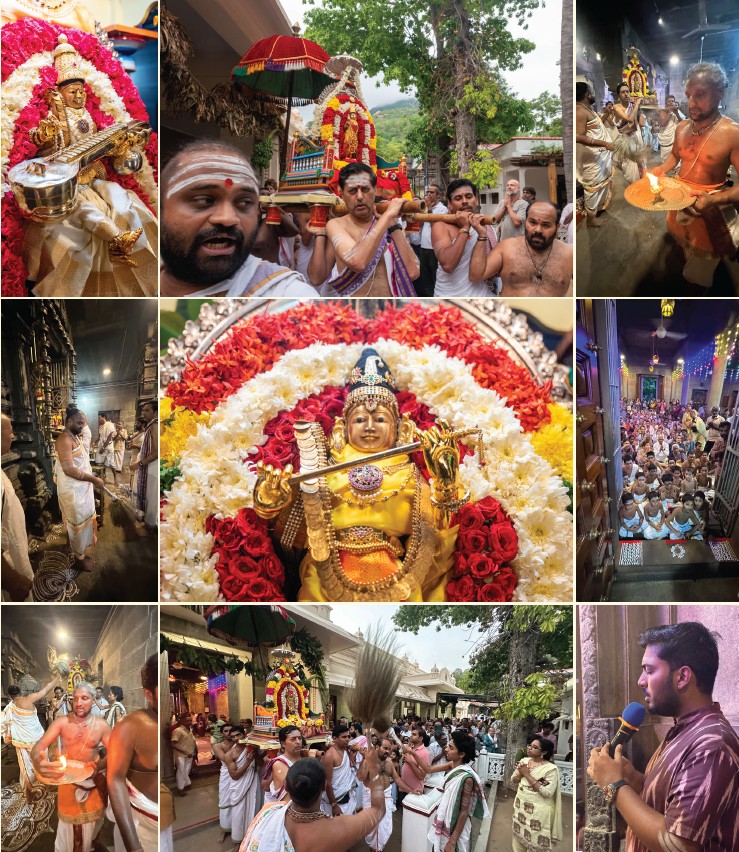
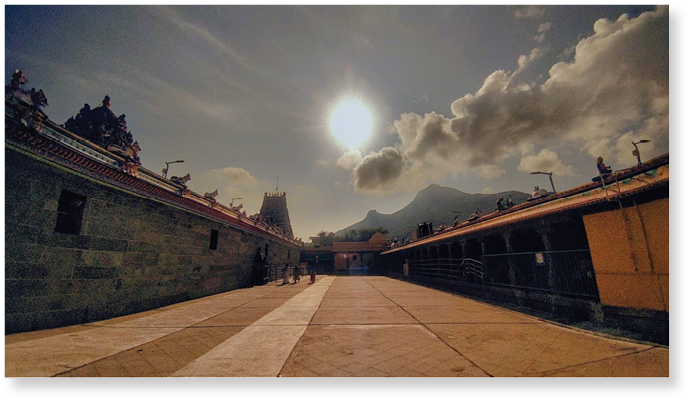
Adi Annamalai Temple, situated on the western flank of Holy Arunachala, offers a unique vantage point. With the sun rising majestically over the Holy Hill, echoing the sacred verses of Manikkavacakar’s Thiruvempavai—Aatiyum antamum illaarumperun cotiyai (“We sing of that rare, supreme Light which has neither beginning nor end”), the cool, crisp morning light lends depth and richness, revealing the vibrant colours and textures of this season of abundance, when all of nature seems to sing out. —
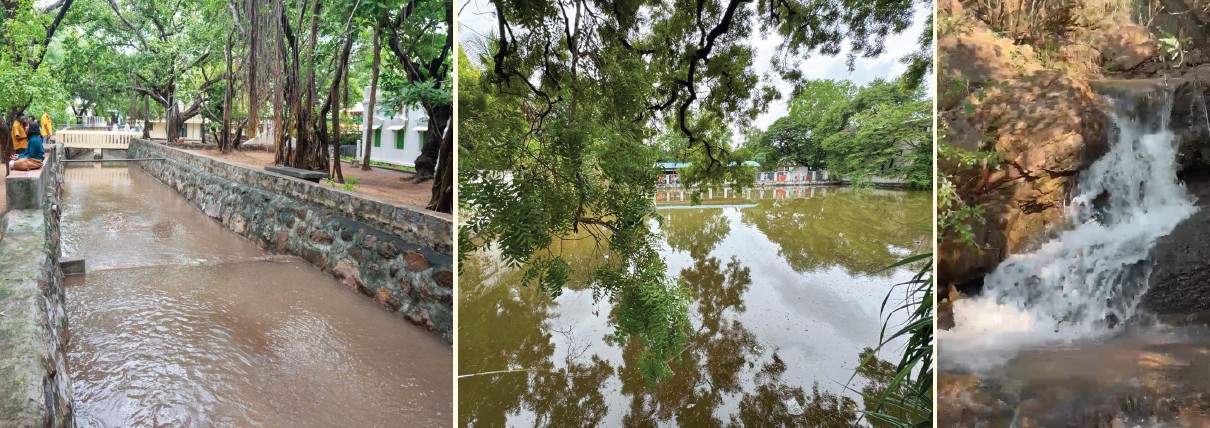
After a long spell of warm, dry weather from late March to mid-October, the northeast monsoon finally brought welcome relief. Heavy downpours swept across Tiruvannamalai, with parts of the district recording exceptional rainfall. Pali Tirtham is now filled to the brim and overflowing—its replenished waters helping restore groundwater reserves depleted during the long dry season. —
Events in Sri Ramanasramam: Saraswati Puja
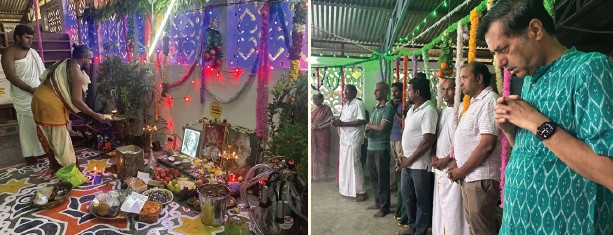
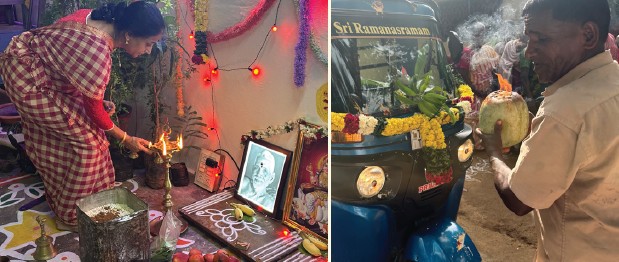
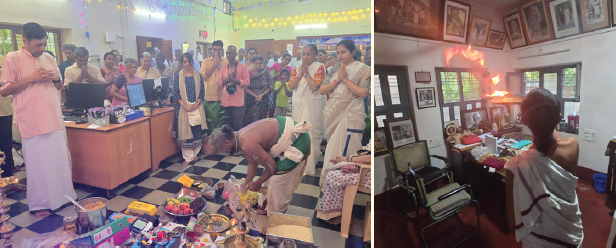
On the morning of Wednesday, 21st October, Saraswati Puja was celebrated at Sri Ramanasramam with the Ashram President in attendance. The day began at the carpentry shop, where the goddess of wisdom was invoked to bless the implements of daily work. Tools from the carpentry shop, gosala, gardens, and Ashram grounds department were reverentially worshipped, acknowledging that every act of service in the Ashram is sanctified by Bhagavan’s presence. The rites concluded with the traditional benediction of the Ashram vehicles.
On the afternoon the day before, puja was held in the bookstall, amidst publications carrying Bhagavan’s teachings. Books, instruments from the Ashram Archives and Dispensary received blessings in a brief arati. The rite continued at the bookstall counters, in the Ashram offices, and the computer room, affirming that learning and service remain under Saraswati’s care. The observance ended with distribution of prasad. —
Events at Sri Ramanasramam: Vijayadasami Garba Dancing
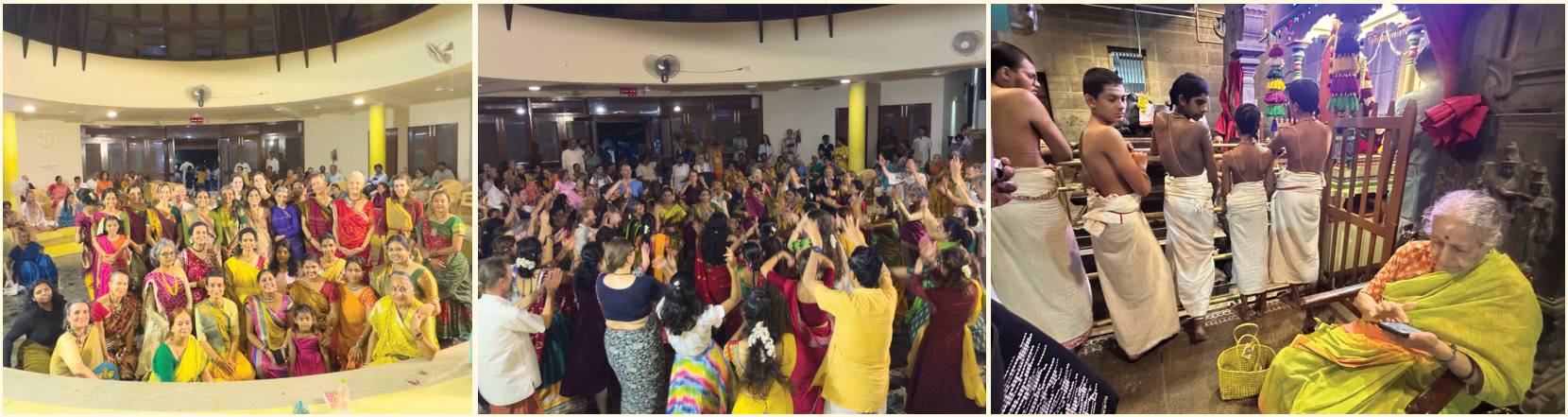
On Vijayadasami, 21st October, Goddess Yogambika was taken in procession before returning to her abode in the inner sanctum of the Matrubhuteswara Shrine. The ceremony marked the conclusion of Navaratri, celebrating the Divine Mother’s triumph over evil and the restoration of dharma. The Ashram’s ten-day festivities concluded with traditional Garba dancing in the Granthalaya Auditorium. Vijayadasami, celebrated throughout India, commemorates Goddess Durga’s victory over Mahishasura, symbolising the triumph of good over evil. —
Ramana Reflections
Vichara in Real Time
The Clarifying Power of Portable Enquiry (Part III)
Audio: RAMANA REFLECTIONS
0:00 / 0:00
Unable to play audio. Please check if the file exists.
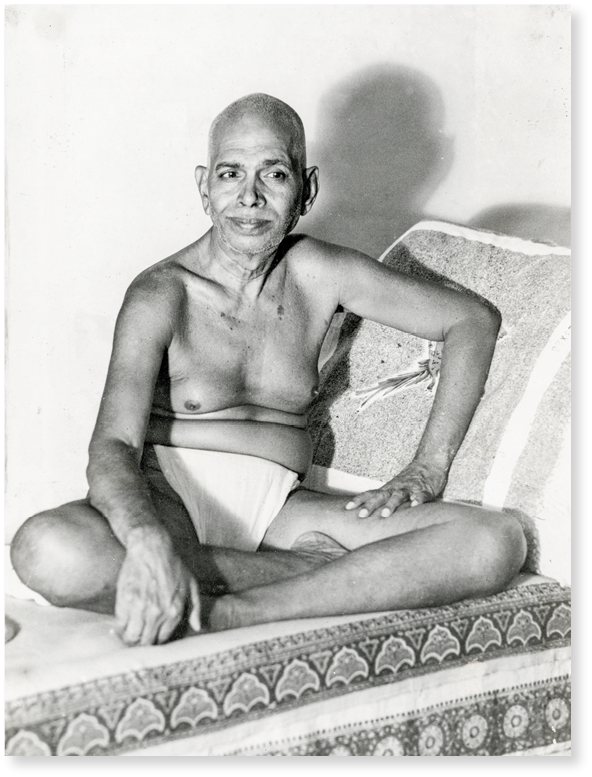
Bhagavan Sri Ramana Maharshi
In the last segment, we explored how Self-enquiry can become a portable practice, accompanying us through the challenges of daily life. By observing passing emotions, habits and reactions without being identified with them, we begin to recognise the conditioning that sustains the illusion of a separate self. Rather than pursuing each thought, enquiry turns attention towards the one behind thought, to the one to whom our thoughts arise.
Through poetry, literature and familiar stories of being lost, we considered how the search for security and belonging often drives us outward, away from the Heart where true refuge lies.
We looked at David Wagoner’s poem Lost which reminds us that wherever we find ourselves and in whatever surroundings, no matter how unfamiliar, we are ever and always “Here.” The disorientation that occasionally comes in the course of life may compell us to ask: Where am I, and what can truly be relied upon? The task is not to escape our circumstances but to meet them with clarity and self-understanding. Portable vichara thus transforms life’s interruptions into opportunities for investigation.
In this segment, we continue exploring how this practice can be deepened. If great stories of the past often turn on a violation of expectation—a child banished to the realm of death, a king losing his kingdom, a respectable man discovering he is dying, we can accept that in the unfolding of our own lives, there are sure to be times when portable vichara becomes indispensable and circumstances serve as an involuntary summons to enquiry.
Nachiketa
We may recall the oft-quoted account from the Katha Upanishad of Nachiketa who undergoes another kind of exile. Sent to Yama, the god of death, after experiencing the wrath of his father, Nachiketa goes willingly and arrives while Yama is away. He waits three days and nights without food or water. When the Lord of Death returns, he grants Nachiketa three boons. Nachiketa asks first for reconciliation with his father, then for knowledge of the sacred fire, and finally for the truth about death.
Yama tries to tempt him with wealth, long life, pleasures and power, but Nachiketa is not interested. He knows the distinction between preyas—the pleasant—and shreyas—the truly good—and knows the difference between the impermanent and the Atman, that the true Self can never be touched by bodily death. Nachiketa becomes a model of courage and discrimination because he does not flee his crisis but rather, questions through it.
Here we see enquiry centering on the mysteries of earthly existence, leading to true knowledge:
The intelligent atman is not born, nor does he die; he did not come from anywhere nor was he anything, unborn, eternal, everlasting, ancient; he is not slain though the body is slain.1
If contemplative traditions have long employed practices of reframing, Nachiketa moves toward the ultimate frame to stimulate inner transformation. Religious traditions have always used meditations on impermanence to contemplate mortality. Consider the Buddhist monk who practises the cemetery contemplations, i.e. meditating in the presence of a corpse. Or the Carmelite nun who stops each morning at the convent graveyard, turning a spadeful of soil where her remains will one day lie—a bodily reminder of life’s transience.
Paradoxically, contemplating mortality can free us from the anxiety of modern life, after all, fear arises from a constricted vantage point. Enquiry helps us recognise that our apprehensions are passing mental states rather than faithful representations of reality. Enquiry is thus rooted in discrimination.
We come to understand that freedom from suffering involves enlarging the frame, moving from helpless victim to detached observer. Over time when pain, loss, and death are met frontally through vichara, everything we know of the world “out there” comes to be seen as taking place through experience “in here”. The distinction between inner and outer as well as the experiencer himself is encountered within experience. Bhagavan confirms our intuition:
The distinction between inner and outer is only with reference to the body. In truth, there is neither inner nor outer.2
What we come to see through portable vichara is that the experience of so-called “external reality” is conditioned. By enlarging our frame, common fears lose their authority. As awareness expands, we are less compelled to organise our identity around a particular hurt, fear or disappointment. Though worries may not completely disappear, by enlarging our capacity to hold them, we no longer mistake them for reality.
Consider how the Buddha compared the effects of a large crystal of salt dissolved in a small cup of water with the same crystal dissolved in the River Ganga. The water in the cup becomes undrinkable, while the great river remains unaffected.3
Stated in brief, while enquiry may not eliminate every painful feeling, it expands our capacity to hold them. What once overwhelmed us may become bearable within a wider field of seeing. This field can become our safe haven—a place of refuge and orientation for all future enquiry.
Riding the Waves of Experience
A mind less preoccupied with defending has greater room for empathy, patience and compassion. When we are no longer continually struggling with internal disturbances, we become lighter and more available, less preoccupied.
Nachiketa’s case shows us that nothing can remedy our condition more readily than being present to it, i.e. making peace with internal unrest and with the challenges that come from outside. Bhagavan called this: suffering what comes our way.4 Each time we muster the courage to greet a moment of discomfort, we learn to let go a little and avoid being force-marched into complete identification with our mental states.
It has been said that we can never truly know ourselves until we face a crisis. In the following stories, we hear about people in crisis. Seeing how they deal with it is instructive. If in the middle of a crisis, we can avoid anxiety’s insistent demand to flee toward the next thing, if our response is neither defeat nor resignation but an instinctive accommodation to circumstances beyond our control, over time we learn to ride the waves of experience rather than exhaust ourselves fighting against them. After all, the only demon that can harm us is the one we run from.
Lear on the Heath
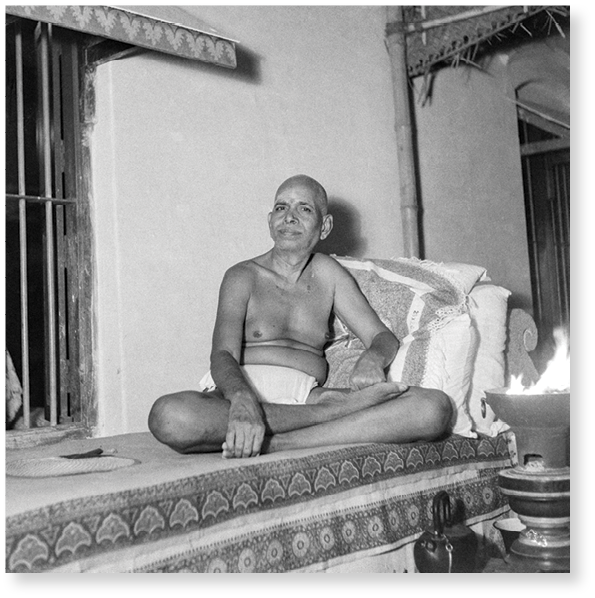
Bhagavan Sri Ramana Maharshi
In Shakespeare’s King Lear, the storm takes the shape as an identity crisis. Betrayed by his two elder daughters and stripped of court, authority, retinue and obedience, Lear finds himself on the heath asking, “Is man no more than this?” Kingship, rank, clothing and social role begin to appear as overlays rather than the essence of a human person.
Lear’s identity had always depended on power, recognition and role. On the heath he begins to encounter something more basic: human vulnerability, mortality, nakedness and shared suffering.
By the time he is reunited with his youngest daughter, the loyal Cordelia, he no longer speaks as a king. “I am a very foolish fond old man,” he says. The crisis has broken him open to a deeper self-knowledge and he, though now a man of modest means, is set free.
Ilyich’s Enquiry
In Tolstoy’s The Death of Ivan Ilyich, we find another example. Ivan has spent his life constructing a socially respectable identity through career, marriage, status and possessions. His values seem unquestionable because everyone around him shares them.
Then a fatal illness strips away his security. Gradually, he suspects that the life he regarded as meaningful may have been false. The dying process becomes an involuntary enquiry, dismantling the self-image he has spent a lifetime constructing. At one point, he confronts his terror:
Yes, there was life, and now it is going, going, and I cannot hold it back.... There will be no me, so what will there be?... Can this be death? No, I don’t want it.
Ivan’s crisis offers an illuminating contrast with Bhagavan’s death experience in Madurai. Both confront mortality, but Ivan carries a lifetime of attachment and conditioning. His enquiry is prolonged and resistant, whereas Bhagavan’s was immediate and decisive, culminating in direct and permanent recognition of that which does not die.
Yet Ivan’s struggle reveals the transformative power of enquiry. As his familiar identity collapses, an unavoidable question suggests itself: If everything I have taken myself to be is falling away, what remains? In his final hours, compassion for his family replaces self-preoccupation and the fear of death resolves itself:
Instead of death there was light. “So that’s it!” he suddenly said aloud. “What joy!” … “Death is finished. It is no more.” 5
What begins in terror culminates in acceptance, compassion and surrender. Ivan’s final days become a severe form of portable vichara, with life itself demanding: What is real, what is false, and what remains when the constructed self falls away?
His story reminds us why identification with what is perishable makes death so threatening. Whatever we take ourselves to be—body, personality, memories or accomplishments—is subject to time and change. As Bhagavan reminds us, whatever is acquired in time must eventually pass away in time.6
Karmic Accumulations
Ivan’s life helps us understand Bhagavan’s observation that living without knowledge of the Self rests upon a flimsy foundation.
We recall Avanti Brahmana, whose loss of wealth and standing becomes the occasion for examining the mind’s role in suffering.
The biographies of saints often speak of early loss. For example, Sri Ramakrishna lost his father early in life and often said that his childhood bereavement carved in him a vast inner void that only God could fill. Likewise, the young Jnanesvar, orphaned and outcast, entered profound states of absorption before the age of ten. Mirabai once said, the wound in my heart was made before this body was born.7
The early wounds of these spiritual luminaries became vichara portals through which divine grace might enter. Like Bhagavan, they stumbled, by grace, upon vichara as a natural consequence of conditions that arose early in life. In not averting their gaze, adverse conditions became transformed into grace. It not only led them out from immediate adverse conditions but to complete resolution of the human predicament.
Knowing the Heart
Portable vichara thus brings unconscious internal disharmony into awareness and allows us to assimilate what circumstances reveal. Therefore, vichara can be understood as a way of processing karmic accumulations and coming to know the heart directly.
The option of greeting adversity with enquiry is available to everyone. We are free to face current conditions and past mistakes without being oppressed by them.
As for the former, we take stock of what is arising before us in real time, seeing it as that which comes to us woven in the pattern of our destiny. After all, what could be more apt for our needs?8
As for the latter, we acknowledge past actions, learning from them, making amends and ceasing to recreate the identity that brought about those intentions, choices and actions.
Vichara functions as a moral clarifier, illumining the inner field of thought, emotion, memory, imagination, desire, conditioning, and self-image. In time, it loosens the patterns that keep egoic identification alive.
As our vichara develops, it grows increasingly subtle, even silent, and soon we find we have no further need to formulate word-questions. In time, we find ourselves being present to whatever appears. In time, our silent seeing becomes the ground of a wordless enquiry.
Now enabled to observe plainly with no intention beyond clear-seeing, we do so without the least grasping, condemning or identifying, without the least urge to escape the conditions at hand. What had been confused becomes clear, born of repeated efforts at uncovering what had been hidden from view.
Grist for the Mill
We no longer entertain fantasies of bypassing unresolved moral or psychological conflicts through the provocative language of non-duality. If we once declared, “All is one, I am the Self,” while refusing to examine inner conditions that give rise to resentment, fear, dishonesty and other unwholesome mental states, we are now at ease with whatever mental states arise, viewing them as grist for the mill.
Deep Down Things
Lines from the Irish poet Gerard Manley Hopkins centre on a lament about humanity’s trampling of the earth and its growing insensitivity to the sacred presence and deeper reality abiding within all things. Yet the poet concludes on a note of hope:
And for all this, nature is never spent;
There lives the dearest freshness deep down things.9
Beneath the exhaustion, conditioning and apparent corruption of the heart lies an inexhaustible source of renewal. Portable vichara helps us loosen the bonds that conceal inner treasures. Behind our troubles, no enduring ego is to be found, but only the Self—eternal, joyous and pure.
Conclusion
If the ego is sustained by unconscious reactivity, portable vichara offers an alternative. Instead of automatically grasping at what we desire or resisting what we dislike, we become curious about the impulse to cling and reject. Through sustained enquiry, the samskaras perpetuating such reactions gradually lose their hold. When hatred, anger and other difficult mental states are brought into awareness without being acted upon, familiar patterns of reactivity cease to be reinforced.
The purpose of portable vichara is therefore not to make life’s circumstances conform to our wishes, but to discover that the one demanding such conformity is only a creation of the mind. Every crisis, disappointment and disturbance becomes an opportunity to expose the phantom within and in so doing, rediscover the Heart.
Portable vichara therefore replaces reactivity with observation, constriction with openness, and unconscious habit with the spirit of enquiry. Becoming our guide, refuge and home, it accompanies us through the changing circumstances of our lives, ever leading us with wise attention and skilful action. In this way, even the difficulties of everyday life become part and parcel of the path trodden by the saints and sages of old, not least of all Bhagavan Sri Ramana. —
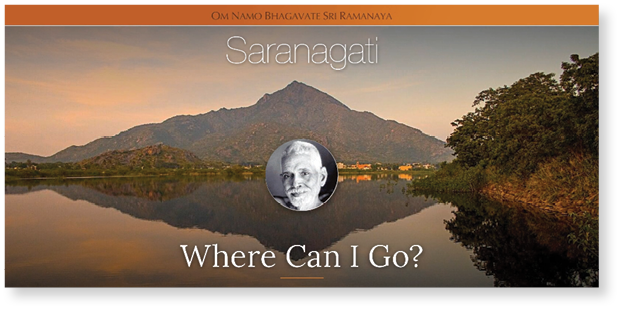
On the occasion of the upcoming Deepavali, Saranagati is releasing a short film in dedication to Sri Bhagavan and his path of transcendence. If we instinctively cling to what is perishable, seeking permanence in a world of ceaseless change, each moment reflects something of the eternal. Bhagavan teaches us that our fear of death arises from identification with the body. Bhagavan, who had transcended this fear at sixteen, could ask during his final illness, “Where can I go?” For him, Being was not confined to form. When the leaf falls, the tree remains; when the tree falls, the earth remains. Beyond every passing form lies the unchanging Self where nothing is truly separate from That. In stillness, Bhagavan directs us towards the deathless Heart, where fear dissolves into peace. [To view this three and half min clip, click:
<https://videos.files.wordpress.com/EhFF7UYG/where-can-i-go-saranagati-v1-1.mp4>.] —
Announcement: Live Streaming
The Ashram is live streaming the Sri Chakra Puja on the first and last Friday of each month. Daily live streaming Mon to Sat from 8 to 9.45am and 5 to 6.45pm IST continues and includes the Veda Parayana, puja and Tamil Parayana. (No streaming on Sundays) To access live streams, go to:
<https://youtube.com/@SriRamanasramam/live>
Obituary: Smt. Sushila Keeni (1936–2026)
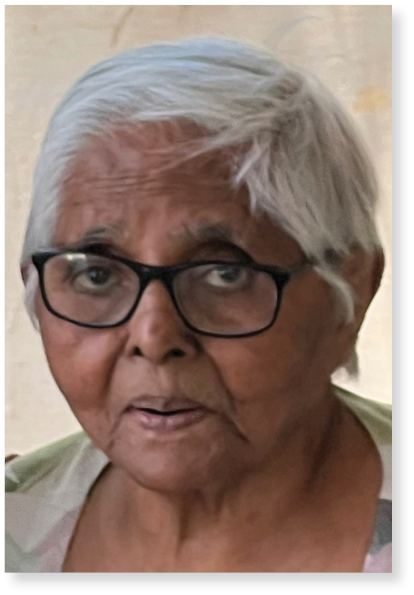
Smt. Sushila Keeni
Smt. Sushila Keeni, a longtime devotee of Bhagavan Sri Ramana and a cherished member of the Sri Ramanasramam community, attained the Lotus Feet of Bhagavan at the age of 90.
Born on 16th May 1936, Sushila was the beloved wife of the late Sri Devdas Keeni, affectionately known to devotees as Keeni Mama. It was through Paul Brunton’s A Search in Secret India that her husband first came to know of Bhagavan and was drawn to Sri Ramanasramam. Following his retirement, he settled in Tiruvannamalai, bringing his wife and children so that they too could share in the peace and spiritual atmosphere of Bhagavan’s Ashram.
Over the years, Sushila became a familiar and much-loved presence at Ramanasramam, which she often described as “heaven on earth”. She found particular joy in the annual Karthigai Deepam celebrations and Bhagavan’s Jayanti, occasions that deepened her devotion and sense of belonging to the Ashram. Among her happiest memories were the times she accompanied her grandchildren on giripradakshina, passing on to another generation her love for the sacred Hill.
Even during the COVID pandemic when travel restrictions kept her away from Tiruvannamalai, her connection with the Ashram remained unbroken. She regularly followed the online broadcasts of the Veda Parayana and Tamil Parayana, maintaining her daily connection to Bhagavan through these sacred recitations. As soon as travel became possible, she returned to Arunachala, although advancing age no longer permitted her to undertake giripradakshina with her former vigour.
Just days before her passing, Sushila made what would prove to be her final visit to Ramanasramam. With her characteristic warmth and enthusiasm, she greeted many familiar faces, renewing the friendships and affectionate bonds that had sustained her over the years. Looking back, her family wonders whether she somehow sensed that this would be her last visit to the place she loved so dearly.
Sushila passed away peacefully, without pain or suffering, leaving behind a legacy of devotion, kindness and quiet joy. Mother of seven children, grandmother of nine and great-grandmother of one, family members feel gratitude for the path she demonstrated for them. They also feel gratitude for the warmth and affection extended to her by the Ashram community, whose kindness always made the family matriarch feel welcome and deeply cherished. Her life was marked by an abiding love for Bhagavan, a devotion that remained undiminished to the very end. May she rest in eternal peace at the Lotus Feet of Bhagavan. —
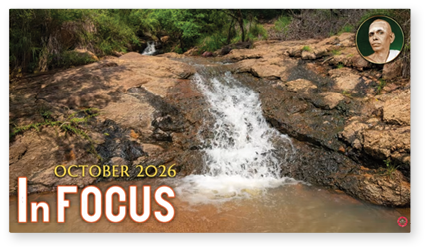
Looking back to last month, In Focus presents clips from the Samvatsara Abhishekam, Muruganar Day and Vinayagar Chaturthi. See the video at:
<https://www.youtube.com/watch?v=VKRVMbg-x4M>. —
Ashram Gardens: The Indian Star Tortoise
During one of the heavy rains at the end of October, an Indian Star Tortoise (Geochelone elegans) was caught in the floodwaters and washed into Pali Tirtham. Being a land tortoise rather than an aquatic turtle, the hapless creature struggled to find its way out, eventually reaching the silt sump near the Ashram Dispensary. With the tank’s high walls, escape would have been difficult. Fortunately, an observant devotee recognised its predicament and came to the rescue.
The Indian Star Tortoise is native to India, inhabiting grasslands, scrub forests and semi-arid regions. Growing up to 25 cm long, it is distinguished by its domed black shell, adorned with radiating yellow markings resembling stars. This striking pattern provides camouflage among grasses and vegetation. It feeds on grass, leaves, flowers and fallen fruit. Females are larger than males, while the shell’s rounded shape helps the animal right itself when overturned.
Listed as Vulnerable on the International Union for Conservation of Nature Red List, the species faces mounting threats from habitat loss and illegal wildlife trafficking. Since 2019, it has enjoyed protection under CITES (Convention on International Trade in Endangered Species) Appendix I, which prohibits commercial international trade. The species is particularly vulnerable to capture because of its attractive shell and popularity in the exotic pet trade. Ramanasramam is happy to count this threatened species among the inhabitants of its grounds and gardens. — <https://saranagati.online/indian_star_tortoise/>
His brow is deeply lined with thought,
his head is highly domed;
His coat is dust from neglect,
his whiskers are uncombed.
Perhaps anticipating the rigours of a modelling career, Pushkin, the domestic short-haired Ashram cat with a distinctive black and white tuxedo coat pattern and piercing green eyes, rests atop the secured back-up electricity generator at Sri Ramanasramam. —