Om Namo Bhagavate Sri Ramanaya
Saranagati Banner
SARANAGATI
SRI RAMANASRAMAM
AUGUST 2026
Vol. 20, No. 8
Saranagati July 2026 Cover

S. Gopalakrishnan

Dear devotees,

In this issue, we take up the life story of K.K. Nambiar, who came to Bhagvan in 1932 while serving as an Assistant Engineer at Salem. A sceptic prior to coming, Nambiar immediately recognised Bhagavan’s greatness and gradually began to share with Bhagavan and with devotees and his many compelling dreams about Bhagavan (see p. 3).

In Ramana Reflections: Happiness the World Cannot Give, we turn our attention to Bhagavan’s admonitions regarding the sense world which, he says, can lead us astray and confuse the mind. In the 21st century, we quite enjoy the entertainments of the digital landscape. But for Bhagavan, such diversions pose a great risk to our long-term happiness and fulfilment (see p. 9).

For videos, photos and other news of events: https://gururamana.org or write to us at: saranagati@gururamana.org.
For the web version: https://sriramana.org/saranagati/August_2026/.

In Sri Bhagavan,
Saranagati


Calendar of Ashram Events

7th Aug (Fri) Kunju Swami Day
11th Sep (Fri) Muruganar Day
10th Aug (Mon) Pradosham
14th Sep (Mon) Ganesh Chaturthi
11th Aug (Tue) Punarvasu
11th Oct (Sun) Navaratri Festival begins
25th Aug (Tue) Pradosham
20th Oct (Tue) Saraswati Puja
27th Aug (Thu) Full Moon
21st Oct (Wed) Vijayadasami
1st Sep (Tue) Bhagavan’s 130th Advent
7th Sep (Mon) Punarvasu
In Profile

K.K. Nambiar

Audio: IN PROFILE
0:00 / 0:00
kknambiyar

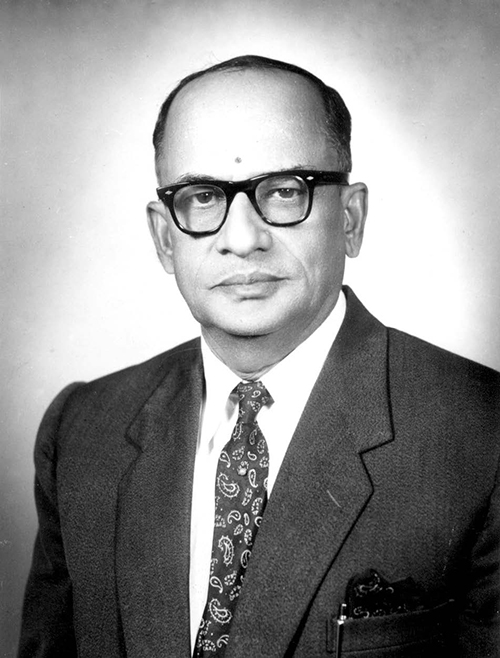
Sri K. K. Nambiar was a Keralite who came to Bhagvan in 1932, while serving as an Assistant Engineer at Salem, about 120 kms from Tiruvannamalai. He was immediately recognised among devotees for his many compelling dreams of Bhagavan which revealed that Bhagavan does not just work in the conventional realm of human speech.

He first heard of Bhagavan through a friend returning from a pilgrimage who left him a Malayalam copy of Who am I? Nambiar, then absorbed in official duties, sports and hunting, merely glanced through it. The reference to a living Maharshi struck him as improbable. He knew of sages in the Puranas, but doubted that such beings could exist in modern times.

A colleague, Ellappa Chettiar, assured him that the Maharshi was indeed living at Tiruvannamalai and suggested that they visit. On entering the darshan hall, Nambiar prostrated before Bhagavan, who was reclining on the couch. No words passed between them, but Nambiar immediately felt an indescribable calm:

I sat transfixed to the spot. Mr. Chettiar who was also sitting nearby got up after about an hour and signalled that it was time for us to go back. We took leave of Bhagavan who nodded assent. On leaving the Ashram, I felt that my heart was being irresistibly attracted, as though by a mighty spiritual magnet towards that Divinity in human form seated on the sofa. My feeling at that time can best be expressed in the words of Poet Kalidasa: “The body goes forward, but the restless heart runs backward like the china-cloth of a banner which is being carried against the wind.”

The visit shattered Nambiar’s former scepticism and awakened a longing to return. A year later, circumstances appeared to assist him. His brother-in-law, Dr P. C. Nambiar, was appointed to the hospital at Tiruvannamalai, allowing K.K. Nambiar1 frequent opportunities to visit. Nambiar’s elder sister, Smt. Madhavi Amma, immediately recognised the significance of the Maharshi. Her sceptical husband strongly objected, sometimes scattering the offerings she had prepared for Bhagavan. His attitude changed when Bhagavan developed an abscessed tooth and summoned him.

Entering the Hall dressed formally in a suit, the doctor simply said, “Bhagavan, vaayai thora”—“open your mouth”—to the amusement of devotees.2 After treating Bhagavan, he became transformed.

He no longer opposed his wife’s visits, and began accompanying her to the Ashram to prostrate and meditate. He even felt that the hand which had touched the Maharshi performed surgical work more successfully thereafter.

Thus K.K. Nambiar, his elder sister and his brother-in-law, P. C. Nambiar, all came to Bhagavan around the same time.

The Happiest Meal

During one visit, K.K. Nambiar sponsored a bhiksha for the Ashram community and visitors. Through the natural arrangement of seating, he found himself directly opposite Bhagavan, with less than a metre between their meal leaf plates.

As usual Bhagavan was to be served first. When rice was brought before his leaf, a small ball of rice rolled into his leaf even before the person had started serving him:

Bhagavan looked at me smiling and said athu thane viluthu “it falls by itself.” This remark from Sri Bhagavan, gave me supreme delight, and I can still recall the ecstasy I felt while partaking of that meal right in front of him, face to face with him. That was the happiest meal in my life.

Life-style Changes

As Nambiar’s devotion deepened, his habits began to change. He had been enthusiastic about hunting and owned several firearms. One day, after shooting a spotted deer in the Hogenakkal forest, he brought the carcass back to the travellers’ bungalow where he was staying.

An ochre-robed swami in an adjoining room saw the animal and spoke with emotion: “Look at the eyes of that deer. How pathetic! If you must shoot an animal, shoot a bear or tiger. Do not kill such innocent creatures.”

Nambiar received these words as though they had come directly from Bhagavan. He laid aside his rifle and revolver and vowed never again to kill an animal. His encounter with the Maharshi was thus not confined to inward feeling; it gradually altered his conduct.

A New Posting

Nambiar continued praying for greater opportunities to remain near Bhagavan. He was then unexpectedly transferred to Tiruvannamalai itself.

This seemed almost impossible in ordinary administrative circumstances, since Tiruvannamalai was not then a district headquarters where a District Engineer would normally be stationed. But in 1936 the Government of Madras experimentally divided several large districts. North Arcot was bifurcated and Tiruvannamalai was made headquarters of the southern portion:

I was chosen as the District Board Engineer for Tiruvannamalai District and asked to start an office at Tiruvannamalai town itself. I had not even dreamt of such a thing until I received the posting orders. Sri Bhagavan’s grace brought me to his abode in this unexpected manner.

Now Nambiar could visit Ramanasramam almost every day. The proximity deepened the gradual transformation already taking place within him.

A senior colleague whom Nambiar brought several times to the Ashram eventually declined further visits, fearing that further contact with Bhagavan might give him a distaste for worldly life and cause him to abandon his career. Nambiar believed this fear to be unfounded. Bhagavan never required devotees to renounce employment or family responsibilities. Rather, his influence made life’s duties easier to bear and less oppressive.

Surrender

As Nambiar’s confidence grew, he began occasionally speaking with Bhagavan. At one point, he wrote in Sanskrit, “I have no other refuge; you are my only support Oh Ramaneshwara! Therefore, have mercy on me and protect me.” Nambiar comments:

Bhagavan took it up, read it with a smile and gave it back commenting upon a parody I had made in the well-known sloka. When I resumed my seat, Sri Bhagavan was steadily looking at me. The gracious look directed at me set my mind completely at rest.
Sri Bhagavan

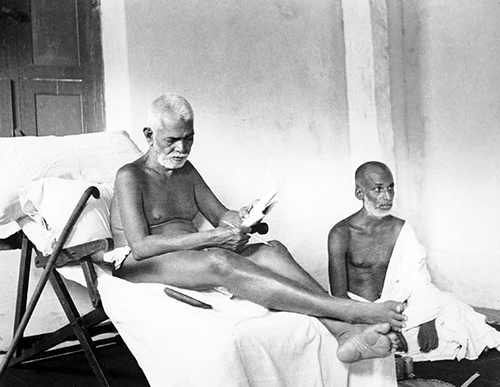
Nambiar came increasingly to regard Bhagavan as divinity in human form. His devotion was reinforced by encounters with other distinguished visitors. Douglas Ainslie, known at the Ashram as Grant Duff, told him that those born in India during Bhagavan’s lifetime were extraordinarily fortunate. Having studied comparative religion, Ainslie believed that Bhagavan’s Advaitic philosophy was uniquely capable of withstanding the scrutiny of the modern scientific age.

Nambiar became acquainted with Yogi Ramiah, Paul Brunton, Major Chadwick and Munagala S. Venkataramiah, all who arrived in the early to mid-1930s which enabled Nambiar to be part of a remarkable international circle of seekers drawn to Bhagavan.

Dream of the Notebook

One of the better-known incidents in Nambiar’s life concerns a dream about a notebook.

One evening at the Ashram, he wished to ask Bhagavan whether he should continue reciting hymns and practising japa. During the solemn period of Vedic chanting and meditation, however, he could not bring himself to disturb the silence. He returned home disappointed.

Early the following morning, in a vivid dream, he saw Bhagavan sitting on a lawn surrounded by Brahmin boys:

Bhagavan was reciting some Sanskrit verses which the boys were repeating. Actually, he was reciting Shyamala-Dandakam itself which I used to recite. This appeared to me a straight answer from Bhagavan to the question I had failed to put to him the previous night. Then the scene changed in the dream. The boys doing parayana were not there. Bhagavan beckoned me to go near him and asked me for a notebook to write something. When I told him that I had only an octavo size notebook ready to spare, he said that would be fine. The dream ended there, but it made such a deep impression on my mind that I could not delay carrying out the behest, however strange it might seem to others.

After an early bath, I traced out the spare notebook, dusted it off and hurried to the Ashram. Prostrating before Bhagavan as usual I handed over the notebook. He received it smilingly and asked me what made me bring it along. I related to him in a whisper all about the dream I had early that morning.

Immediately he called his personal attendant and asked, “Madhava, did I not ask you last evening to fetch a notebook to write down a Malayalam Translation of the Sanskrit text of Ramana Gita? You didn’t bring it. Here is Nambiar who has brought it for me”.

Bhagavan asked Nambiar to recount the dream aloud so that everyone in the hall could hear it. The notebook was subsequently used for Bhagavan’s translation and became one of Nambiar’s treasured relics, now preserved in the Ashram’s archives.3

Guidance through Dream

A similar incident occurred shortly afterwards. Nambiar dreamt of a young Goan devotee named Sridhar sitting before Bhagavan and practising intense pranayama. In the dream, Nambiar saw sparks of fire rising along the devotee’s spine. Bhagavan remarked that such gymnastics of breath control were unnecessary and that Self-enquiry was easier and safer.

The next day Nambiar sought out Sridhar and told him what he had seen. The young man became deeply emotional and embraced him. He explained that he had long practised pranayama and had been waiting for an opportunity to ask Bhagavan whether he should continue. The previous night he had sat in the hall hoping to raise the question but had found no occasion. He accepted Nambiar’s dream as Bhagavan’s answer.

The two became friends. Sridhar later received sannyasa from Swami Ramdas and became Gurudevananda. During a later journey together to Swami Omkar’s Shanti Ashram, East Godavari district in Andhra Pradesh, Nambiar experienced the sacred syllable Om as a flood of light enveloping him.

This episode reinforced his conviction that Bhagavan had many ways of instructing devotees. Verbal discourse was only one of them. Guidance might arise through silence, dreams, another person’s words or a sudden inward certainty.4

Silent Instruction

Nambiar increasingly saw the Ashram as a place where doubts were resolved and aspirants were guided without any fixed or predictable method. Bhagavan sometimes spoke at length to sincere seekers, quoting scriptures and explaining subtle points. At other times, especially when questions arose from vanity or intellectual display, he remained silent or gave a brief reply that exposed the questioner’s superficial understanding.

Nambiar told Bhagavan of an unusual experience:

One day while sitting with eyes closed in meditation in the hall, I had a sensation of numbness creeping all over my body and I saw my own skeleton as in an X-ray picture. I spoke to Bhagavan about it. He said that I should not give any attention to such things, but should intensely continue the meditation without being distracted.

On another occasion, an elderly visitor recited a Sanskrit verse declaring that he was not the body, senses, breath or mind. He then complained that he still felt pain when bitten by an insect. Bhagavan sharply asked, “Who said you are not the body?” The reply exposed the difference between verbally repeating a truth and actually realising it.

A group from Lahore likewise arrived with written questions about God-realisation and the methods recommended by Bhagavan. They sat impatiently while he remained silent. When Paul Brunton suggested that the answers could be found in Ashram books, the leader angrily dismissed the idea, unaware that the man he was rebuking was Brunton. Later, when the party requested an interview with Brunton and discovered his identity, their anger subsided and they apologised.

The incident suggests that Bhagavan’s silence itself could function as a mirror. It brought hidden impatience, pride and expectation to the surface, revealing the questioner to himself.

Miracles and Divine Action

Nambiar once asked why saints did not openly perform miracles to convince modern materialists of spiritual truths. The miracles of Christ, he argued, had played an important role in the growth of Christianity; perhaps similar demonstrations could lead sceptics towards faith.

Bhagavan perused his note and replied by putting a counter-question “Did those saints of yore, referred to as having performed miracles, know and act as though they were performing those miracles?”

The answer redirected attention from personal supernatural power to impersonal divine action.

Bhagavan repeatedly warned seekers that fascination with siddhis could divert them from Self-realisation. Yet unusual events occurred around him. When such events were reported, he generally attributed them to automatic divine action rather than individual agency. Things just happened in his presence:

One morning while we were all seated in the hall, a gentleman brought a fairly large-size photograph of Kavyakantha Ganapati Muni and presented it to the Maharshi. Maharshi while receiving the photo exclaimed that it was only the previous day that the Ashram had received a Telegram that Nayana had attained Maha Samadhi at his Ashram at Nimpura near Kharagpur. The messenger who brought the picture was taken aback as he did not know about it. He had left Nimpura a few days earlier and had no knowledge of it.

Such incidents confirmed for Nambiar that life was governed by a deeper intelligence than the human mind could perceive.

The Dream of Rescue

Another of Nambiar’s significant dreams was one in which he found himself trapped at the bottom of a filthy manhole. An unseen hand grasped him by the head, lifted him high into the air and carried him to an Ashram near a hill.

He understood the dream as a symbol of Bhagavan lifting him out of the degraded life he had previously led and bringing him to the spiritual path. The image remained with him throughout his life as an assurance of protection and transformation.

Decades later, in 1981, an odd incident recalled the dream. While speaking with the devotee, Joan Greenblatt, near the Ramanasramam post office, Nambiar described how drops of filth had fallen upon his arm while he was being lifted from the manhole. At that exact moment, drops from a crow above fell upon the same place on his arm. Both he and Joan looked up in amazement.

Nambiar did not insist upon a rational explanation. He simply asked, if such things were only coincidences, what then should be called a miracle?

In Bhagavan’s Presence

Nambiar witnessed visitors becoming intensely emotional in Bhagavan’s presence. Some trembled, entered ecstatic states or lost control of their bodies. One woman rushed towards Bhagavan as though possessed and had to be restrained. Bhagavan generally remained silent and calm.

A striking case involved R. D. N. Simham, the Director of Town Planning in Madras. Simham initially declined to visit the Ashram, saying that he already saw Bhagavan inwardly during his early morning practices. On the final day of an official visit, however, he changed his mind.

At the Ashram, he stood before Bhagavan trembling, holding a paper in his folded hands. Eventually he sat cross-legged directly before Bhagavan. Suddenly he began violently striking his thighs against the floor, creating loud sounds. Some devotees feared that he had been bitten by a snake or scorpion and moved to assist him. Bhagavan simply said, “Leave him alone.”

Within moments Simham became quiet, rose and prostrated before Bhagavan. He then resumed his seat in a normal state. He never explained the experience.

For Nambiar such episodes strengthened the impression that Bhagavan’s presence worked directly upon the hidden depths of those who approached him. Yet Bhagavan himself claimed no personal power. He remained the silent, unmoving centre around which intense transformations occurred.

Bhagavan’s Guidance

In his reminiscences, Nambiar presents Bhagavan not merely as a teacher, but as a living presence guiding every aspect of a devotee’s life. His grace appeared through peace in the Hall, personal transformation, unexpected circumstances, dreams and striking coincidences. Yet its deepest expression was the gradual reorientation of Nambiar’s life towards detachment, meditation and surrender.

Bhagavan never encouraged fascination with visions, miracles or psychic experiences. Their value lay only in strengthening faith, dispelling fear and turning the devotee inward towards Self-enquiry—the direct path to the source of the “I.”

For Nambiar, the Guru’s guidance assumed countless forms, all revealing one compassionate intelligence patiently drawing the seeker towards the Self. —

(to be continued)

[Editor’s note: The above is taken from the Ramanasramam publication of Nambiar’s account of his life with Bhagavan, entitled, The Guiding Presence of Sri Ramana. In July–August of 1983, at the request of the Ramana Kendra, Madras, Nambiar delivered a series of talks recounting over five decades of devotion and service.

Nambiar relates that after a serious illness in July the previous year, he experienced Bhagavan’s grace as a constant inner presence, free from fear. With growing interest from devotees and from V. Ganesan, then editor of The Mountain Path, these reminiscences were published by the Ashram.]

1 Nambiar is a clan name. Neither K.K. Nambiar’s full name nor that of Dr. P.C. Nambiar is mentioned in the Ashram literature. ↩

2 Devotees chuckled because, in Tamil, the thora is used for youngsters. The well-intending doctor, a Malayalam speaker, in whose language thora is used for all, did not know that he should have used the formal thoranga for someone of Bhagavan’s stature. ↩

3 The archives’ digital scans of this notebook are currently unavailable. ↩

4 See also, Day by Day, p. 246; My Recollections of Bhagavan, p. 129. ↩
Announcement: Saranagati.Online

On 1st September 2026, Saranagati e-magazine begins its 20th year. Marking this milestone, the publication has launched a website in response to requests to make Saranagati articles and content more accessible. The site includes a complete pdf archive of Saranagati issues published thus far for free downloading. Over time, this archive is hoped to become Google searchable, once traffic to the site increases and the uploaded files are indexed. It is hoped that all two hundred plus Saranagati issues will be available for a general Google search over time. Please see https://saranagati.online/. —

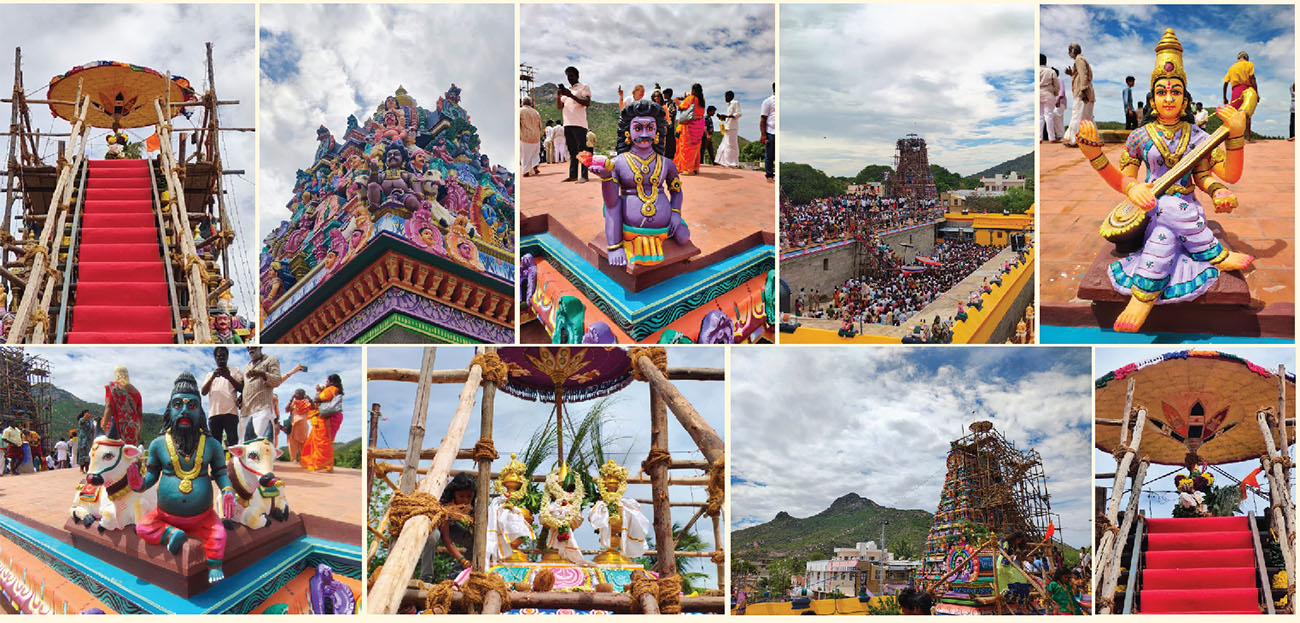
Events in Tiruvannamalai: Kumbhabhishekam at Adi Annamali Temple

D. Thiyagarajan

Sri Bhagavan

The historic Adi Arunachaleswarar Temple, traditionally believed to have been established by Lord Brahma, recently celebrated Maha Kumbhabhishekam. The sacred ceremonies began on Friday, 26th June and culminated in the main consecration on 2nd July. Following early-morning rites for the peripheral deities of the outer prakara, the Maha Kumbhabhishekam of the Rajagopuram and the towers above principal deities, was performed at 10.15 am.

The temple’s previous consecration was held in July 2012, when thirty-nine homa kundas were installed in the yagasala. An earlier major renovation, undertaken at a cost of Rs. 25 lakhs through the dedicated efforts of Swami Ramanananda Saraswathi, culminated in the consecration ceremony of 1996. The occasion was graced by the presence of the head of Kanchi Shankara Math, Sri Jayendra Saraswathi Swamigal.

A century back, during renovations at Adi Annamalai Temple in 1918, a tunnel was discovered in the outer prakara near the temple kitchen. Bhagavan was asked to inspect it while on his pradakshina. Devotees may recall how Bhagavan described Holy Arunachala as having a vast interior in which even ‘an army battalion’ could stay and perform tapas. Recalling a vision and a passage from the Puranas, Bhagavan advised that the tunnel be sealed, and the authorities complied without further investigation. —

Similes from Bhagavan: Returning to the Source

Waters rise up from the sea as clouds, then fall as rain and run back to the sea in streams; nothing can keep them from returning to their source. Likewise, the jiva rising up from Thee cannot be kept from returning to Thee again, though it may stray along the way. A bird that rises from the earth and soars into the sky can find no place of rest except the earth. So must all retrace their path; and when the jiva finds its way back to its source, it will sink and be merged in Thee, O Arunachala, Thou Ocean of Bliss! — Sri Arunachala Ashtakam v. 8

Ramana Reflections

Happiness the World Cannot Give

kknambiyar
Audio: RAMANA REFLECTIONS
0:00 / 0:00

The one goal sought by all, yet attained by few, is lasting and meaningful happiness. We continually pursue fulfilment, but regularly search for it outwardly—in the seen, heard, touched, tasted, smelled and conceived. We imagine that freedom lies in the sense domain, mistaking it for our natural home. Bhagavan summarises the human predicament in the preface to his Tamil translation of Adi Sankara’s Vivekachudamani:

Every being longs to be happy and free from sorrow and bodily affliction, which are not its true nature. Everyone loves himself because happiness is inherent in his being. Even in deep sleep, when everything else is absent, happiness remains. Yet, ignorant of this truth, people seek fulfilment in worldly pleasures and wander through material existence, forsaking the inward path to lasting happiness.1

Our suffering arises from not knowing what happiness truly is and where it may be found. Victims of a profound forgetfulness, we seem to be like the woman Bhagavan spoke of who forgot that she was already wearing her necklace. She searched everywhere until a friend pointed out that the necklace was around her neck. On feeling it with her hands, she rejoiced. Yet she had gained nothing new. Ignorance had caused her distress; knowledge restored her happiness. Likewise, the Self is ever present. Nothing new has to be acquired. Ignorance of the Self brings misery; knowledge of it reveals the happiness that has never been absent.2

The musk deer offers a similar image. Perceiving an intoxicating fragrance, the deer races through forests and across rocky slopes searching for it, unaware that the fragrant musk lies within. So too, we pursue external objects, imagining that happiness resides in them. When a desire is fulfilled, the mind briefly subsides and our native peace shines through. We attribute that peace to the external object itself and begin to search afresh. The error is not that we desire happiness, but that we look for it where it cannot be found.

In the hall in November 1945, Bhagavan told the story of Dattatreya, the avadhuta:

A king passing through a forest encountered a naked ascetic resting in perfect contentment. When summoned, the ascetic remained unmoved, so the king approached and asked about his guru and the secret of his happiness. Dattatreya replied that he had twenty-four gurus: earth, wind, sky, water, fire, sun, moon, birds, animals, insects and human beings—all had taught him.3

Dattatreya learnt from everything and everyone he encountered. What was noble taught him what to cultivate; what was harmful taught him what to avoid. Earth taught patience, wind freedom, water purity and fire detachment. He found instruction everywhere because he no longer demanded that the world satisfy him. Dattatreya’s happiness did not arise from favourable circumstances but from freedom in the midst of them. Bhagavan points to the same discovery:

Everyone wishes to rush out. There is no limit to going out. But happiness lies within and not without… You do not acquire happiness. Happiness is your very nature.4

Sri Bhagavan

When the mind moves outward toward the senses, it becomes agitated. This is because the outer world is not its natural home. Sense enjoyments may relieve discomfort, but the relief never lasts. Worse, each satisfaction strengthens the conviction that happiness depends upon repeating some experience. Yet objects, feelings and thoughts appear only after the arising of the “I”-thought. Asked where this “I” comes from, Bhagavan directs us back to consciousness:

Soul, mind and ego are merely words; Consciousness alone is real, and its nature is Bliss. There is no separate enjoyer, for joy and the one who experiences it merge in Consciousness. Happiness lies in turning the mind inward; pain arises when it moves outward.5

The ordinary “I” is sustained by movement toward experience. It says, “I want this” and “I do not want that.” Wanting is its occupation—its reason for being. It tries continually to reproduce earlier pleasures and avoid earlier pain. With every desire, the ego renews itself. But when wanting subsides and the mind remains free of thought, the separate “I” cannot maintain itself. Bhagavan comments:

Self-realisation is not the acquisition of bliss but the discovery of the bliss that was present before, during and after every experience.6

The pursuit of satisfaction is usually unconscious. Vichara introduces awareness into that movement. Instead of being carried away by longing, we observe the longing as a mental state. Instead of assuming that the desired object contains happiness, we ask who desires it and from where the desiring “I” has arisen.

As this inquiry deepens, the old habits of pursuit and avoidance begin to weaken. We learn to remain in a neutral state—neither chasing the wanted nor fleeing the unwanted.7 This is as good as it gets in the spiritual life. Bhagavan says:

Our aim is not to acquire happiness, which is our true nature, but to remove misery by dissolving the samskaras that obscure it. Practice therefore brings no new attainment; it heals the predispositions that conceal our innate peace.8

If the mind seeks rest, it has forgotten where true rest is found. The mind is a tool of the Self, not the Self itself, and cannot independently identify its source. Ignorant of the infinity within, it searches frantically like an insect beating its wings against the windowpane, trying desperately to reach the sunlight beyond the glass. The effort is intense, yet the barrier is created by a mistake in direction. Bhagavan distinguishes pleasure from happiness:

Pleasant contact, or its memory, and freedom from unpleasant experience are commonly called happiness, but this is only relative pleasure. Everyone seeks absolute, lasting happiness, which cannot be found in external objects but only in the Absolute within.9

The mind remembers former pleasures and longs to repeat them. But repetition brings diminishing returns. The stronger the earlier enjoyment, the greater the craving for its return and the sharper the disappointment when it is not reproduced. Though longing to escape suffering, we invariably cling to its causes.10 Bhagavan highlights our dilemma:

One cannot put out a burning fire by pouring petrol over it. Attempting to satisfy a craving for the time being so that the passion may later be suppressed is simply foolish.11

Pleasure and aversion sustain one another. We grasp at desirable experiences and resist what is unpleasant, driving the mind further from its source. As dependence upon stimulation grows, silence becomes difficult to bear. The psychology of wanting is like a merry-go round—the plight of hungry ghosts—where indulging sense desire magnifies our discontent. The mechanism of addiction is hard to come free of but the first step is identifying the trap as a trap.

Modern neuroscience offers a useful insight. Repeated exposure to intense stimulation reduces sensitivity to reward, producing tolerance: Over time, the original activity brings less pleasure, therefore stronger, longer or more frequent stimulation is needed to achieve the previous effect. Without it, ordinary life may feel dull, restless or unsatisfying until sensitivity gradually recovers.

Food, scrolling, work, excitement or intoxicants briefly lift our spirits, but dependence upon them deepens the very sense of lack they were meant to relieve. We become like the dog chasing its own tail. The faster we pursue satisfaction, the faster it recedes.

Literature down through the ages has reminded us of this blind spot and helps us clarify the confusion.

We recall the story of King Midas who was granted a boon that everything he touched would turn to gold. The king initially believed his deepest wish had been fulfilled: branches, stones and furniture became precious metal in his hands. But bread, too, hardened at his touch, water turned to gold at his lips, and even his beloved daughter became a lifeless statue. The gift that promised unlimited satisfaction became a nightmare.

The story highlights how desire to make pleasure permanent drains life of its warmth. What we selfishly try to possess becomes dead in our grasp.

The 17th-century English poet George Herbert offers a similar theme in “The Pulley”. God pours strength, beauty, wisdom, honour and pleasure into humanity, yet withholds one final gift: rest. If human beings possessed both worldly blessings and complete contentment, they might become absorbed in the gifts and forget their source. Restlessness therefore becomes the “pulley” drawing us back to God.

Dissatisfaction may not be a defect but a form of grace. The world gives enough pleasure to attract us, yet never enough to end the search. Its incompleteness prevents us from mistaking the reflection for the source.

Restlessness is painful while it moves from one object to another. Turned inward, it becomes homesickness for the Self. In his Confessions, Saint Augustine writes:

Our hearts are restless until they find rest in Thee.

The senses cannot be pacified by furnishing ego with satisfying experiences. We repeatedly mistake a fragmentary good for the Good itself. Beauty, love, knowledge and pleasure are not false, but they become sources of suffering when asked to bear the weight of Infinity. No finite object can satisfy an infinite longing. Bhagavan therefore directs our attention beyond craving to the fundamental misidentification beneath it:

What is happiness? Is it a healthy and handsome body, timely meals and the like? Even an emperor has troubles without end, though he may be healthy. All suffering is due to the false notion, “I am the body.” Getting rid of it is jnanam.12

Self-enquiry gradually exposes the false identification. As the peace of the Self becomes more evident, dependence upon outward pleasure diminishes. This is vairagya, not a grim rejection of life, but the discrimination that recognises the painful consequences concealed within transient pleasures.13

In his How Much Land Does a Man Truly Need?, Tolstoy offers a vivid illustration. Pakhom is promised as much land as he can walk around in a single day, provided he returns to his starting point before sunset. Tempted by every fertile field, he repeatedly extends his route. Realising too late that evening is approaching, he races back at full speed to reach his starting point. Arriving just at sunset, he collapses from exhaustion and dies on the spot. His servant buries him in a grave six feet long. That, Tolstoy concludes, is all the land a man truly needs.

Like Pakhom, our desire keeps us extending its boundaries. We acquire experiences, accumulate impressions and assemble them into a makeshift identity. In this way the round of samsara becomes perpetual. Yet the Self remains untouched, obscured but never destroyed.

What, then, is the practical response?

For many today, restraint must begin with reducing needless stimulation, particularly compulsive device use. Constant visual and auditory input gives the mind no opportunity to settle. Thought is the ego’s support system. Entertainment, information and incessant digital communication insulate us from silence and unresolved inner experience.

Switching off the phone and remaining without distraction may require more courage than we imagine. By ceasing to chase outward forms, we allow buried samskaras to surface and the mind and heart to heal. In this quieter inner space, vichara can come alive, no longer drowned by the noise and confusion of a heart besieged by sense data.

This work can be deeply challenging. After all, who are we without our sense indulgences? Here we recall the child Prahlada. He lived in the palace of his father, Hiranyakashipu, who demanded universal worship. Yet Prahlada’s mind remained steadfastly absorbed in Lord Vishnu. Threats, punishments and repeated attempts on his life could not shake his devotion. Exposed to snakes, elephants and other dangers, he regarded all beings without enmity, seeing neither friend nor foe. His happiness did not depend upon changing circumstances or his father’s approval, but arose from a deeper source. Prahlada’s serenity was the fruit of knowing the divine presence everywhere. He thus exemplifies the peace Bhagavan describes—a happiness that endures amid adversity because it springs from one’s own nature.

Tradition speaks of guarding the sense doors. This means remaining watchful as sights, sounds, smells, tastes, bodily sensations and thoughts arise. We neither grasp at what is attractive nor resist what is unpleasant. In this way, contact with sense objects is prevented from developing into attachment, aversion or mental proliferation.

Guarding the senses is not suppression. It is the recovery of freedom before reaction becomes compulsion. It preserves inward simplicity and prepares the mind for Bhagavan’s instruction, summa iru—be still.14

At first this discipline may seem burdensome. Yet, with practice, we discover the quiet joy of remaining present to what lies within instead of continually drowning it with external input and stimulation.

The necessity of this feature of Bhagavan’s teaching is confirmed by direct experience. As we become willing to remain with whatever arises in the heart, we begin to know ourselves more intimately, beyond the distractions of the senses. We gradually recognise that the constant crowding of the mind with sense impressions is one of the greatest obstacles to vichara. As the mind becomes less burdened, difficulties fall away of themselves.

The consumer mind fears that restraint means deprivation. It asks where happiness will come from if familiar pleasures are relinquished. Yet genuine restraint does not arise from moral pressure or self-denial. It grows naturally as we taste the deeper joy revealed through inwardness and, above all, through Bhagavan’s vichara.

Merely wishing to overcome our addiction to stimulation is not enough. If compulsions could be removed by mere wishing, Bhagavan would have done so on our behalf. As has often been said, no deity or human person can free us from karma and the consequences of past actions; only we can do so by responding rightly when they arise.

When stimulation is reduced, discomfort may initially increase. Thoughts, emotions and tendencies formerly hidden by distraction begin to surface. Yet if we remain present without immediately escaping into sense enjoyments, these samskaras are allowed to arise, mature and heal. Therefore, the burden of conditioning is gradually weakened.

The real choice is therefore not between pleasure and deprivation. It is between two kinds of happiness: one dependent upon thought, stimulation and circumstances, and the other, revealed from within when compulsive movement ceases. The first must constantly be renewed; the second is self-existing. Bhagavan asks only that we stop looking for permanent happiness where it cannot be found.

Like the necklace already resting around the seeker’s neck, the bliss we seek has never been absent. What is required is not acquisition, but recognition; not further outward striving, but clear inward seeing and finally, complete rest in the Heart. —

1 This is an abridged restatement of the first paragraph of the introduction that Bhagavan wrote for his translation of Sankaracharya’s Vivekachudamani while living at Virupaksha Cave. (Collected Works, p. 208.) ↩

2 Talks, §63 (6th July 1935). ↩

3 Day by Day (22-11-45 Morning). ↩

4 Talks, §229 (8th July 1936); §290 (30th November 1936). ↩

5 Ibid, §244 (29th August 1936). ↩

6 Ibid, §28 (4th February 1935). ↩

7 “Ramana Reflections: Chasing the Sucrose Gradient”, Saranagati, September 2020, p. 6. ↩

8 Talks, §290 (30th November 1936). ↩

9 Ibid, §28 (4th February 1935). ↩

10 Shantideva, The Way of the Bodhisattva. ↩

11 Talks, §523 (2nd October 1938). ↩

12 Talks, §633 (23rd February 1939). ↩

13 Ibid, §302 (25th December 1936): Everyone seeks happiness, yet mistakes pleasures accompanied by pain for happiness. Pleasure and pain alternate endlessly in worldly experience. Dispassion consists in discerning what does not end in pain and directing oneself towards that alone. Without such discrimination, a person stands with one foot in worldly pursuit and the other in spiritual practice, progressing satisfactorily in neither ↩

14 Talks, §426 (12th June 1937). ↩

Announcement: Live Streaming

The Ashram is live streaming the Sri Chakra Puja on the first and last Friday of each month. Daily live streaming Mon to Sat from 8 to 10.45 am and 5 to 5.45 pm IST continues and includes the Vedaparayana, puja and Tamil Parayana. (No streaming on Sundays) To access live streams, go to: https://youtube.com/@SriRamanasramam/live

Around the Ashram: Letting No Dust Alight

Sri Bhagavan

The body is a bodhi tree,
the mind a bright mirror stand.
Always diligently clean it,
and let no dust alight.

— Shen Hsiu, 7th century

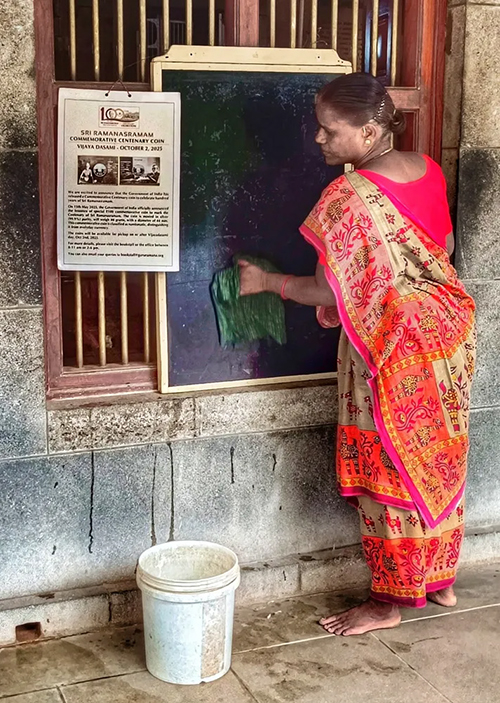
Next to the notice announcing the recent release of the Ashram’s Commemorative Centenary Coin, minted in 99.9% pure silver, Ashram staff member, Kalaa, wearing the traditional printed sari featuring animal motifs, wipes “the dust” of the community notice board. —

bsky.app/profile/ainekeenan.bsky.social

Events at Sri Ramanasramam: Nayana Day

Sri Bhagavan

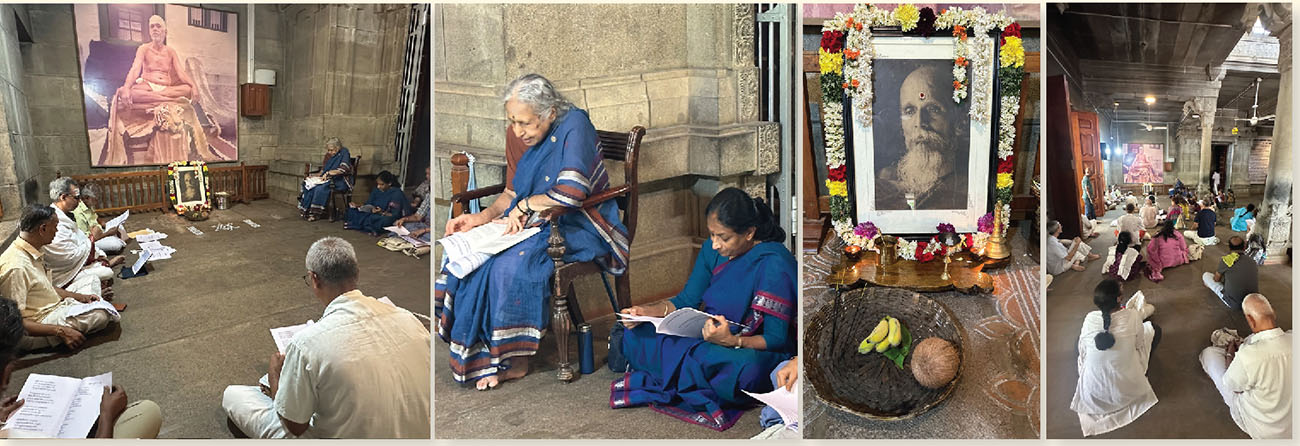
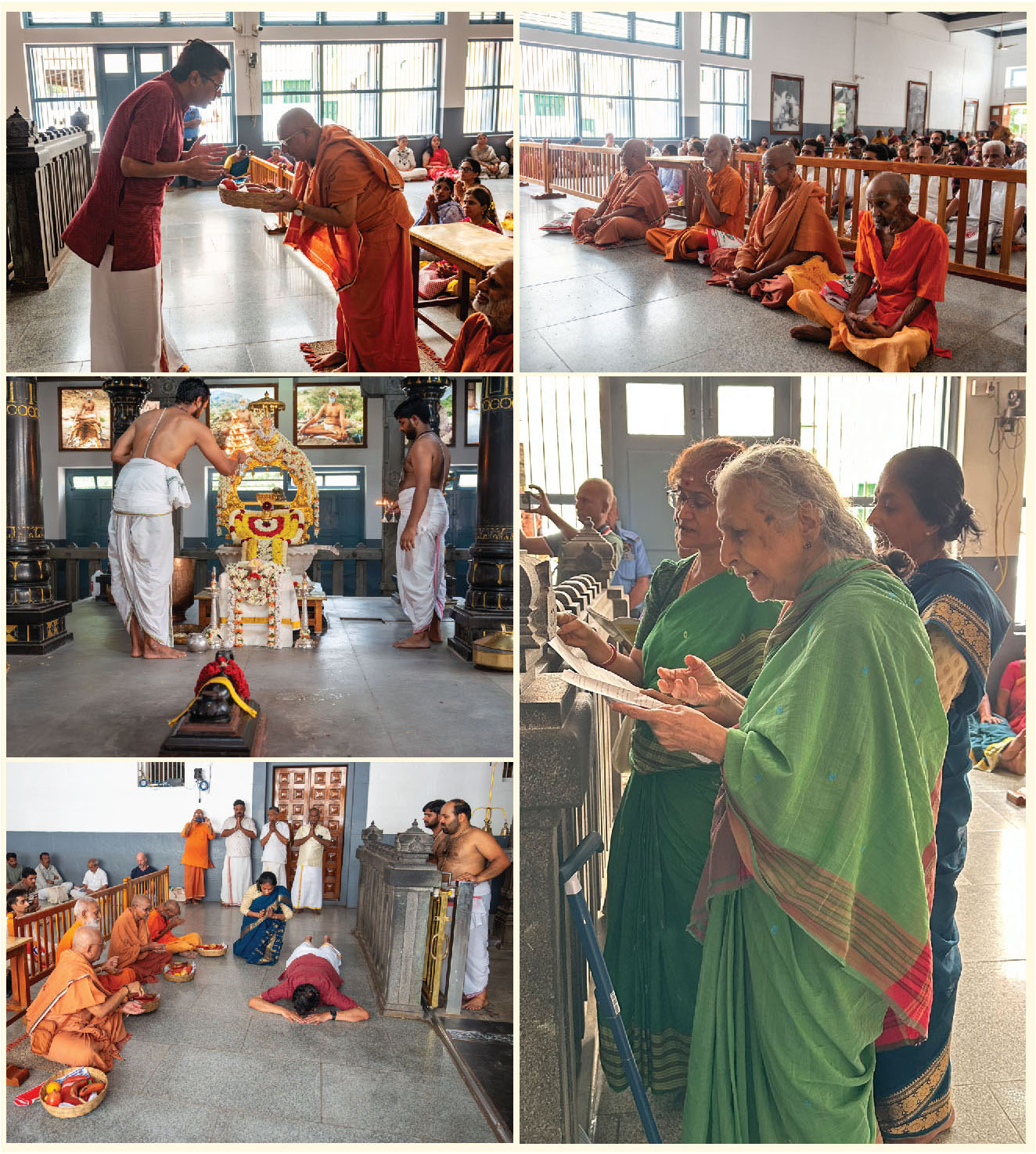
On the 25th July, Kavya Kantha Ganapathi Muni Day was celebrated in the New Hall with the recitation of Sat Darshanam and the first three chapters of the Ramana Gita followed by arathi. —

Obituary

Sri Sundararajan (1951–2026)

Sri Bhagavan

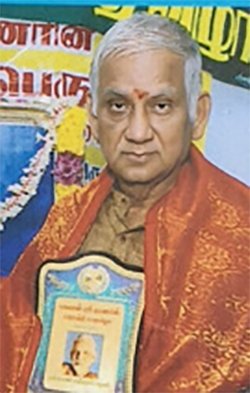
Sri Sundararajan, poet and scholar of Tamil literature, was deeply devoted to Sri Bhagavan. In his early years, he drew inspiration from the Vedas, the Upanishads, Swami Vivekananda and Mahakavi Bharathiyar, but a series of inner revelations eventually anchored his life in devotion to Bhagavan.

At the Meenakshi Temple in Madurai, he experienced Lord Siva as Chokkanathar, who directed him to recite the Maha Mrityunjaya Mantra. Later, at Hosur, he received an inner instruction to go to Tiruvannamalai.

Though initially hesitant, he arrived during the Karthigai Deepam festival. On his early visits to Sri Ramanasramam, Sundararajan imagined that Bhagavan’s teaching was intended only for advanced aspirants. But while looking through the window of the Old Hall, he envisioned Bhagavan appearing before him and declaring, “I am not as you say.” He immediately understood that Bhagavan’s grace was universal.

Soon afterwards, a close associate encouraged him to study Conscious Immortality. Spellbound by Bhagavan’s words, he began reading the Maharshi’s works with increasing intensity, and his life gradually became one of deepening surrender. Moved by Sri Muruganar’s poetry, he prepared and published commentaries on selected verses from Guru Vachaka Kovai, Sri Ramana Sannidhi Murai and the nine-volume Sri Ramana Jnana Bodham. He distilled these profound works into accessible books freely distributing them to present-day devotees.

Sundararajan’s life became a continuous meditation on Bhagavan. Whether engaged in spiritual study or ordinary conversation, his thoughts invariably returned to the Master.

Born in Srirangam, he spent much of his life in Bangalore and Chennai before returning to his birthplace. On the night of 21st July 2026, after praying to Bhagavan as usual, he peacefully breathed his last. He is survived by his wife, Mrs. Ranjini Sundararajan. His life remains a testament complete surrender. —