

Dear Devotees,
Devotees are preparing for Bhagavan's 76th Aradhana, which this year falls on 15th April, the day after the Tamil New Year and Bhagavan's Nirvana Room Day.
The recently renovated Ashram kitchen has been reopened and staff are finding the new equipment a great help in meeting the demands of ever-increasing numbers of visitors to the Ashram.
In this issue, we hear about the Swedish devotee who came to Bhagavan in 1948 and lived out his monastic life in S. India following Bhagavan's Mahanirvana. A new biography on the life of Swami Ramanagiri sheds light on his formative years (see p. 3).
In Ramana Reflections: Cultivating the Doubt Sensation, we explore possibilities for making Bhagavan's inquiry practicable with simple suggestions for making one's practice engaging (see p. 10).
For videos, photos and other news of events:
https://gururamana.org
or write to us at:
saranagati@gururamana.org.
For the web version:
https://sriramana.org/saranagati/April_2026/
In Sri Bhagavan,
Saranagati
In This Issue
- In Profile: Swami Ramanagiri
- Announcement: Saranagati's Upcoming 20th Year
- Origins: Skandasramam Annamalai Swami
- The Faces of Arunachala
- Ramana Reflections: Cultivating the Doubt Sensation
- Announcement: Sri Chakra Puja Live Streaming
- Announcement: Ashram's WhatsApp Channel
- Around the Ashram: Steps for an Orderly Ascent
- Events at Sri Ramanasramam: Kitchen Renovations
- Events at Sri Ramanasramam: Sri Vidya Havan
- Obituary: Smt. Sakkubhai Srinivasan (1936–2026)
- Obituary: Dr. G. Swaminathan (1936–2026)
Calendar of Ashram Events
APRIL 2026
1st Apr (Wed) Full Moon |
15th Apr (Wed) Pradosham |
2nd Apr (Thu) Jagadisha Swami Day |
17th Apr (Fri) Amavasya |
14th Apr (Tue) Tamil New Year/Nirvana Room Day |
29th Apr (Wed) Pradosham |
15th Apr (Wed) Sri Bhagavan's 76th Aradhana |
30th Apr (Thu) Full Moon |
Swami Ramanagiri
Audio: IN PROFILE

On the night of 26th February 1949, during the Mahasivaratri celebrations in the Old Hall, a young foreigner sat in Bhagavan's presence absorbed in the practice of vichara. He had spent the previous forty days and nights at the feet of the Sage endeavouring to learn the practice that Bhagavan so emphatically recommended for sadhakas. At some point during the all-night vigil, amidst the recitation of the Rudram while standing in the long queue to have darshan, Ramanagiri's turn came and he approached the "Great Magnet". He stood before the Maharshi and experienced what he called, "a piercing yet moon-like look from those sun-like eyes." In that moment the noise of the hall seemed to fade in the distance and all his earlier efforts would culminate in a singular event. The burdens of twenty-seven years of seeking seemed to fall away—in this first of a series of openings that would fundamentally alter his life.
Who is Swami Ramanagiri?
Per Alexander Westin1 was born in Stockholm on 19th June, 1921 and showed remarkable spiritual longings from an early age. One of his early biographers, Prof. K.C. Sastri tells us Per's eastward journey began with Swami Vivekananda's Raja Yoga, which profoundly influenced him as a student, leading him to practice its teachings even while still in Sweden. Shaped by the turbulence of the Second World War, Per eventually found his way to India, took sannyass, and became a devotee of Sri Bhagavan.
His Swedish biographer, Ulf Odehammar2, tells us that in his school years, Per was deeply inspired by India's rich religious heritage and looked for the opportunity to travel to India. The moment came when under the auspices of Uppsala University where he was studying the history of religions and religious psychology, he was granted permission to attend a two-year programme as a student of philosophy at Benaras Hindu University. But once in India, even before his course work began, he was smitten by the longing to seek the Lord—not through books and learning, but directly—apprenticing himself to the teachers and holy men he encountered. He thus gave up his studies and, it would seem, never took a single course at BHU but instead took sannyasa diksha shortly after his arrival.
His first guide was the Danish mystic Alfred Julius Emmanuel Sørensen, known by the spiritual name Shunyata, who had come to India fifteen years earlier after meeting the poet Rabindranath Tagore in Europe. Over time Shunyata settled in the Himalayan town of Almora, living in caves near Kasar Devi and came on regular visits to South India to see Bhagavan Ramana. Shunyata tells of his meeting with Per not long after the young Swede arrived on the subcontinent:
It was a sunny winter day in holy Benaras in the 1940s when I met Per Westin. He came gliding along by the shore where the washermen were busy washing the linen of respectable ego-jies. I was sharing my leftover food with donkey friends, as human friends would always give me too much to eat. Per seemed touched by my donkey friendship. He was in the body of one some twenty-five summers—tall, dark-haired, and slim. He was studious-looking, civilized, respectable and balanced. His upper lip had been slightly disfigured by some explosion he endured during his military service. We went together to see some sadhus, gurus and learned pandits. One guru fastened on Per the name "Sri Hanuman." I was not much impressed by the competence of that guru nor with the name he had given Per. Since Per had been in holy Bharat only a brief while [and yet, was already greatly inspired by the religious culture of India], I was convinced that he would eventually find his path.3
Family Roots in Sweden
Per Westin was born into a family whose story reflected both hardship and perseverance. Ulf Odehammar traces the family's origins to the rugged coastal archipelago north of Stockholm. Per's grandfathers had been sea captains who combined seafaring with small-scale farming. Life there was shaped by wind, water, and the rhythms of the sea. But the shipping crisis that struck Scandinavia in the late nineteenth century destroyed the fragile prosperity of many such families.
When Per's grandmother was widowed with five children, she moved the family to Stockholm in search of work. The move marked the beginning of a new chapter. Among the children was Robert Westin, Per's father, who would rebuild the family's fortunes through determination and skill.
Per's father abandoned the uncertain life of the sea while still a teenager and apprenticed as a steel engraver. The craft demanded patience, steady hands, and long years of discipline. Gradually, he mastered the trade and established his own workshop in Stockholm. By the early 1920s he had founded Westins Ateljé, an engraving and goldsmith workshop that produced sports medals, badges, and decorative metalwork.
The business prospered. At its height it employed about thirty workers and even produced royal medals, Odehammar tells his reader. Through industry and perseverance Per's father restored a measure of the family's prosperity that earlier generations had lost.
Even though born into rising prosperity, Per's early years were not spent in comfort and quiet but in the bustling streets of Stockholm's Old Town, where the family lived above the busy commercial district of Österlånggatan. The narrow streets were filled with merchants, carts, and crowds. For a sensitive child such surroundings could be overwhelming.
Per would later describe the city as "the nectar of madness."4 Even as a boy he seemed to sense that something deeper lay beyond the restless energy of urban life. While the household outwardly reflected success and ambition, inwardly Per was developing a rich imagination and a natural inclination toward solitude and interiority.
A Mysterious Fall
One remarkable story from his boyhood occurred when he was about six years old.
According to later accounts, Per fell from a second-storey window into the courtyard below. His family rushed outside expecting the worst. To their astonishment, the child was alive and unharmed. When he regained consciousness, he asked his mother, "Where is that bird?" He later explained that a great white bird had carried him gently to the ground.
The family could find no explanation for this comment. Years later, when Per was living at Sri Ramanasramam, he saw a white peacock and was deeply moved. Something in him recognized the bird instantly. He felt it was the same presence that had saved him as a child.5
In later years Per sometimes hinted that the path to India had begun long before he consciously chose it.
A Childhood of Inner Distance
Although Per grew up in a loving household, he seems never to have felt entirely at home in it. After arriving in India, he wrote a touching line that his biographer preserved:
I feel like a little child. I would like to gather all the little children and pray with them, but they probably wouldn't agree to have a playmate with a big black beard.
The remark reveals both innocence and humour, but it also hints at a deeper transformation. In India, Per felt as though he had rediscovered a childlike simplicity that had never adequately expressed itself in his early years.
Djursholm
During the early 1930s the family moved from the crowded streets of Stockholm to the prosperous suburb of Djursholm, an area known for elegant villas and elite schools. The move reflected Robert Westin's growing success, Odehammar tells us.
Yet the young Per sensed the emptiness that can sometimes accompany wealth and an increasingly elevated social status. The social expectations of this environment did not fully satisfy the deeper questions stirring within him.
Relief came through the surrounding natural world. The family spent summers in the Roslagen archipelago, a landscape of islands, forests, and open sea. Sailing, swimming, and wandering along the rocky coast brought Per a sense of peace that city life could not provide. The natural world awakened in him a love that remained throughout his life.6
Religious Influences
Odehammar tells how Per's family belonged to the Swedish Mission Covenant Church, a Protestant movement that emphasized humility, discipline, and service. His father served as a youth leader, and the household observed strict moral standards. Alcohol, dancing, cinema, and other amusements were discouraged.
The church cultivated compassion for the poor and enthusiasm for missionary work abroad. Stories of missionaries traveling to distant lands to serve the poor such as in China, Africa, and India were often shared in church circles. No doubt these stories influenced Per in exposing him to the spiritual traditions of Asia. Yet the church's emphasis on doctrine and moral regulation did not fully satisfy his longing. Even in youth he appears to have been searching for a more direct encounter with the sacred. He later illustrated this search through a parable:
He compared his childhood world to a deep well inhabited by frogs. From the bottom of the well the frogs could see only a single star in the night time sky. They were told that this star represented heaven. But one frog longed to climb out of the well and see the sky—the entire sky—for himself.
When Per later arrived in India, he said it felt as though he had finally climbed out of that deep dark well. Instead of one star, he saw a sky filled with countless stars—and then, too, the rising sun.
Lundsbergs Skola
Odehammar tells us that at the age of eighteen Per entered Lundsbergs Skola, one of Sweden's most prestigious boarding schools. The fact that his family could afford such an education for their son shows how far his father's success had carried them.
Lundsberg was modelled after British public schools and sought to train the future leaders of Swedish society. Its motto, "A sound mind in a sound body," reflected an ideal of discipline, endurance, and physical strength.
Sports such as rowing, shooting, riding, and fencing were central to the school's culture. Younger boys were expected to defer to older students, creating a strict hierarchy. The environment demanded resilience and self-control.
Yet the school also provided strong intellectual training and powerful social networks. Many of Per's classmates would later become prominent figures in Swedish public life.7
Per entered the school at a late age compared with other students and graduated only at the age of twenty-two. He proved to be an excellent student, especially gifted in languages. By the age of twenty-one he reportedly spoke several languages, including Latin and Russian.
He also developed athletic abilities and artistic interests. Yet even amid this structured environment his love of nature remained strong. The dream of a life closer to the natural world never left him.
The Great Loss
In 1943 tragedy struck. Per's father Robert had recently suffered severe financial difficulties after investing in a tar factory. Then, only ten days after the death of his own mother Amanda, Robert died in hospital in Danderyd at the age of fifty-two. The official record states that he took his own life, Odehammar reveals.

Per's father, Robert Westin (left); Per and his sisters (right)
The shock to the family was immense. Robert had been known not only as industrious, but as a respected man of faith. His death revealed how fragile outward success can be. The funeral drew a large gathering of relatives, employees, church members, YMCA associates, and friends. Per's father left behind a substantial estate, though debts had reduced its value.
For Per, however, the deeper impact was spiritual rather than financial. The sudden loss of his grandmother and the suicide of his father forced him to confront profound questions: What is the meaning of life? Why does suffering exist? How can faith coexist with despair? These questions intensified the search already arising within him.
Turning East
During this period, Per encountered the teachings of Swami Vivekananda who offered a spiritual path based on direct experience rather than on dogma. He spoke of self-discipline, meditation, and inner discovery. Such ideas deeply resonated with Per's own spiritual aspirations.
Military Service
During the war years Per completed his military service in the Gotland Infantry Regiment. Since Sweden was a neutral country, Per saw no combat in the Second World War. However, from 1944 to 1945 he advanced from squad leader to platoon leader trainee and eventually to conscript sergeant and his evaluations were consistently strong. Military life may have provided stability during a period of personal upheaval. Accounts mention an accident involving a rifle or explosion that affected his breathing.8
Uppsala and the Final Preparation
After military service Per entered Uppsala University. He initially pursued theological studies but soon turned toward the academic study of religion. Two professors were particularly influential.
One was Geo Widengren, a renowned scholar of the history of religions who explored the experiential aspect of religious life. Another was Helmer Smith, professor of Sanskrit, who introduced students to the sacred literature of India—the Rigveda, the Yoga Sutras, and Buddhist texts.
Through such influences Per began to see India not merely as a distant land but as a force operative in his own life—a living source of spiritual wisdom.
Another powerful inspiration came through the writings of Dr. Sarvepalli Radhakrishnan, the South Indian philosopher, scholar of Comparative Religion, statesman who served as President of India, and vice-chancellor of Banaras Hindu University, and as professor who once taught at Oxford. Radhakrishnan's ideas opened fresh horizons for the young Per.9
Europe after the devastation of World War II was searching for deeper meaning, and many were turning to Eastern spirituality for clues. For Per this attraction was more than intellectual curiosity. It was a call.
The Journey
In 1947 the opportunity finally arrived. After completing his studies, Per received permission to continue his research in India at Benaras Hindu University. Uppsala issued a travel certificate in May 1947, Odehammar notes.

On 20th November that year, after a long sea voyage through the Mediterranean, the Suez Canal, Aden, and Karachi, Per arrived in Bombay. India had gained independence only three months earlier in mid-August, and the country was experiencing upheaval. But ancient traditions were being re-ignited, and seekers from around the world came in search of ancient wisdom.
Into this atmosphere arrived Per Westin, carrying grief, questions, discipline, and a longing he did not yet fully understand.
The path that began in the disciplined worlds of Djursholm, Lundsberg, the military barracks of the Gotland Infantry Regiment, and the Religious Studies Department at Uppsala University was leading toward something wholly unexpected—a spiritual rebirth in the land he would soon come to call Mother India.10 —
(to be continued)
Endnotes
1 Swami Ramanagiri is little known to devotees though some articles have appeared over the decades in the Mountain Path. Till recently, the details of his biography were unclear. But in the last few years, a more detailed account has appeared, clearing up some of the confusion of earlier efforts. ↩
2 The scholar and writer, Ulf Odehammar, has researched at length Swami Ramanagiri's early life and written up an engaging and detailed account. The following sections are freely adapted from his careful work, collated and published at: https://tinyurl.com/mr3dfz35. ↩
3 Dancing with the Void: The Innerstandings of a Rare-Born Mystic, Shunyata, pp. 55-59. ↩
4 All these details come from Ulf Odehammar's engaging history. ↩
5 Ramana devotees will immediately appreciate the resemblance of this story to that of Arunagirinathar, who was saved by Lord Murugan, the deity whose vehicle is the peacock. ↩
6 These reflections from Ulf Odehammar's account. ↩
7 Ulf Odehammar points out that Per's attendance at the prestigious Lundsberg may be the reason that Shunyata and others assumed Per was born to an aristocratic family, which seems not to have been the case. ↩
8 These details owing to Ulf Odehammar's meticulous research of records at various government institutions in Sweden. ↩
9 Dr. Radhakrishnan's uncle Swami Pravananda was instrumental in introducing Frank Humphries to Nayana and Sri Bhagavan. ↩
10 Many thanks to Ulf Odehammar of Gothenburg, Sweden, for his careful research and comprehensive biography of Swami Ramanagiri's early life. For the full account, readers are directed to: https://tinyurl.com/mr3dfz35. For further reading, please consult the following: Dancing with the Void: The Innerstandings of a Rare-Born Mystic, Shunyata pp. 55-59; Swami Ramanagiri: A Tribute, Prof. K.C. Sashi in The Mountain Path, April 1986, pp.71-74; Guru, by 'a Chela', The Mountain Path, Oct 1980, pp. 229-30; Swami Ramanagiri, The Mountain Path, Jayanti issue, 1994, pp.145-148; A Pilgrimage, pt II by Dennis Hartel, in The Maharshi, Jul/Aug 2019; Swami Ramanagiri by David Godman, The Mountain Path, Jan 2010, also, https://tinyurl.com/ymut6mz4, The Mountain Path, July 1977, p.167; see also Arunachala Asrama's Ramanagiri archives: https://tinyurl.com/yx2a7cv6. ↩
Announcement: Saranagati's Upcoming 20th Year

On 1st September 2026, Saranagati e-magazine begins its 20th year of publication. Marking this event, among other things, the publication will be launching a website in response to requests to make Saranagati articles and content more accessible. The site will include a complete pdf archive of Saranagati issues published thus far for free downloading. —
Skandasramam Annamalai Swami

Annamalai Swami, though little known to later devotees, played an important role in Bhagavan's early years on Arunachala. A native of Arani, just 50 kms north of Tiruvannamalai, he first met Bhagavan at Virupaksha Cave, later studied Tamil scriptures at Kovilur Mutt. He then returned to Skandasramam, where he served Bhagavan and assisted Mother Alagammal. He also composed devotional songs later sung on his death anniversary.
A severe plague outbreak in 1921, following earlier ones in 1905 and 1908, emptied Tiruvannamalai. While many fled, Bhagavan remained at Skandasramam with a few devotees as the disease reached the Ashram.
Kunju Swami arrived at this time, on the same day of Annamalai Swami's passing on 2nd February 1922. He found the place quiet and grief-stricken. Seeing Mother Alagammal mourning, Bhagavan consoled her, pointing to Kunju Swami: "Why are you upset? Another son has come to fill his place."
For Kunju Swami, the day marked both loss and "new birth," as it coincided with his first darshan of and surrender to Sri Bhagavan.
Annamalai Swami's memory continues to be honoured annually with puja, songs, and feeding of the poor, with Bhagavan himself ensuring these observances were maintained, including the recitation of the 36 verses Annamalai Swami wrote on advaita. A sample of these verses appears below following the invocatory verse written by Sri Muruganar:
Sri Ramana Stotram (Kappu)
Let us contemplate in our hearts the benevolent Lord Ganesha, the sacred feet of Lord Murugan, the generous benefactor Arunachalesan, his consort Unamulai, the glorious Venugopalan, my father Ramanan, and the pure Kalavalli (Saraswathi), who is like a rain-bearing cloud.
Annamalai's Text
In the glorious town of Arunachala, where he lived and bestowed his grace, the essential detachment, and compassion for all beings, the knowledge of Brahman, and the sublime devotion to God—these all combined to take form as the one great consciousness; let us enshrine that Ramana within our hearts. 1
I beheld his form, radiant like pure gold; I saw the simple loincloth he wore, shining brightly; I saw his eyes that reduce fierce sins to ashes; I saw his forehead adorned with sacred white ash; I beheld his two lotus-like feet; I saw him seated firmly on a majestic tiger skin; I witnessed his grace responding to the heartfelt words of his devotees—as I beheld the divine presence of the gracious Ramana. 2
Shining forth in the form of pure gold, the prosperous Sonachala mountain Where the noble eye of true wisdom gleams, and the assembly of devotees experience within their own hearts the bliss of self-realization, Is the great teacher Ramana, who bestows divine grace upon the world. 3
[Editor's note: Sri Ramanasramam is collating the 36 original Tamil verses of Annamalai Swami for publication and release on the Bhagavan's 76th Aradhana Day 15th April, under the title, Sri Ramana Stotram. Along with the original verses will be a transliteration and English translation. For those who want to hear these verses in Tamil, see the following: https://shorturl.at/dZpSH.]
The Faces of Arunachala
Dr. Carlos Lopez

Arunachala wears many faces—each a quiet revelation of the Self in form, light, and colour. To behold the Hill is not merely to see a landscape but to encounter a living presence that speaks through silence. Its slopes, shadows, and changing hues mirror the subtle ways in which the infinite discloses itself within the finite. Whether through a photograph, a painting, or a passing glance—we are drawn beyond the ordinary flow of time. Something in us pauses. We are held by a sense of wholeness not constructed but revealed. It is the same quiet recognition that arises when we notice the delicate veins of a banyan leaf, the stillness of water reflecting the sky, the play of light across an open field, or the unguarded face of a child. Such beauty is a hint of the underlying harmony that sustains all things. In nature's smallest details, we glimpse an order that is at once intimate and boundless. So too with Arunachala.
In the above images the photographer has captured vast, unassuming forms along the pradakshina path where one senses both the depth of human tenderness and the immensity of divine wisdom. The Holy Hill gathers these into a single presence—silent, steady, and luminous—inviting us to look again, and in looking, to remember. —
Cultivating the Doubt Sensation
Audio: RAMANA REFLECTIONS

Over the decades devotees have complained about the difficulty in practising vichara—Sri Bhagavan's method of self-inquiry. They say that when they attempt inquiry their questioning soon becomes mechanical and dry. The effort to investigate the nature of the "I" loses vitality, and they abandon the practice out of boredom or frustration. This is perhaps the most commonly cited reason for not practising vichara.
What can be done?
The first step is to find a way to make inquiry engaging and meaningful. If we begin by honestly acknowledging that we do not know who or what this "I" is—though whatever we think, say, and do refers to it—then curiosity naturally arises. Discovering that the most familiar word in our vocabulary refers to something we cannot clearly identify should give us pause.
Bhagavan repeatedly points out that the sense of individuality is not what we assume it to be:
The 'I'-thought is the first thought of the mind. When the inquiry 'Who am I?' is persistently pursued, all other thoughts disappear, and finally, the 'I'-thought itself vanishes.1
Everything we do revolves around this mysterious "I." Yet when we attempt to locate it directly, it proves strangely elusive. Bhagavan therefore urges the seeker to examine it more closely:
When the mind turns inward seeking "Who am I?" and merges in the Heart, the "I" lowers its head in shame and the true "I" appears as Itself.2
The fact is simple yet unsettling. Either we believe that the one we regularly refer to and call "I" exists—or it does not. If we believe it exists, then we are burdened with being at odds with Bhagavan's own testimony. If Bhagavan was mistaken about the illusory nature of the separate self, then we will want to show how that could be possible. If, on the other hand, we accept Bhagavan's words in respect of the illusory nature of the separate self, then we need to explain how we would continue to live, act, think, and speak as though this small "I" were real.
A paradox lies at the heart of our existence. If we take it seriously, it should provoke in us a certain unease. How can we go on living while holding this contradiction at the centre of our lives?
There is a usefulness in this otherwise uncomfortable incongruity, namely, that it helps us become interested in the practice Bhagavan gave us. Generating such interest is what the ancients called cultivating the doubt sensation.3
What does this phrase mean? It means, first of all, acknowledging we have a problem. We do not know who or what we are, and yet, we proceed moment by moment as though we did. When seen clearly, this is astonishing. If we are honest, we recognize that we are living a kind of unexamined assumption—perhaps even a subtle falsehood. At the centre of our life stands an unquestioned identity. Living a shadow existence, out of touch with our basic nature moment to moment—who would not want to unravel this puzzle? Sri Muruganar's verse highlights the urgency of the task:
The ego is a formless phantom that arises by grasping form. If sought, it disappears; if ignored, it thrives.4
When we allow ourselves to remain open to this paradox, a certain ambivalence naturally arises. We begin to see that we have been living outwardly, disconnected from the Heart. How did we fail to notice this earlier?
Self-inquiry exposes the gap between the intentions we imagine guide our lives and the deeper motivations actually operating beneath the surfaces of the conscious mind. The practice highlights the conflict underlying our inner life.
Here true vichara begins. What first appeared dull or mechanical begins to reveal itself as deeply intriguing. Time-honoured, questioning stimulates perplexity in the sadhaka because this 'I' is the ultimate mystery. Perplexity, a right-hemisphere function, is at odds with conceptual knowing, a left hemisphere function. Perplexity is the aimed-for because it inverts the literalism of the ego and helps us overcome the illusion that egoic knowledge can help us.
On a mundane level, consider the experience of losing our house key. Searching for it is not boring because we must find it. After all, without the key we cannot leave the house. The urgency of the situation naturally energizes the search.
A more powerful analogy might be that of a missing child.
Imagine a family walking in a forest reserve on a Sunday outing. Toward evening they suddenly realize their young daughter has wandered away. The forest is thick, and darkness is approaching. Panic sets in. The family calls out the girl's name again and again at full volume, but the trees swallow up their earnest cries.
Among the family members is the child's mother who listens differently. Though her ears are no sharper than anyone else's, she listens with her entire being. Her attention becomes utterly focused. By the sincerity and intensity of her love she senses where the child must be—and finally finds her.
Looking for the missing "I" requires the same kind of listening. Ordinary faculties—eyes, ears, imagination, intellect and the ruminative mind—cannot discover it. The thick forest of conditioning and mental habit separates us from the Heart. Only the kind of listening born of sincerity can reveal the way.
In the search within, however, there is no lost child apart from the seeker herself. The task is not to discover where this little "I" is hiding, but to discover that it is not there at all.
Such a search requires a thorough investigation. Yet the greatest challenge lies elsewhere. As we begin looking inward, we encounter forgotten impressions, unresolved emotions, and buried memories—"orphaned children of the Heart" that have long been ignored. Such encounters are unsettling, even terrifying.
At this stage, practitioners may become discouraged and ask whether there might be an easier path. Bhagavan is clear:
Other than inquiry, there are no other adequate means for making the mind quiescent.5
Intangibility
Bhagavan is communicating something essential: genuine progress requires inwardness. He tells us we are mistaken if we imagine we can make progress in the religious life without examining the source of the "I".
Inquiry is the name we give to this inward turning. But the mind resists it. By its nature, the mind thrives on outward activities—thoughts, plans, opinions, endless commentary and chatter. What it does not enjoy is the suspension of thought. This is why devotees starting out with inquiry practice like to imagine that inwardness only means looking at the contents of the mind—its stories, thoughts and ideas. But the contents of the mind are just objects of the sense realm, after all, the mind door belongs to the form-world—created, conditioned and external.
So then, what is true inwardness? It is the realm of the Heart below the thinking mind and its objects. This is where Bhagavan is directing us. Self-inquiry turns the mind back upon itself. Instead of allowing thought to roam outward toward mind objects, inquiry demands that the mind examine its own source. Bhagavan explains the method with great simplicity:
Whenever thoughts arise, do not follow them. Ask instead, 'To whom has this thought arisen?'6
The mind finds this work uncomfortable because it deprives it of its favourite occupation. Inquiry halts the habitual processes of analysing, labelling, remembering, worrying, reverie, and storytelling. In truth, the mind is our playground of distraction which protects us from the unsettling state of not-knowing.
But why should not-knowing be frightening? Because it exposes everything that has been pushed down into the depths of the Heart. When inquiry suspends the mind's outward movement, these hidden layers become visible.
A grief moment arises when we see that the world we have been inhabiting is only a surface reality. A deeper dimension of being—the life of the Heart—has gone largely unnoticed all of our lives. With this recognition comes a quiet lament—the years spent in deflection, distraction, and avoidance.
The temptation may arise to abandon inquiry altogether. The spirit is willing but the flesh is weak7, so it is said. Turning away seems easier than taking responsibility. We console ourselves: perhaps my life rests on an illusion but at least it's a comfortable illusion.
This is how the familiar patterns of neurosis appear safer than stepping into the unknown.
Samskaras

At this juncture, the true potential of vichara can reveal itself. Inquiry asks us to probe the made-up self and to become intimate with all that undergirds it. Vichara is the means by which we overcome our dissociation.
But what exactly are we dissociating from? From the samskaras. Indeed, samskaras may be understood as dissociation itself, i.e. fragments of experience that have been exiled from conscious awareness.
If the ego serves as a stand-in for the inner life, we may be cut-off from our surroundings, may feel detached, as if watching a movie of our lives from the outside. Taking this ghost realm as reality, we have ever failed to notice how our misery is rooted in the alienation from the life within.
We may think of samskaras as "reactivity". Samskaras arise from the resistance to the conditions of daily life. We grasp at what we want, and push away what we do not want. Born of preferences, this non-stop karma-producing habit sets up the barrier between the made-up "I" and the Heart below. When we figure out how to greet WHAT IS on its own terms, when we are able to observe our difficulties without angling for a preferred set of outcomes, then an important threshold will have been crossed, Bhagavan tells us.
Since samskaras thrive in concealment, the moment they are brought into the light of awareness, their destructive power is reduced. If we overcome our reactivity completely, no new samskaras can arise; and if we mend the existing samskaras, the path will likely lead in one direction, namely, to the gradual attrition of the illusory notion of a separate self. This is the intended purpose of vichara. Bhagavan comments:
A struggle is kept up between [an inner] spiritual force and innate samskaras, until the latter are destroyed. [Then,] the soul is led into the Heart to rest forever in peace.8
We sometimes imagine that we do not need meditation or vichara practice but only need to know about them. Once in possession of the map, we imagine there is nothing more to be done. But knowledge about how to cross the barrier only has value if we put it into practise.
Relating to our knowledge as an attainment—a shiny object to possess and revere—is a form of delusion. Conversely, imagining that we do not need the map at all but can just practice meditation and vichara blindly is likewise mistaken. A vital vichara practise requires understanding the lay of the land, as well as cultivating the intense longing to look vigorously within.
Had our suffering been consciously engaged with from the beginning, it would not have hardened into these deeply embedded patterns of separation. This is why Bhagavan insists that suffering is the way.9 What he points to is not suffering for its own sake but the necessity of turning toward discomfort. To engage with what is painful is to re-associate with what has been exiled.
By becoming familiar with inner residues—and by allowing ourselves to register the discomfort they evoke—their hold on us is loosened. This is the subtle and inscrutable function of vichara: through direct encounter, it exposes the mechanisms of avoidance and gently heals the wounds they cover over.
Meditation
When Bhagavan says that meditation is the expulsion of thoughts,10 we might ask why thoughts need to be expelled? Because they function as the vanguard of our dissociation. Shielding us from unprocessed material within, our thoughts serve as substitutes for the life of the neglected Heart, keeping us safe—as it were—from the pain of karmic afflictions.
Bhagavan asks us to relinquish the comfort of distraction in order to make friends with our suffering. Yet, even here, discomfort is not the most challenging feature of inquiry practise. More unsettling is the apprehension of relinquishing the status quo—the identity we have come to depend on.
If inquiry dissolves the sense of a solid "me", then it may feel like the ground beneath us were giving way. From the standpoint of the ego, this feels like death. From the standpoint of wisdom, it is the beginning of freedom.
As the path unfolds, we learn to encounter internal "sticking points" with patience and care. No need to force things. Rather, we gently accompany our fragile psyches into shadowy areas, slowly becoming acquainted with a hidden terrain.
We observe reflexes such as the impulse to withdraw or distract. We compassionately nudge ourselves forward, recognising that the aim is not necessarily dismantling ego all at once but gradually allowing its hold on us to be diminished.
At the heart of this work is a willingness to be at ease with not-knowing. When we understand that we do not know what this "I" is—or where it can be found—our inquiry takes on a new intensity, like that of the mother searching for her lost child.
As thoughts arise, the mind attempts to reassert its habitual patterns. But we need not give in to them. We just keep looking as if searching were the only thing that mattered.
Here we become who-idiots. Enthralled by what-we-know-not, the sound of who begins to echo in our Hearts as if it were the only thing there is. We know who is a mystery but we also know that the solution does not lay in finding something. Rather, by maintaining the sense of uncertainty, we are made ready for something altogether new to enter in. As we focus inwardly with a felt sense of seeking, the awareness becomes ever more subtle. Bhagavan gives us his assurance:
With repeated practice in this manner, the mind will develop the skill to stay in its source.11
As the identification with thought loosens, something begins to shift. The boredom that once plagued our inquiry reveals itself as restlessness. As our resistances moderate, our inward gaze becomes vibrant and quietly compelling.
Conclusion
Cultivating the doubt sensation means, first of all, appreciating the poignancy of life, i.e. the certainty of death and the uncertainty of the time of death. We recognise that there is something we must do and yet do not know exactly how to go about it.
Staying close to the doubt sensation propels us ever further through questioning. As we get more familiar with the inner domain, we cease to be thrown off balance by what arises. The phantom "I" begins to lose its solidity and with it, our investment in the mind's aimless stirrings. Increasingly, we find ourselves content just to rest in a simple, nameless awareness.
Bhagavan's inquiry is thus no longer a dry technique but the royal road to the Heart. What once appeared dull and mechanical turns out to be the portal to the ground of our being.
The journey of inquiry is thus not an aimless excursion into the realm of phantoms but a long-sought return to the place of origin—the Heart—our True Home. —
Endnotes
1 Who Am I? §8. ↩
2 Ulladu Narpadu, v. 30. ↩
3 For example, monks of 8th century China. ↩
4 Guru Vachaka Kovai, §25. ↩
5 Who Am I? §12. ↩
6 Ibid., §12. ↩
7 Matthew 26:41. ↩
8 Talks, §247, 8th September, 1936. ↩
9 Talks, §107, 29th November 1935. ↩
10 Talks, §452, 7th February 1938. ↩
11 Ibid., §12. ↩
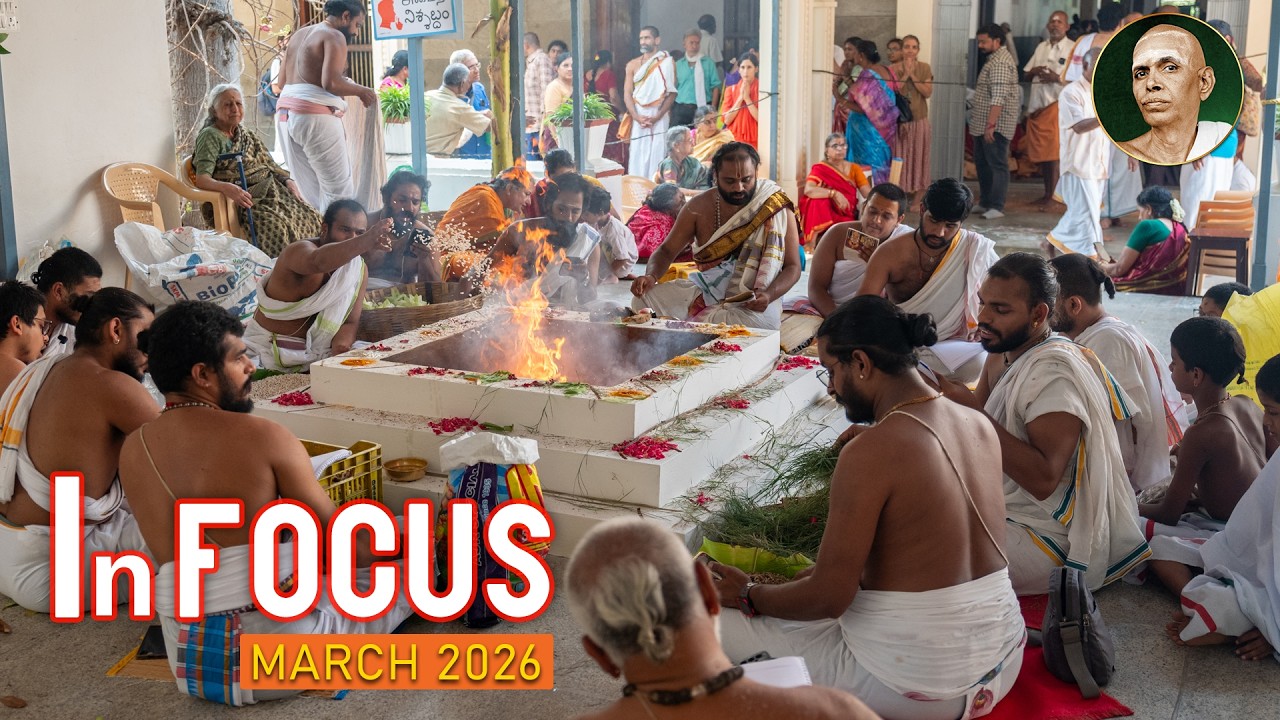
Ashram Video: In Focus - March 2026
Catch up on the latest events, daily life, and special moments at Sri Ramanasramam. Watch our newest "In Focus" monthly wrap-up video below.
Announcement: Live Streaming
The Ashram is live streaming the Sri Chakra Puja on the first and last Friday of each month. Daily live streaming Mon to Sat from 8 to 9.30 am and 5 to 6.45 pm IST continues and includes the Vedaparayana, puja and Tamil Parayana. (No streaming on Sundays) To access live streams, go to:
https://youtube.com/@SriRamanasramam/live
Announcement: Ashram's WhatsApp Channel
Now users can subscribe to Saranagati e-newsletter in pdf or web version formats at:
https://web.whatsapp.com/channel/0029VaByrGSC1FuLjCG2fW2P
as well as receive Ashram updates. For those wanting to register for Saranagati by email, go to:
https://www.gururamana.org/Resources/saranagati-enewsletter.
Around the Ashram: Steps for an Orderly Ascent

This is certain: Worship, praise and meditation,
Being work of body, speech and mind,
Are steps for orderly ascent.
— Bhagavan Sri Ramana, Upadesa Saram, v. 4.
Granite steps lead into the Dining Hall. The interior visible through the doorway reveals a traditional South Indian design, with a high ceiling and ceiling fans. The white-painted, textured exterior and bright green door are characteristic of the original style, as are the thick, load-bearing walls and a distinctive teak-beam ceiling. Historically, the Dining Hall was a place of quiet, simple and traditional dining, with seating on the floor, upholding the traditions set during the Maharshi's time. Now, with its new extension, it can accommodate 200 people at tables, and the kitchen can cook meals for up to ten thousand.
Bhagavan emphasises that an orderly approach eventually leads to stillness of the mind and the ultimate wisdom, moving from viewing God as an 'other' to realising the Self as the 'I' within, culminating in pure being: kāyavāng-manah kārya-muttamam pūjanam japa-ścintanam kramāt. Upadesa Saram, v. 4 highlights that worship (body), chanting (speech), and meditation (mind) are, in order, steps for purification and preparing the mind for Self-realisation. It suggests a progression from physical rituals to verbal praise, and finally to silent, inward meditation. —
Events at Sri Ramanasramam: Ashram Kitchen Renovations

On early morning of the 18th March, the newly renovated kitchen was inaugurated. New cooking facilities including boilers, steamers, enhanced service piping and larger capacity burners will provide for ease of food preparation for large numbers. The modified kitchen now relies more on Gobar Gas (about 50%) made in the Ashram gosala itself from cow dung. The kitchen's floors and walls were freshly tiled for ease of cleaning. —
Events at Sri Ramanasramam: Sri Vidya Havan

In the Sri Vidya tradition, Goddess Lalita Tripurasundari is supreme, the physical universe being but her manifestation. She is worshipped through the two-dimensional Sri Chakra yantra and through the three-dimensional Meru Chakra. Each year at the Ashram, the Sri Chakra and the Meru Chakra are reconsecrated in yagna called Sri Vidya Havan. This year's havan took place on Friday, 20th March commencing at 7 am with Navavarana Puja from 8-11am and followed by homa. At 2.30 pm purnahuti took place followed by deeparaadhana. Procession into the Mother's Shrine ensued and abhishekam and final deeparaadhana took place at 2.45pm. —
Smt. Sakkubhai Srinivasan (1936–2026)

Smt. Sakkubhai Sreenivasan was born in Thanjavur in 1936 into a family closely connected with Sri Bhagavan. The family later moved to Chennai, where her father, Sri Gopala Iyer, worked in the High Court and became a devoted follower. During court vacations he would bring the family to Tiruvannamalai for Bhagavan's darshan, forming a lasting bond with the Ashram.
Sakkubhai's childhood unfolded in this sacred atmosphere. The family endured early sorrow with the loss of Sakkubhai's mother, and the younger children were largely raised by relatives. Her younger sister Santhabhai contracted polio at the age of four, becoming the focus of deep concern. Through this trial the family experienced Bhagavan's compassion in many ways, preserving these as lifelong memories. When her father once spoke to Bhagavan about Santhabhai, Bhagavan remarked that in her eighteenth year, an engineer would marry her, and she would have a good life—words that later proved true. The family also recalled small but touching incidents reflecting Bhagavan's kindness: he advised simple siddha treatment when young Santhabhai fractured her hand, and gently comforted her after a bee sting when she had struck a nest with a stick. Bhagavan took the opportunity to explain ahimsa and respecting all animals and beings.
On the eve of Bhagavan's Mahanirvana, 14th April 1950, Shantabhai wept, saying Bhagavan had appeared to her and told her he was going far away. When the news came the next day, her father regretted doubting the child's intuition.
Sakkubhai Amma grew up in this atmosphere of devotion. Her family maintained a long association with Sri Ramanasramam through both service and reverence. In the early 1960s her husband, J. Srinivasan, was requested by A. R. Natarajan to undertake the Ashram's annual auditing. Despite advice to the contrary, Sakkubhai urged her husband to accept it as Bhagavan's call. The family continues this service today through their son, Sri Gopalkrishnan.

Sakkubhai is remembered as straightforward, deeply loyal to family and tradition, and devoted to Bhagavan. Musically inclined, she offered devotional songs during Jayanti and Aradhana celebrations.
Smt. Sakkubhai Sreenivasan merged at the Feet of Sri Bhagavan on 23rd February 2026 at the age of ninety. With her passing, a living link to an earlier generation of devotees quietly comes to a close, even as the devotion she embodied endures. —
Dr. G. Swaminathan (1936–2026)

We mourn the passing of Dr. G. Swaminathan, President of Guru Devi Sri Janaki Matha Ashram, Thanjavur, who passed away in February at the age of 90. Born in 1936, he was the son of Dr. C. S. Ganapathy Iyer and Guru Devi Sri Janaki Matha, the saintly devotee whose life was inseparably bound up with the grace of Bhagavan Ramana. Though her son by birth, GS also regarded her as his Sat-Guru, and his life reflected devotion, service, and faithful stewardship of her legacy.
Blessed from childhood with close contact with Bhagavan, GS often accompanied his mother to the Ashram. These visits left a deep impression. He cherished Bhagavan's affectionate recognition in the dining hall: "Oh, you are Swaminathan! Have you come alone? I knew you would come."
Bhagavan called GS "Thoppan Swami," the one who teaches his father, recalling Lord Murugan as Swaminathan who taught the OM mantra to his father, Lord Siva.
GS also recounted incidents revealing Bhagavan's grace. As a child in the hall during the dark early morning hours, he lamented he could not see Bhagavan; just then, the lights came on, Bhagavan explained that as light reveals objects, the removal of ignorance reveals Truth. On another occasion, a thorn lodged in the boy's foot suddenly "flew out" after a prayer to Bhagavan—an event he so treasured that he retained the thorn as a memento to Bhagavan's grace.
GS also preserved a photograph he took of Bhagavan in 1949 at age thirteen near the gosala. One day when Bhagavan was walking near the gosala, he caught sight of the boy hiding with a camera. Bhagavan joked with his attendant that the child wanted to "catch him" and put him in "his box." Seizing the moment, Swaminathan jumped out from behind the haystack and snapped the picture—an incident he fondly recalled.

Photo of Bhagavan GS took as a young boy
A physician by training, Dr. Swaminathan dedicated his life to Janaki Matha Ashram as its President, ensuring it remains centred for Bhagavan's worship, Vedic study, daily puja, and charity. After Janaki Matha's mahasamadhi in 1969, Dr. GS helped establish it as a public trust, performing kumbhabhishekams in 1972, 1987, and 1999 with Sringeri Math's blessings.
A veteran of the Indian Air Force, GS was honoured with the national flag at his funeral. A moksha deepam was lit at Bhagavan's Samadhi Shrine on the evening of his cremation.
May Dr. G. Swaminathan rest in the peace of the Self. —