SRI RAMANASRAMAM
NOVEMBER 2024 VOL. 18, NO. 11
Dear Devotees,
In this extended Navaratri issue, we conclude the life story of Andavan Pichhai, the South Indian saint who came to Bhagavan in 1950 and had multiple intense spiritual experiences in his presence. A year after Bhagavan’s Mahanirvana, she had a vision of Bhagavan that changed her life forever.
In Ramana Reflections, we consider the formation of a separate self from a wholly different lens and ponder how Bhagavan’s vichara can show us the way out..
For videos, photos and other news of events, go to https://www.gururamana.org or write to us at saranagati@gururamana.org. For the web version: http://sriramana.org/saranagati/November_2024/
In Sri Bhagavan,
Saranagati
Table of Content
- In Profile: Andavan Pichai (pt III)
- Announcement: Daily Live Streaming
- In Focus: October
- Events in Sri Ramanasramam: Navaratri
- Iconography of the Mother's Shrine: Yogambika
- Sadhu Natanananda's Upadesa Ratnavali §13
- Breaking Free from the Trance of ‘I’ (part II)
- Similes from Bhagavan: Waves of the Ocean
- Navaratri: Suvasini Puja
- Navaratri: Saraswati Puja at the Bookstall and Carpentry Shop
- Tiruchuli and Madurai Schools
- Best Shot: Navaratri Preparations
- Verses for the Ashram Centenary: A Mother’s Tomb
Calendar of Ashram Events
2nd Nov (Sat) Skanda Sashti commences |
28th Nov (Thu) Pradosham |
8th Nov (Fri) Mastan Swami Day |
1st Dec (Sun) Karthigai Sarva Amavasya |
9th Nov (Sat) Annamalai Swami Day |
4th Dec (Wed) Karthigai Deepam Festival commences |
13th Nov (Wed) Pradosham |
13th Dec (Fri) Bharani Deepam, Maha Deepam |
15th Nov (Fri) Pournami, Annabhishekam |
15th Dec (Sun) Full Moon Day |
16th Nov (Sat) First day of Karthigai month |
16th Dec (Mon) Dhanur Masa Puja commences |
20th Nov (Wed) Punarvasu |
17th Dec (Tue) Sri Bhagavan’s 145th Jayanti |
IN PROFILE
Andavan Pichai
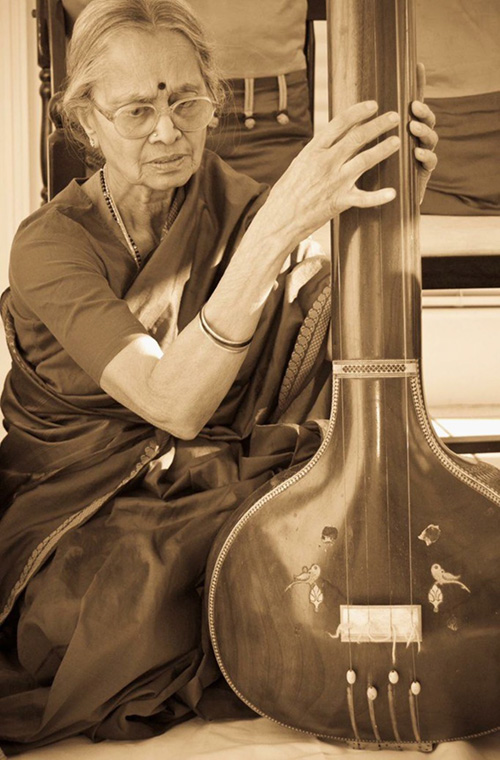
In the last segment, we saw how in late March 1950, hhai and others visited Tiruvannamalai for na Maharshi's darshan, arriving at night to find the temple closed. A boy named Dandapani offered to perform puja for them, using flowers and fruits from the sanctum. Afterward, he accepted Pichhai's small coin as dakshina, promising they could bring more the next day. The boy then led Pichhai to a shrine of Lord Muruga, shared stories, and mysteriously vanished.
We also saw how the group's visit to see Bhagavan Ramana took place the next day on a Monday, an auspicious Pradosham day. We recall how Pichhai felt an overwhelming joy upon entering Ramanasramam, sensing a profound familiarity despite it being her first visit. Her mind stilled, her senses ceased, and from afar, she saw Ramana's radiant face, feeling herself immersed in bliss, beyond dualities. As she drew closer, Bhagavan's gaze fell on her, and with a flash of light, she received an initiation through his eyes. This moment dissolved her ignorance, revealing the essence of 'Who am I?' in a vision of unity with the Supreme. In a daze, she saw her companions offering fruit, and Ramana, with humor, asked if they'd met 'Dandapani', affirming the boy they'd encountered the night before as none other than Lord Muruga. Ramana enjoyed the grapes she'd brought, completing her blissful experience. 1
Two Weeks LaterOn 12th April, 1950, Pichhai and others went to see Bhagavan, as the Maharshi's physical condition was reported to be very serious. There was a stream of visitors and each was allowed just a minute at his side. When it was Pichhai's turn, she approached with a photograph of the Sage she had purchased earlier. Unsure where to place it, Sri Ramana himself took the photo from her, held it in his right hand, and allowed her to prostrate before him. He smiled, gave her the photo back, and raised his hand in the abhaya mudra, offering blessings. Pichhai was saddened by her inability to form any words to share with him. Just two days later, the world learned of Maharshi's Mahasamadhi. Shortly after this, Pichhai had a profound experience. While sitting in her courtyard, she heard Ramana Maharshi's voice say that two grandsons would be born to her, one to be named Ramana and the other Dandapani. True to this vision, her son Ganapathy had a son in June, named Ramana, and in August, her daughter Kalpagam gave birth to a boy named Dandapani, after the boy in Arunachala Temple. Interestingly, Dandapani, born at 2 am, did not cry upon his birth but laughed with a gurgling sound, leaving both the mother and the nurse astonished. Pichhai later heard the child ask her to sing him a lullaby.2
Pichhai saw this newborn as an incarnation of Lord Muruga and was eager to fulfill his request. Late one night, while trying to write down her thoughts, she was interrupted by what seemed to be her four-year-old grandson, Babu, causing mischief. When she called for her daughter-in-law Sitamma to take him away, Sitamma insisted that Babu was asleep beside her. Pichhai realized then that this mischievous boy was Muruga Himself. With this realization, the divine child enacted ten stages of childhood in front of her, inspiring her to write a hundred verses by dawn. These verses, filled with devotion, were later delivered to Tiruppugazh Mani, who sang them at the nearby Muruga temple. The verses captivated the audience so much that they were immediately printed and distributed among devotees.
The Ever-Lengthening MalaIn June 1951, Pichhai celebrated her grandson Ramana's first birthday. After the feast, a poorly clad woman came to see Muruga's picture in Pichhai's puja room, bringing a small jasmine garland, which the vendor had claimed would grow. Pichhai placed it on a nail ten feet above, inviting the woman to lunch. Afterward, Pichhai returned to the puja room and found the garland had miraculously lengthened to the floor, emitting a beautiful fragrance. Witnesses came to witness this miracle, taking pieces of the garland as prasad.3
Grace of Bhagavan Ramana
On the 28th August, 1951, the day of Gayatri Japa, Pichhai decided to manage the kitchen herself, allowing her cook to join the family prayers. He went upstairs, after placing a large vessel of water on the stove for making coffee.
Pichhai went to the courtyard near the puja room to decorate it with kolam. The courtyard, a gathering place for bhajans, had a platform built around two trees. When she opened the door, she was stunned to see Ramana Maharshi
seated on the platform, holding Dandapani's hand. Ramana spoke to her, saying:
Are you afraid of me, thinking that I am a ghost? Please come closer; I am Ramana. I have come to talk freely with you, as you desired when you met me last."
He invited her to hold Dandapani's hand. Pichhai prostrated to the Maharshi and sat near him. He explained to her the subtle body, the gross body, the five koshas and so on. He conferred on her the highest jnana and then initiated her into the Gayatri Mantra. Being a woman, Pichhai felt hesitant to recite that holiest Mantra, but the Maharshi made her repeat it along with him. Much of his upadesa, however, was transmitted to Pichhai through his piercing look. The Maharshi again explained that she could touch him. When she attempted to touch his feet, she felt only empty space. He laughed, saying her gross body couldn't sense his subtle form, but blessed her by placing his hands on her head, which she could feel deeply. The vision then vanished and Pichhai lost track of time. She fell into deep samadhi in her position of prostration. That was a Friday.
Pichhai's husband and his sister came to the kitchen at about 10 am to have coffee. Pichhai was nowhere to be seen, and they found the water boiling in the vessel. They thought that Pichhai must be in the puja room. Instead, they found her in the courtyard, near the bhajan platform, in the prostrating position and unconscious of the world around her. She was carried inside and given injections, which however failed to revive her. The next two days Pichhai remained in the same condition.
On Sunday, the bhajan party arrived, led by Tiruppugazh Mani, who, despite hearing Pichhai was unwell, insisted on seeing her. A few were taken upstairs, where they found her still in samadhi. They began singing "Kandar Anubhuti" with cries of "Haro Hara," which gradually brought her back. Mani applied kumkum to her forehead, helping her sit up, and asked her about her experience. Pichhai described ascending six steps, witnessing the Annamalai Jyoti, and merging into "nothingness." When pressed for more, she again slipped into unconsciousness.
Later, with Ramana's grace, Pichhai composed "Shashtimalai," a series of songs describing six states of consciousness she'd experienced. Mani reassured her family that such episodes were samadhi states, not illness, and nothing to fear. Though she frequently entered these trances for hours at a time, Pichhai prayed to the Lord that she remain connected to the world and not be overcome by such prolonged states. 4
Increasing VisitorsPichhai's growing spiritual presence attracted many visitors to her home. Young and old, rich and poor, all came to seek her blessings. However, this newfound attention began to trouble her husband. Although he was a kind and generous man, he loved the quiet and orderly life. The increasing flow of visitors and Pichhai's rising fame unsettled him, and he eventually asked her to leave their home, believing they could no longer live under the same roof. Pichhai was sent to Delhi to live with her daughter Kamakshi, which turned out to be a blessing in disguise.
In Delhi, Pichhai and Kamakshi began singing Muruga bhajans together. The women in the neighbourhood joined them, forming a bhajan group that met every Thursday. As Kamakshi's husband, Kuppuswamy, returned from his tour, he too joined the group, along with some of his colleagues. One of these attendees was a friend of Colonel K.A.A. Raja, who soon began participating as well. Raja invited Pichhai and her group to his house for an all-night bhajan session, which further strengthened Pichhai's spiritual presence in Delhi.
Pichhai's husband soon regretted his decision to send her away. He realized that the influx of people was not Pichhai's fault, and he deeply missed her. She returned to her family, and life resumed with a new sense of balance. Pichhai continued her spiritual journey, nurturing the devotion of those around her while living a life of quiet contemplation 5
Swami SivanandaOn 4th July 1953, Pichhai left for Delhi to spend two quiet months at her daughter's home. Later, on 21st September, she was persuaded to join a group of friends, including Jagannatha Iyer and Tamil Isai Mani, on a pilgrimage to Haridwar and Rishikesh. After bathing in the Ganges at Haridwar and witnessing the Ganga Arati, they journeyed to Rishikesh. At the Sivananda Ghat, Pichhai encountered Swami Brahmananda, who she had known in his earlier life, and he led the group to meet Swami Sivananda.
Pichhai felt a deep connection to Swami Sivananda the moment she saw him. His compassionate gaze captivated her, and when he inquired about her, she was introduced as "Andavan Pichhai." During a satsang that night, Swamiji asked her to sing. On the spot, she composed and sang five bhajans dedicated to him, pleading for liberation from the sorrows of samsara. Swamiji was overjoyed by her soulful music and praised her. The group planned to return to Delhi the next day, but Swamiji asked that Pichhai stay behind, which disappointed the others. Pichhai, however, felt as if she were in a dream, and was wholly obedient. The next morning, she and Isai Mani were sent to Badrinath as per Swamiji's instruction.6
Kaivalya GuhaOne day, while performing her mantra japa in the Kaivalya Guha, a small cave in Sivananda ashram, Pichhai heard the voice of a child calling her. She discovered an idol of Muruga lying in a room above the cave. Swami Venkatesananda confirmed that the idol had been meant for her, and Pichhai began performing abhishekam for the Muruga idol daily. On Skanda Shashti, 7th November 1953, the idol was installed in the ashram's bhajan hall, a ceremony in which Pichhai played a central role. During the puja, Pichhai's plastic bangles caught fire, but she was so absorbed in her devotion that she didn't notice until Swami Chidananda rushed to her aid. Despite suffering severe burns, Pichhai continued her practice with remarkable endurance throughout the winter, wearing only tatters of the sari she had left. Swami Sivananda tested her patience and dedication, withholding new clothing that had been sent to her from home to observe how she would cope with the harsh conditions.
On 3rd March 1954, during Sivaratri, Swami Sivananda initiated Pichhai into the sannyasa order. Although Pichhai initially resisted taking sannyas, feeling unworthy, Swamiji insisted, stating that she was destined for this path. Her son officiated at the ceremony, and Pichhai donned the ochre robes of a renunciant. Swamiji said her final home would be Rishikesh, and promised to bring her back during her last days.
Pichhai returned to Madras as a sannyasini, causing confusion and unease among her family members. Her husband, Narasimhan, struggled to come to terms with his wife's new status, locking her away in a room to avoid public scrutiny. However, after developing a severe health condition that left him unable to pass urine for four days, he called for Pichhai's help. In desperation, Pichhai prayed to Lord Muruga and applied vibhuti to Narasimhan's body. Miraculously, he was healed almost immediately.
The next morning, Narasimhan received a visit from three mysterious swamis who further blessed him, including one who resembled Swami Sivananda. This profound experience transformed Narasimhan, who became deeply devoted to Pichhai and Swami Sivananda, even adopting the name "Murugananda." From then on, he treated Pichhai with utmost reverence and began his own spiritual practice, following the guidance of Swami Sivananda.
Pichhai's journey as a sannyasini had not only deepened her own spiritual connection but also transformed the lives of those around her, especially her husband. Through her unwavering faith and devotion, Pichhai became a beacon of spiritual light, inspiring devotion and reverence wherever she went.
In 1957, she and her cousin travelled to Kanchipuram by bus. During the journey, some Brahmin widows mistook Pichhai for an untouchable due to her humble appearance—dressed in inexpensive cotton saris and devoid of jewellery. The widows refused to sit near Pichhai, and when they all alighted at the same place, the Brahmins were still unfriendly. A bullock cart driver took pity on Pichhai and her cousin, offering them a ride to Kalavai, where Kanchi Periyavar, known by many as Chandrashakarendra Saraswati, the sage of Kanchi, was staying. Pichhai, filled with compassion, asked the driver to allow the elderly Brahmin women to ride, but he angrily refused. 7
KalavaiAt Kalavai, Pichhai stood at the back, near a drain, while the Brahmin widows continued to scold her. Kanchi Periyavar, seeing the commotion, asked who Pichhai was, and upon learning her identity, instructed a priest to seat her near the puja platform. The Brahmin widows, realizing their mistake, changed their attitude toward Pichhai.
That night, Pichhai stayed at the Kalavai Mutt. The next morning, they visited the Kanchi Kamakshi temple, where the marriage of Goddess Kamakshi was being celebrated. At the temple, one of Pichhai's friends asked her to sing of Devi instead of Muruga, which was her usual theme. Initially hesitant, Pichhai sang a song dedicated to Devi, after which she fell into a deep state of unconsciousness. While in this state, she composed sixteen songs in praise of Kamakshi. The priest, moved by her songs, suggested that Pichhai immediately present them to Kanchi Periyavar.
Upon receiving the songs, Periyavar was delighted. However, when Pichhai hesitated to sing the fifteenth verse, which contained phrases she didn't fully understand, Periyavar insisted that she sing it, reminding her that the songs were divinely inspired. After hearing all sixteen songs, Periyavar was so pleased that he removed the garland from his own neck and placed it on Pichhai.
Back in Mylapore, Pichhai and her husband continued to lead a spiritual life. They celebrated every Karthigai and Skanda Shashti with a large bhajan party that included prominent singers like M.S. Subbulakshmi. Their pujas were simple, with a lighted lamp and six lemons symbolizing Lord Muruga's six faces. Devotees eagerly took the lemons as prasad, and the family's home became a centre of spiritual activity.
During a visit to Madurai, Pichhai attended Sivaratri at the Sundareswara temple. Initially barred from participating in the Rudra recitation because she was a woman, Pichhai was eventually allowed to join after an archaka, who recognized her from a previous visit, intervened on her behalf. Pichhai chanted the Rudram alongside twelve priests.
Another spiritual experience occurred when Pichhai visited the Meenakshi temple in Madurai. As she sang a panchakam in praise of Madurai Nayaki, she had a vision of the goddess, who appeared to her in a radiant, life-like form. Pichhai entered a state of ecstasy, trembling and crying as she beheld Devi. Her vision continued until the priest concluded the arati, at which point the Devi returned to the idol. A fellow devotee, Prabhakaran, also witnessed the vision and expressed his gratitude to Pichhai for facilitating such a divine experience.8
Aavudaiyaar TempleIn 1961, Pichhai visited the Aavudaiyaar Koil temple at Tiruperundurai, accompanied by Rajamma and Ramaswamy. The temple, built by Saint Manickavachakar, has no idols, only a pitha (dais or platform) for Atmanathar and another for Yogambika. During the puja, the pujari, upon seeing Pichhai, became extremely nervous and cried out, "Oh, Pinnavasal Periyavar!" Mistaking her for the revered saint, he dropped the plate of prasad. Pichhai, who was in a state of blissful ecstasy, was brought back to awareness by the noise, and blood oozed from the crown of her head, a sign of her heightened spiritual state. Ramaswamy later explained to the pujari the phenomenon of Pinnavasal Swami 9 appearing in Pichhai, after which the pujari prostrated before her.10
In 1961, Pichhai observed Sivaratri in Kanchipuram, and later that year, her compositions were celebrated at a grand function in Madras. M.S. Subbulakshmi and S. Lalita performed her songs. The main work, Kirtanamala, included
fifty songs on Kanchi Kamakshi and Sringeri Sarada, with musical notations. Though invited, Pichhai and her husband, Narasimhan, politely declined to attend.
The following year, in 1963, Pichhai and Narasimhan planned to visit Swami Sivananda, but sadly, Narasimhan received news of Swami Sivananda's Mahasamadhi before they could make the journey. During this time, Pichhai began composing an
anthaadi—a traditional poetic form where the last word of one verse becomes the first word of the next—on Lord Muruga. She composed seventy-four stanzas but was unable to continue. Narasimhan insisted she complete the
poem, and after great effort, she added a final verse, completing the anthaadi. The last stanza reflected the ultimate spiritual realization:
Darkness was removed permanently by light; good and bad were both transcended; the pain of successive births was eradicated when the jiva united with Siva.
In 1964, Pichhai observed Sivaratri at the Kapaliswarar Temple in Mylapore. The same year, she and Narasimhan visited Delhi, where they celebrated Skanda Shashti with a special puja.
In 1965, during the Indo-Pakistan War, Major General Singappa Raja received a message from Kanchi Periyavar asking Pichhai to compose a Kali Kavacham for the protection of his soldiers. Although hesitant, Pichhai trusted in Periyavar's will and soon had a divine vision of a grand procession of gods and goddesses, led by Devi Kali Mata herself. This vision inspired her to write the Kali Kavacham, which served as spiritual armour for the soldiers during the war. 11
In 1968, after Narasimhan's passing, Pichhai moved to Vaishnavi Ashram in Tirumullaivayil, near Madras, where she lived peacefully for nine years. She composed songs for the Devi Vaishnavi, including Navaratnamalai, and continued her spiritual practices, teaching bhajans to local children and organizing group singing. During the Navaratri festival, Pichhai led pujas and composed devotional songs, never discriminating between the rich and the poor.
PilgrimagePichhai's spiritual journey continued with pilgrimages to Mathura, Brindavan, Rishikesh, Varanasi, and Ayodhya. In 1976, during her final Navaratri at the Vaishnavi Temple, she wrote Vaishnavi Manasapuja, filled with deep devotion. In her later years, Pichhai reflected on her spiritual experiences, recognizing that silence and surrender had illuminated her path.
Collating Her SongsPichhai, after recovering from a period of illness in 1982, dedicated herself to organizing her songs, articles, stotras, and her Tamil autobiography. Despite her frail health, she worked tirelessly to arrange her writings into a permanent collection, often foregoing sleep to complete the task. Once the work was finished, her stomach pain returned, suggesting that the Lord had temporarily relieved her of the pain to complete this work.
Pichhai had frequent visions of Lord Muruga, and one day, while feeling downcast, she noticed the tulsi mala around His picture swinging vigorously. She interpreted this as a sign from the Lord, reassuring her of His constant presence and guidance in her life.12
 Meeting Great Saints
Throughout her spiritual journey, Pichhai was blessed to meet and be in the company of many great saints. One of them was Appanna Swami, a siddha who attained illumination through intense tapas. He visited Pichhai frequently, and on one occasion, after singing "Abhirami Anthaadi" with great devotion, he entered a state of samadhi in her presence. The aura of bliss surrounding him was palpable. Later, he insisted on having bhiksha from Pichhai, even though she had little food left, only to discover that a feast had been prepared by a neighbour.
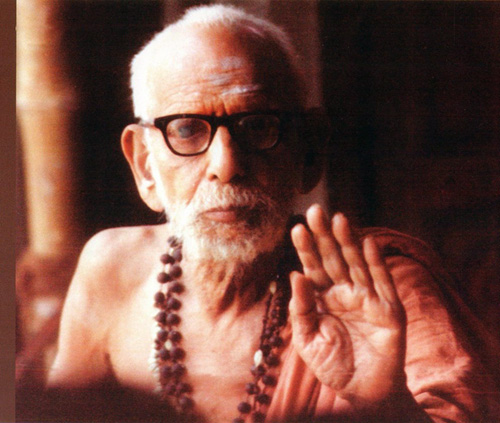
Another saint who played a significant role in Pichhai's life was Swami Gnanananda of Tapovanam in Tirukoilur. A respected figure who lived for a hundred and sixty years, Swami Gnanananda blessed Pichhai when she visited him. Songs of praise for him flowed spontaneously from Pichhai during her visit. Pichhai also had a miraculous escape from an accident while travelling to see Swami Gnanananda, which reinforced her faith in divine protection.
Pichhai's connection with saints wasn't limited to these experiences. She had deep interactions with Swami Krishna Bodhashram, who was moved by Pichhai's bhajans and recognized her spiritual greatness. He remarked that education in the worldly sense was unnecessary for souls like Pichhai, as their divine wisdom came from within.
One of Pichhai's most devoted disciples was Mahalinga Iyer, a renowned music critic who initially doubted Pichhai's compositions. After hearing her sing "Hey Kamakshi!", with perfect rhythm, meter, and melody, he was deeply moved and became one of her greatest admirers. He later ensured that Pichhai's songs were recognized and broadcast by the Music Academy in Madras.
Another notable devotee was Rajagopalaswamy, a Devi Upasaka who was advised by Kanchi Periyavar to seek Pichhai's guidance in constructing a Rajarajeswari temple. Periyavar also instructed him to initiate Pichhai into the Navakshari Devi Mantra to legitimize her role in guiding the temple's construction. In a divine trance, Pichhai provided detailed instructions for the temple's structure, which were later published in the form of hymns. The temple, known as Nanganallur Rajarajeswari in Madras, was completed in six years, following Pichhai's vision.
In her later years, Pichhai's compositions and spiritual legacy continued to grow, with many prominent figures acknowledging her divine gift. Her songs, filled with devotion and wisdom, remain a testimony to her deep spiritual connection with the divine. Even in her final years, Pichhai's devotion to Lord Muruga, her humility, and her willingness to serve others shone through, leaving an indelible mark on all who knew her. 13 —
(series concluded)
Announcement: Daily Live Streaming
Ramanasramam is live streaming each day, 8-9.30 am and Mon-Sat, 5-6.45 pm IST, which includes the Vedaparayana, puja and Tamil Parayana and. To access Ashram videos, go to: https://youtube.com/@SriRamanasramam/videos
In Focus: Novermber Edition
For the September edition of In Focus, copy the following URL into your browser October Infocus
Events in Sri Ramanasramam: Navaratri
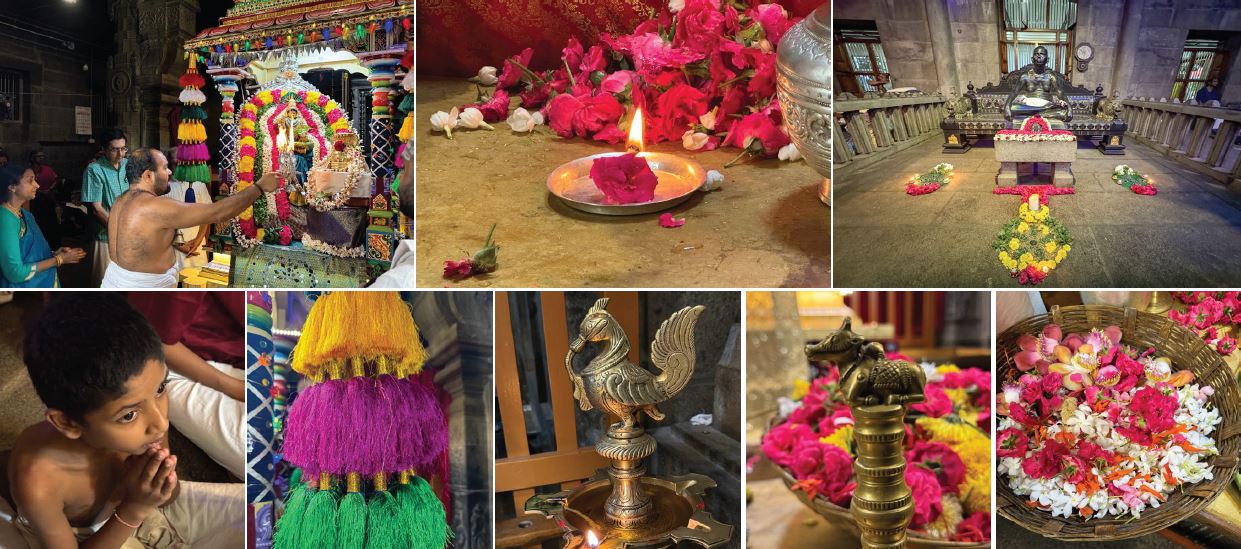
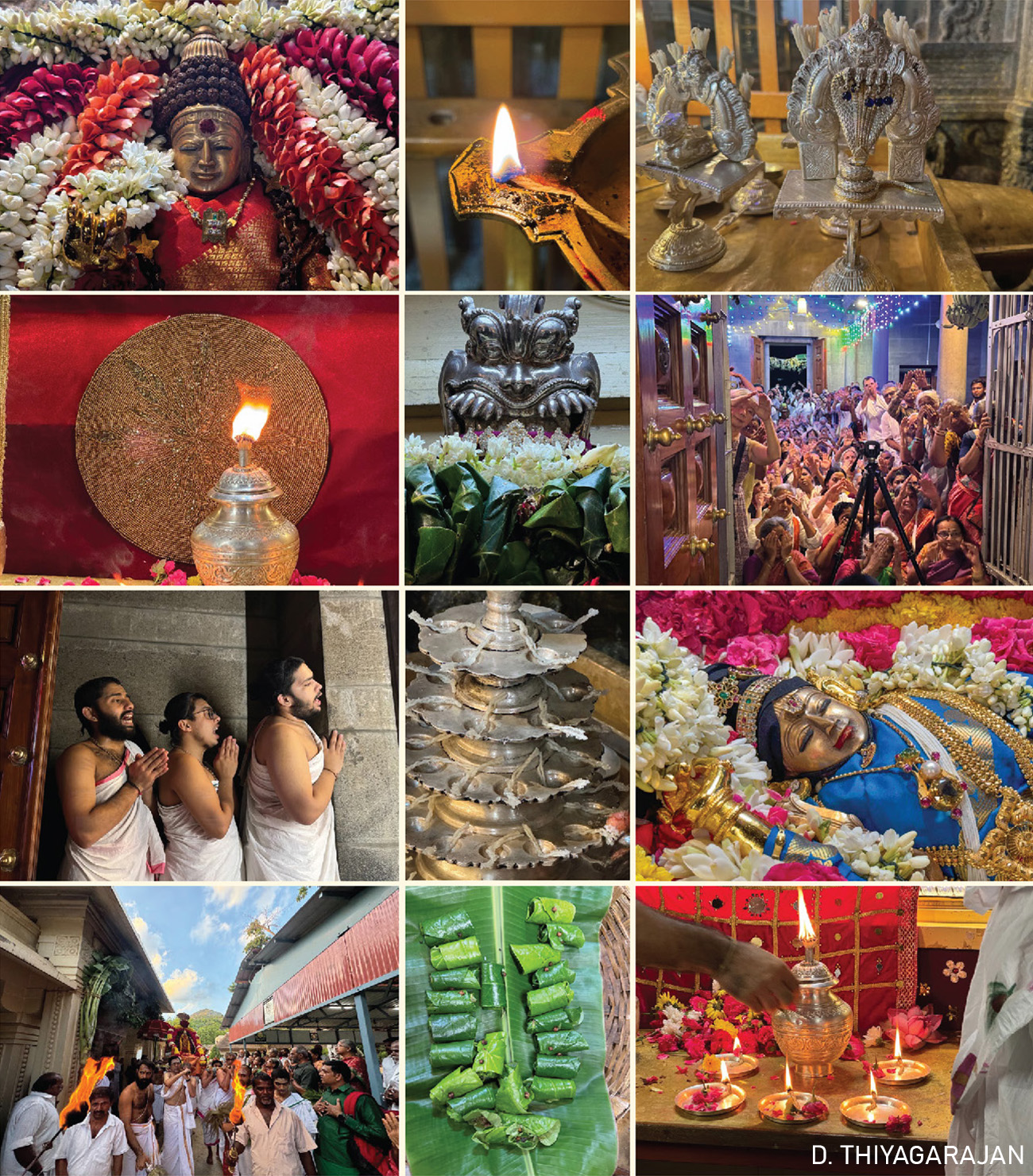
Sri Ramanasramam Navaratri is the annual festival observed in honor of the goddess Durga, spanning nine nights, in the month of Aswini (September–October). The alankaras this year began on 3rd October with Meenakshi, followed by Gajalakshmi on Friday the 4th, Tapas on Saturday the 5th, Linga Puja on Sunday the 6th, Rishabha Vahanam on the 7th, Sesha Sayanam on the 8th, Venuganam on the 9th, Saraswati puja on the evening of the10th and Mahishasura Mardini observed on Friday evening 11th October. —
Iconography of the Mother’s Shrine: Utsava Murthi Yogambika
Goddess Yogambika
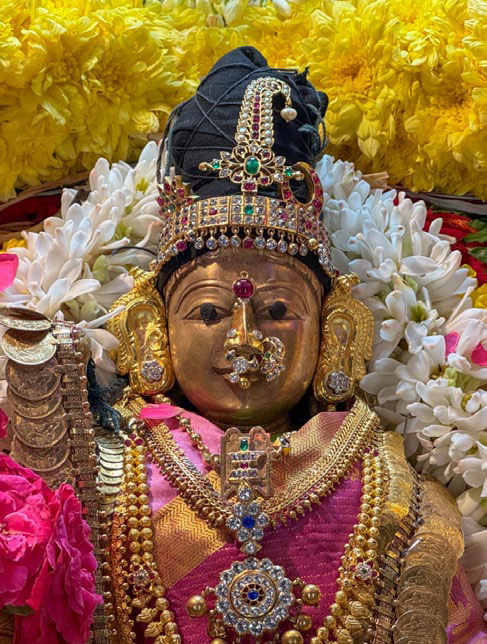
GODDESS YOGAMBIKA in Ramanasramam is an utsava murti or a processional deity used during the Navaratri festival. The portable utsavar serves as a substitute for the central idol present in the temple shrine, called the mulavar. Utsava from ut ('removal') and sava ('sacrifice') is a 'celebratory or festive joy' + murti means 'holy form,' = 'a festival deity' as colloquial understood.
Sri Ramanasramam's processional deity, Yogambika is a form of Mahadevi, the supreme goddess, sometimes depicted holding multiple weapons. She is revered as the mother of the universe and all beings. According to the Devi Mahatmyam, after Mahishasura was slain by Durga, the deities embarked on a pilgrimage to the Himalayas and sang a hymn in praise of the supreme goddess. Meanwhile, Goddess Parvati came to the source of the Ganges to bathe. She addressed the divinities, but before they could respond, she shed her outer corporeal form, revealing her true form, which was then named Ambika. In the Devi Bhagavatam, Ambika is described as the lineal progenitor of all the goddesses. Worshipped in many forms and names, her form depends on her mood. This is depicted in Ramanasramam Navaratri when Yogambika takes a new form each of the nine nights.
Sadhu Natanananda’s Upadesa Ratnavali §13
Isvara’s Attributeless Attributes
The Vedas glorify God as ‘omniscient’ only for the sake of those who think themselves to be people of little knowledge. [But] when keenly scrutinized, [it will be understood that] since God is by nature the real Whole [apart from which no ‘other’ can exist for Him to know], He does not know anything. — GVK §930
How can we assign attributes [like sajathi], namely, the distinction between one cow and another, [vijathi], the difference between a cow and a horse, and [swagatha], the difference between a tree and its branches to Isvara, who is Being-Consciousness-Bliss—the permanent unbroken whole? Why is it necessary to attribute powers like omniscience to Isvara when no such attributes could be possible [for the Supreme]? What value could attributes have for the one who is [supremely non-dual by His very] nature? The Vedas make these statements so that jivas may humble themselves. Entangled in the never-ending cycle of birth and death, unaware of their true nature (swarupa), jivas view themselves as a body and act accordingly. The Vedas initially attribute qualities like omniscience to Isvara out of grace, but this is simply to dispel the delusion of jivas and impart to them the ultimate truth. —
RAMANA REFLECTIONS
Simplicity and Self-Emptying in the Age of Quantity (Postscript)
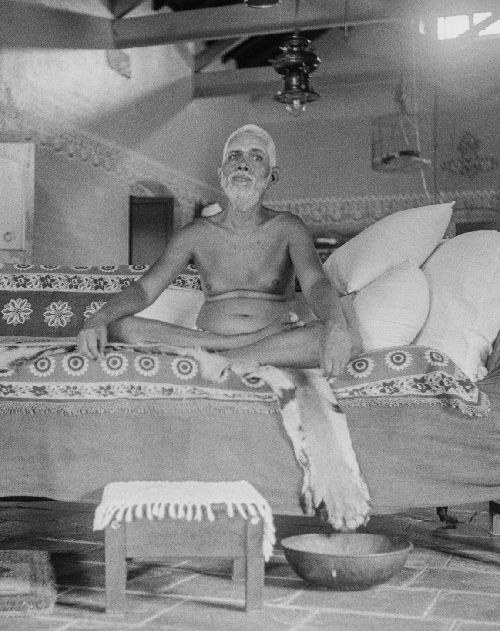
We saw in the last issue how, six weeks before young Venkataraman left home for Tiruvannamalai, he experienced an intense fear of death, wondering, since death is coming, what it was that was dying? This moment, charged with existential immediacy, became the turning point of his life.
In the process of deep inquiry, young Venkataraman overcame the illusion of a separate I. But one may wonder, how and why does this illusion arise in the question. This discussion involves fresh insights from
the sciences, not least of all human physiology which reveal that the human nervous system, which has its own laws, may play a role in the illusion of a separate self.
Modern neurobiology can help us understand how the autonomic nervous system, which evolved to guard against threats and enhance survival, has become hard- wired into our bodies and minds over millions of years.
Our ancestral nervous system can be traced back to the era of our reptilian forebears, around 220 million years ago. This hard wiring ensures that we react swiftly to potential threats. We see it at work in our daily lives. For instance, imagine a speeding vehicle suddenly appearing in our path. To avoid danger, our autonomic response system overrides other bodily functions, suspending digestion, higher cognition, and any awareness of discomfort and focusing solely on survival. We become in that moment reflexive beings, where the thinking mind (buddhi) is put on pause, giving way to motor reflexes.
Autonomic reflex is our body's innate intelligence (manas), which functions below the level of conscious thought, a mechanism designed to save our lives. But what happens if this system stays activated, keeping us in a state of perpetual vigilance? What if we cannot distinguish between genuine threats and benign conditions? What if the relentless pace of modern life keeps us in a state of fight or flight, even when there is no immediate danger?
Many in the contemporary world experience a constant low-grade state of threat, a by-product of the autonomic struggle to adapt to the barrage of stimuli in our high-speed, high-stress world. In a chronic threat state, signals from the brainstem proliferate and send messages of alarm to our visceral organs, leading them to prioritize survival over functions essential to growth, renewal, and cognitive clarity. These organs, kept in a hyper-ready state, are unable to repair, heal, or return to their natural rhythms. If prolonged, this can cause disruptions to long-term health and aggravate anxiety and stress.
If this constant state of alert becomes the default for individuals in the modern world, then anxiety will become increasingly prevalent. Threat responses high- jack the feedback loops between the brainstem and visceral organs, causing the system to perform in ways that are not suited to actual conditions. This can make it difficult to navigate everyday tasks with calm and clarity. Higher cognitive functions—such as learning, decision- making, and social engagement—are thwarted, limiting our ability to handle life's demands with grace and ease. The challenge is compounded by the accelerated pace of the world, marked by technological innovation, virtual communications, constant connectivity, and the digitally driven demands made on us daily as well as the tight schedules they entail. Our task is not to avoid modern life but learning to skilfully navigate it. Cultivating awareness of internal and external cues to discern when we are in a state of threat is key. Only by crossing this awareness threshold can we learn to adapt and become resilient amid life's rapid shifts.
On the other hand, if missing an appointment or being late for work feels as threatening for us moderns as encountering a sabre-toothed tiger felt for Paleolithic humans, then we are in trouble. Our physiology is not designed to bear that kind of tension for extended periods. Finding ways to adapt to the demands of the modern world is where Bhagavan's vichara is useful.
Imagine leaving for work to attend an important meeting, when, and at the last minute, your spouse asks you to take your son to school, causing a delay. While rushing to catch the train, you find the public transport is suffering a technical glitch, further impeding your progress. You take out your cell phone to notify your boss, only to discover your battery is low. Just as you attempt to send the SMS, the phone dies. Arriving to the office late, you find the meeting has already begun, and your boss shoots you an unflattering glance.
You sit down, struggling to focus as the events of the morning replay in your mind. Just then, you are called upon but find yourself unable to adequately reply. Your inability to respond leaves you feeling humiliated in front of your colleagues, amplifying your distress. That night, you lie awake, reflecting on your day, grappling with feelings of inadequacy and shame. Such situations become fertile ground for inquiry.
Complexity
When we speak of complexity, we often think of data, artificial intelligence, or vast digital networks. Yet, the complexity most relevant to our well-being is internal, arising from a lack of literacy concerning the body- mind's inner
states and unskilfulness in regulating them. The true complexity lies in a dysregulated autonomic nervous system and our (cognition-centred) reactions to it. When the nervous system is aroused, we are vulnerable to distortions in
viewing the external world. The result is that even routine tasks become overwhelming, not because of any inherent difficulty but because the autonomic state of fight or flight disengages circuits meant for creativity, connection, and
learning.
Ironically, the complexity of modern life is not in the external world but in the fragmented, anxious way we perceive and react to it. As Sri Ramana reminds us:
If you consider yourself the body, the world appears to be external. But when you are the Self, the world appears as Brahman.1
In other words, it is not outer conditions but our inner state that shapes experience. If we address the roots of internal turmoil through inquiry, we begin to see the world as it is—free from projections born of unprocessed fears.
Layers of Autonomic States
The autonomic nervous system operates on instinct, instantly processing signals from the environment before conscious thought intervenes. As a result, we often find ourselves responding automatically to situations without understanding
the deeper layers of what's occurring within us. The autonomic nervous system reacts much more swiftly than the conscious thinking mind. Broadly speaking, we experience three primary autonomic states:
1. The Threat State: Triggered by the fight-or-flight response, this state is crucial for survival. However, chronic activation of this state can make it challenging to relax, leading to persistent anxiety and stress.
2. The Freeze State: A response to extreme danger, the freeze state leads to shut down or dissociation, often manifesting as numbness or a sense of helplessness.
3. Homeostasis: A state of ease which allows us to engage socially, communicate openly, and pursue growth and recovery.2
In the earlier example of arriving late to a business meeting, our hero may have entered a mild threat state, where essential social engagement functions were inhibited. In the first minutes after arrival, his threat response deactivated organs required for social interaction. Processing the verbal interactions was made difficult because autonomic threat prevents activation of the muscles of the middle ear that allow for recognising human speech. The threat state impairs cognitive clarity and social awareness. The person may feel shame for not being 'alert', unaware that the autonomic nervous system has momentarily restricted the social engagement system, giving priority to survival.
Identifying states of arousal allows us to be self- compassionate, replacing self-criticism with self- awareness. There is no benefit in berating ourselves for reflexive, autonomic responses, as they are not within our immediate conscious control. In fact, recognizing the utility of the threat state in contexts like athletics, where the body primes itself for optimal performance, helps us understand that this same response system is less suited for moments requiring calm deliberation, like negotiations or social engagement.
A track-and-field athlete about to run a 100m race will hyperventilate to oxygenate the blood and stimulate the sympathetic nervous system associated with threat.
This causes the visceral organs to reduce their functions (including the thinkingmind) so that thebodycanbeready for a burst of power. But having the same autonomic activation when entering an important meeting handicaps us precisely because the mechanisms that allow for social engagement and cognitive processing are in abeyance. Our work lies in cultivating a literacy of states and the ability to regulate them when they are mismatched. If an unwanted threat state arises—colloquially understood as 'anxiety'—we take steps to soothe the nervous system toward a calmer response. This requires care, as, after all, coercion or desperation will exacerbate the very threat we are aiming to calm.
Self-Regulation
How does gaining awareness of autonomic responses relate to Bhagavan's self-inquiry practice?
In inquiry, we are refining awareness of inner states, beginning with relaxed observation of the body and mind. Self-regulation techniques create a supportive baseline from which inquiry becomes more accessible. Deliberately lengthening
exhalations, as in pranayama, for example, can help calm a threat state. Spending time with a trusted friend or family member in times of stress can calm hyper-arousal. Monitoring states throughout the day can help us identify
a threat when it arises and sometimes we just have to momentarily step away from a stressful situation and take a break from the physical environment that is causing our apprehension.
In the case of extended periods of autonomic arousal, we may try visualizing a family member and recall the feelings of unconditional love they elicited in us. Similarly, we can practice gratitude, even amidst adversity, by sending compassionate thoughts to friends or acquaintances who have shown us kindness. These interventions help us address threat responses directly.
There is, however, one master intervention, namely, cultivating the capacity to be aware when we are in a threat state. Acquiring this ability can help us come free of threat states and the anxiety they bring with them.
By implementing these simple interventions, we learn how to inquire into the state of the heart and mind, and to assess the quality of whatever arises at any given moment. This preparatory vichara involves questions like: Who is investigating? Who is assessing?
Awareness about what is going on within us allows us to take steps toward autonomic nervous system balance, laying the ground for vichara practice in its more classical form.
Self-Inquiry and the Trance of I
From a psychophysiological perspective, the chronic threat response feeds the trance of 'I'. This is why we perceive ourselves as separate from others and in need of constant protection. In reality, the autonomic nervous system is the
master of ceremonies, the one in charge and not the ego, even if the latter ever indulges narratives, judgments, and self-definitions to bolster its sense of separateness.
Through inquiry, we discover that our identifications are only veils covering what lies deeper. Bhagavan encourages us to ask, Who am I? or Who is feeling anxious? Questioning shifts our attention from identification with transient experiences toward awareness of the witnessing Presence. Inner calm allows us to question deeply and perceive that our true Self is beyond fleeting mental states and the reactive mind.
Embracing self-inquiry and investigating the 'I' that arises with each autonomic reaction is the first step toward freedom. It turns out there is no need for ego's incessant control. Breaking free from the illusion of a separate self and the trance of I means returning to the silent, undivided awareness that is our true home. —
Similes from Bhagavan: Waves of the Ocean
Countless vishaya-vasanas (subtle tendencies of the mind in relation to objects of sense-gratification), coming one after the other in quick succession like the waves of the ocean, agitate the mind. Nevertheless they too subside and finally get destroyed with progressive practice of atma dhyana or meditation on the Self. Without giving room even to the thought which occurs in the form of doubt, whether it is possible to stay merely as the very Self, whether vasanas can be destroyed, one should firmly and unceasingly carry on meditation on the Self. — Who Am I? §13
Navaratri: Suvasini Puja
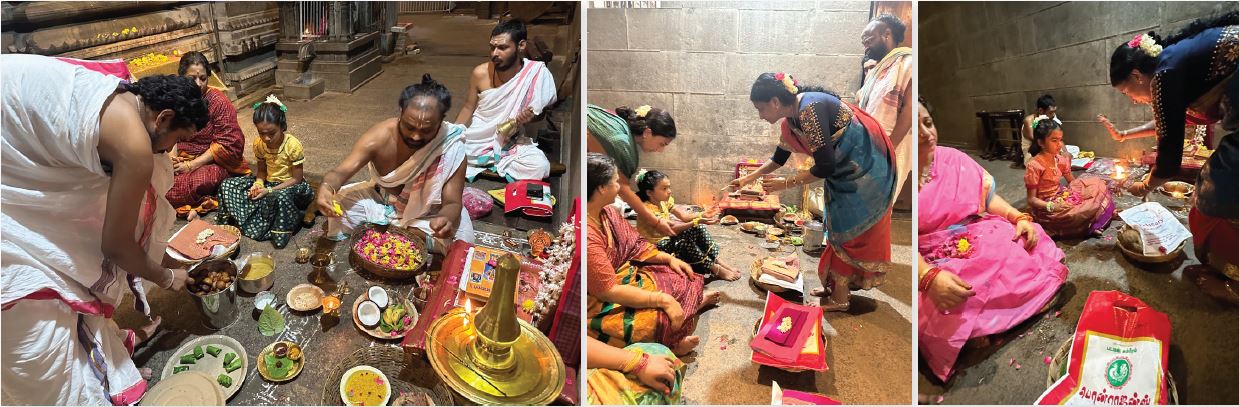
Suvasini puja, also known as Suhasini puja, is observed during Navaratri to honour the feminine divine presence embodied in a married woman, or sumangali, as a manifestation of Goddess Durga. Often, a young maiden or child is worshipped alongside her elders, symbolizing the universal presence of Devi across all ages. These auspicious pujas, performed close to the sanctum sanctorum, are believed to resolve various life challenges and bring blessings. Participants offer fruits, saris, and other gifts to the sumangali, followed by arati and prostrations as expressions of reverence for the goddess.
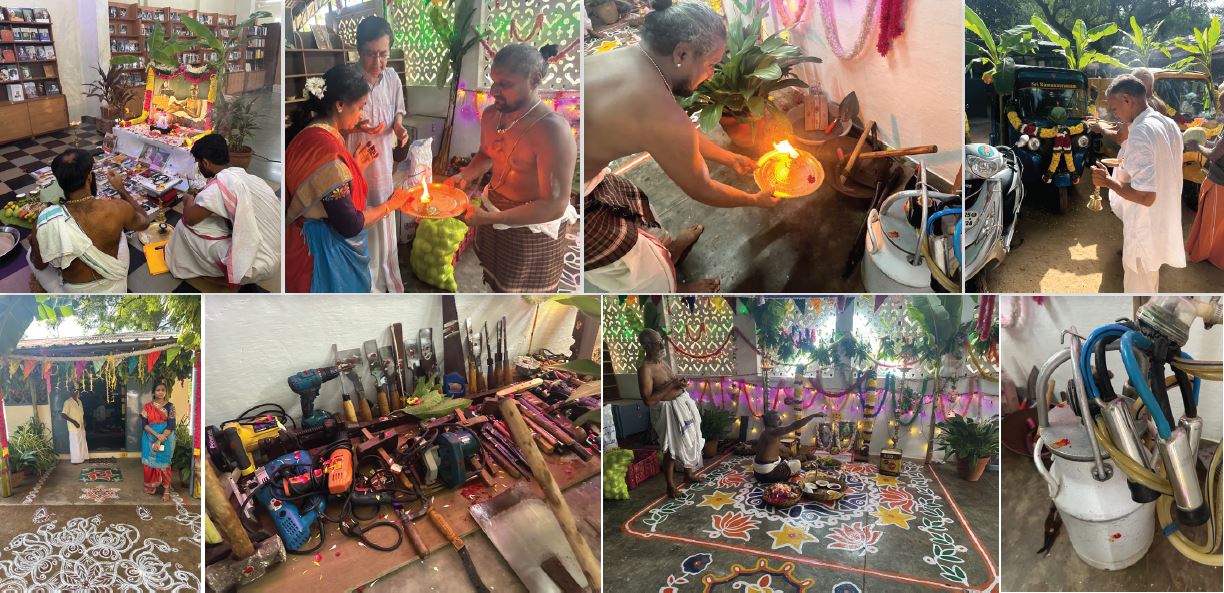
Events in Sri Ramanasramam: Saraswati Puja at the Bookstall and Carpentry Shop
Tiruchuli and Madurai Schools
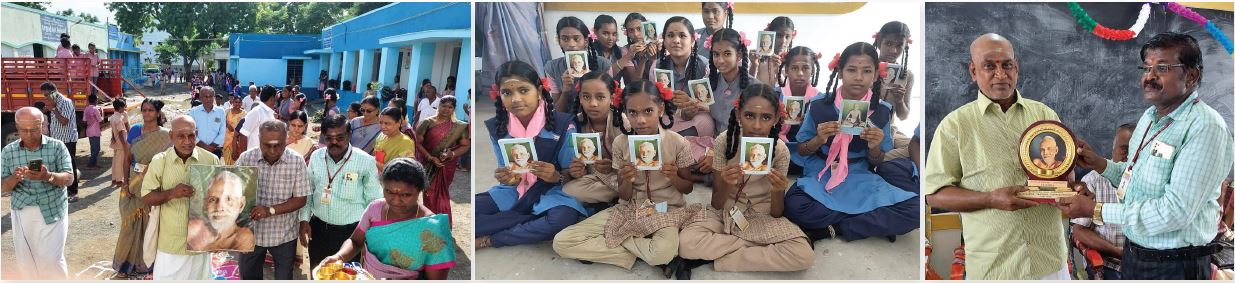
In 1994-95, Dr. Bhatiani family (Delhi) donated Rs.35,000 to carry out an urgent renovation to Tiruchuzhi School where Sri Bhagavan studied in 1885-90 (inaugurated by Sri. V.S. Ramanan with a stone plaque).
In 1995, Dr. Gargi Keeni donated more than Rs. 2 lakhs to provide desk and benches for the Tiruchuli School and a classroom for Madurai U.C. School.
From then on, Madurai Ramana Kendram supplied notebooks and annual monetary prizes to students scoring high marks, amounting to more than Rs. 1 lakh each year.
In 2013, Sri Ramanasramam sponsored Rs. 40 lakhs for a library in Tiruchuli which was inaugurated by Ashram officials and Dr. Ilaiyaraaja.
On 12th October 2024, a new building with six classrooms was inaugurated at the Sethupathi Government High School at a cost of Rs. 80 Lakhs. The desks and benches were supplied by Tirunelveli Pushpalata School and fan and lights were supplied by Madurai Ramana Kendram.
Best Shot: Navaratri Preparations
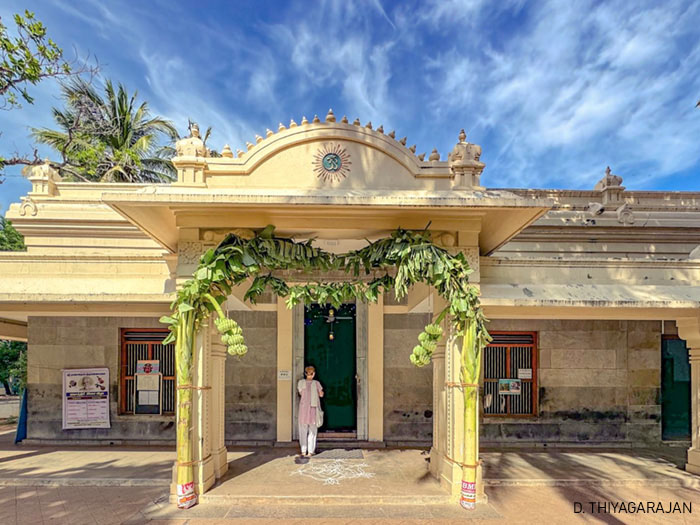
Under a boundless sky, there's a stillness that feels timeless, untouched by the upcoming celebration. The air holds a quiet anticipation as colourful decorations and festival lights emerge, adorning the inner Ashram environs. Some move about quietly though their excitement is growing. The sky remains calm, its tranquillity contrasting the imminent festival's energy—a reminder of the presence that shall sustain a most joyful celebration at the foot of Arunachala. The blue canvas above waits as final preparations are underway in anticipation of the deity's appearance at sundown.
Verses for the Ashram Centenary
A Mother's Tomb
Oft have we seen the Sun
Reveal the form
Of this our glorious Hill,
If not its subtle influence.
Naught could be so fair,
So far beyond compare,
As this,
God's Holy Hill.
And did not
The peerless Voice of the Hill
Foresee that when his Mother
Left her body
It would rest
In what might have been
The selfsame spot where he himself
Had taught an ageless wisdom
To the sons of Brahma
So long before?
And so it was
That when she passed away
That peerless Sage
Came down from the Hill
To that same spot,
To found a Sanctuary,
A Fount of
Wisdom and Grace
For this our present age.
Endnotes
- 1 Saranagati, September 2024, pp. 3-6.
- 2 The Gift of God or Andavan Pichhai, Smt. Radha and Dr, Krishna Rao, A Divine Life Publication, 1983, pp. 38.
- 3 Ibid., p. 43.
- 4 Ibid., pp. 43-46.
- 5 Ibid., pp. 41-43.
- 6 Ibid., pp.57-58.
- 7 Ibid., pp. 57-78.
- 8 Ibid., pp. 78-83.
- 9 A well-known saint of that day.
- 10 See Saranagati October 2024, p. 5 regarding Siddha Ramakrishna taking ‘rebirth’ in Pichhai
- 11 Ibid., pp. 98-105
- 12 Ibid., pp. 108-122.
- 13 Ibid., pp. 124-141.
Publisher: Dr Venkat S. Ramanan
saranagati@gururamana.org
