Saranagati Banner
SARANAGATI
SRI RAMANASRAMAM
JUNE 2026
Vol. 20, No. 6
Saranagati June 2026 Cover

Dear Devotees,

In this issue, we complete the life story of Swami Ramanagiri who came to Bhagavan in 1949 and sat in the hall in Bhagavan's presence for forty days. Bhagavan continued to appear to him through dream even after Bhagavan's Mahanirvana in April 1950 (p. 3ff.).

In Ramana Reflections: Cultivating the Doubt Sensation (Part III), we see how resistance complicates what needs overcoming, and how samskaras can lose their harmfulness when brought into awareness. As true inquiry redirects our attention from mental objects to the hidden source, Bhagavan calls us to depart the dry dock of ideas and enter the sea of practice (p. 10ff.).

We lament the loss of Smt. Bala Saraswati, age, 102, a member of the beloved Gridilur family, long-associated with Sri Bhagavan, who passed away last week. We will look at her life in the August issue of Saranagati.

For videos, photos and other news of events: https://gururamana.org or write to us at: saranagati@gururamana.org.
For the web version: https://sriramana.org/saranagati/May_2026/

In Sri Bhagavan,
Saranagati


Calendar of Ashram Events

JUNE 2026
9th Jun (Tue) Maha Puja
26th Jun (Fri) Cow Lakshmi Samadhi Puja
12th Jun (Fri) Pradosham
27th Jun (Sat) Pradosham
17th Jun (Wed) Punarvasu
29th Jun (Mon) Full Moon
JULY 2026
12th Jul (Sun) Pradosham
25th Jul (Sat) Kavya Kanta Ganapati Muni Day
14th Jul (Tue) Punarvasu
26th Jul (Sun) Pradosham
23rd Jul (Thu) H C Khanna Day
29th Jul (Wed) Guru Purnima (starting 28th night)
In Profile

Swami Ramanagiri (Part III)

Audio: IN PROFILE
0:00 / 0:00
Swami Ramanagiri

In the first two issues we saw how Ramanagiri came to India after a long search marked by solitude, moral seriousness, personal loss, and dissatisfaction with conventional religion. Influenced by Swami Vivekananda, he arrived in India in 1947 and spent time in Almora with the Danish mystic Sunyata, who recognized his sincerity and directed him to Bhagavan Sri Ramana.

Per reached Tiruvannamalai in January 1949. Sitting silently in Bhagavan's darshan hall, he absorbed teachings that turned attention away from speculative thought toward the inquiry, "Who am I?" A letter attributed to him describes how he practised in the caves of Arunachala:

I sat with closed eyes and asked constantly: 'Who am I?' Thoughts came like visitors and tried to distract me. Each time I answered them with the Lord's name until the mind grew quiet and merged into stillness.1

While at Ramanasramam, Per had a dream in which Bhagavan appeared as light and answered his doubts. Following forty days of inquiry, on 26th February 1949—Mahasivaratri night, Per underwent a decisive breakthrough in Bhagavan's presence. Per later writes:

Out of all human beings, 108 are chosen. Out of these 108, nine are selected. Out of these nine, seven go mad. One goes knowingly back to maya, and one goes to the Supreme.2

Bhagavan's Devotees

Among the many devotees who passed through Sri Ramanasramam in early 1949 were individuals who later played important roles in Per's life. Photographs from 1949 show him with Dr. TNK, the lawyer S. Doraiswamy Iyer, and Ramana's attendant Vaikunta Vasar.

Later that spring as temperatures rose in South India, Per made his way northward to stay with Sunyata. During this period Per continued his spiritual practice centred on inquiry and underwent several initiatory experiences that prepared him for renunciant life. He stayed with Sunyata in the summers of 1948, 1949, and 1950.

Per is thought to have undergone monastic initiation in the Dasanami monastic order, an ancient lineage said to be founded by Adi Shankara. Under the guidance of a guru belonging to the Giri branch of the order, Per received diksha. Formal renunciation entailed abandoning personal possessions and wearing the ochre robes of a wandering monk. From that point forward he was known simply as Giri. He renounced family ties, social identity, and material security in order to dedicate himself entirely to meditation, study, and the path of realization.3

Sunyata later wrote that Bhagavan Ramana had given Per the name Ramanagiri. This is unlikely as Bhagavan Ramana was not in the habit of changing people's names. A more likely scenario is that Per adopted the name voluntarily, adding "Ramana" to the monastic title "Giri" he had already received from his initiating guru. The new name symbolized a decisive break with his earlier life. He had left behind his country, language, and social identity to follow the path of renunciation.

Local accounts claim that Ramanagiri attained enlightenment in 1949, but we know from his own testimony that he continued practising self-inquiry after this experience, which would suggest the breakthrough in Bhagavan's darshan hall had been an important opening but not realisation.

Pada Yatra

It seems that Ramanagiri's movements during the remainder of 1949 included a long pada yatra (pilgrimage by walking) through southern India, visiting temples across Tamil Nadu and Kerala. The journey would have likely brought him to Tiruchendur, Palani, and Vadipatti near the Sirumalai hills, where his own ashram later came up.4

Bhagavan's Mahanirvana

While Ramanagiri was on pilgrimage in South India, Bhagavan's condition worsened and was diagnosed as malignant sarcoma. Several operations were performed, along with radium, homeopathic, herbal, and Ayurvedic treatments, but the tumour repeatedly appeared and eventually spread throughout the body. Despite severe pain, anaemia, and physical weakness, Bhagavan remained serene, light-hearted, and utterly unconcerned. When amputation of the arm was suggested, he refused, saying, "The body is itself a disease. Let it have its natural end."5

Throughout the illness, Bhagavan submitted to treatments, not from personal desire to be cured, but to calm the fears of devotees. He repeatedly taught that the body was not essential, and that the Self could neither suffer nor die. He accepted bodily pain without identifying with it. He continued his normal Ashram duties, namely, correspondence, publications, and attention to devotees.

Even in the final days, Bhagavan insisted that his devotees be allowed darshan morning and evening. He comforted those who feared his death, saying, "They say I am dying, but I am not going away. Where could I go?"6

On the final evening, while devotees sang 'Arunachala Siva', Bhagavan's eyes opened, tears of bliss appeared, and his breathing quietly stopped.

The next day his body was interred between the Old Hall and the Matrubhuteswara Temple, where his samadhi became a place of meditation. Government archival video footage shows Swami Ramanagiri paying his respects.

Pondicherry

Following Bhagavan's physical departure, most devotees took leave from the Ashram. It was as though they could not bear being in Bhagavan's Ashram without Bhagavan in the physical form.

In coming years, however, devotees would return, saying they felt not absence but a deepened presence as Bhagavan's living grace and guidance somehow mysteriously remained at the Ashram.

In late April, Ramanagiri travelled to Pondicherry. At that time, Henri Cartier-Bresson was visiting Aurobindo Ashram. Sri Aurobindo, then seventy-eight years old, rarely appeared in public, but Cartier-Bresson managed to photograph him together with his spiritual collaborator Mirra Alfassa, known as "the Mother." The photographer had only recently documented the Maharshi's final days.

Among the images from Pondicherry is a photograph dated 23rd April, 1950, showing Ramanagiri bowing respectfully before the Mother and handing her a note. The contrast between Bhagavan Ramana and Sri Aurobindo impressed Ramanagiri:

This Aurobindo expresses the most complicated thing in a complicated way. This Bhagavan Ramana expresses the simplest thing in a simple way.7

The remark highlights the difference between the two. Aurobindo emphasized a collective transformation of humanity through the descent of higher consciousness. Bhagavan Sri Ramana focused on an inward search for the Self through inquiry and simplicity.

Madras

Swami Ramanagiri's biographer tells us that during this time Ramanagiri stayed in Madras with Srinivasa Parthasarathy, a wealthy supporter who became both patron and father-figure. From a prominent family, Parthasarathy was the brother of Gandhian activist Ambujammal and later became Swami Anvananda, founding a temple to the Divine Mother at Ambattur, Chennai. Through him, Ramanagiri entered a circle of educated devotees, including K. C. Sastri of Prithvi Insurance. These connections gave practical support and deepened Ramanagiri's devotional interest in Arunagirinathar and his Thiruppugazh—the devotional verses on Lord Murugan.

Vision on the Beach

A dramatic episode occurred on the beach south of Madras near the Theosophical Society at Adyar.

Ramanagiri was walking in the gardens near the Theosophical Library when he experienced a vision of Bhagavan Ramana, who beckoned him to follow. He walked south along the shoreline to the fishing village of Tiruvanmiyur, where he sat down to meditate. On the subject of meditation Ramanagiri later wrote:

It's a play with toys, but not a play for children. It is a mad play, and when one doesn't know it's a play, one suffers badly. Meditation is … not for the weak.8

When his host in Madras could not locate him, a search was organized. Eventually he was found motionless in deep meditation on the beach. A small palm-leaf shelter was constructed to protect him from the sun.

Ramanagiri reportedly refused to leave, saying that Bhagavan had instructed him to remain there.9

During this time, he lived in extreme simplicity. Food was brought to him, though he often gave it away to fishermen who gathered around him. He later mused:

Learning is learned ignorance. Unlearning is learning.10

Eleanor Noye

In the years prior to Ramanagiri's arrival in India, the American, Eleanor Pauline Noye came to Bhagavan on a journey that "began in anguish". Though the exact source of her suffering is uncertain, she became known at Ramanasramam as the "weeping widow". There was talk that she had been abandoned by her husband, a New York banker. Years of grief and sleeplessness left her physically and emotionally broken. Feeling inwardly urged to travel, she tried to sail for India but repeatedly fell ill. At last, with great effort, she reached Sri Ramanasramam in late 1939.

Her first meeting with Bhagavan was transformative. After years of insomnia, she slept soundly on her first night at the Ashram. Her strength returned, her mood lifted, and she felt Bhagavan's peace enter her heart.

A few days later, as Bhagavan came down the Hill, he asked in English, "Do you have more peace now?" She replied, "Yes, I do."

Her devotion deepened quickly. Bhagavan told her, "Get rid of the notion 'I am impure'. The Self is ever pure."

When the time came for her to return to America, she found herself unable to board the ship in Madras, cancelled her ticket at the harbour, and came straight back to Tiruvannamalai, feeling she was returning home.

Ashram life became her joy. However, in 1940, family duties drew her back to America, but she remained inwardly connected through letters, awaiting the opportunity to return to the Ashram.

In 1949, Eleanor finally got her chance. She had learned that Bhagavan was not well and made the determination to come. She took a steamer through the Suez Canal and when she reached Madras, took the train to Tiruvannamalai.

She stayed with the Maharshi up to and beyond Bhagavan's Mahanirvana. Afterward, while overnighting in Madras, she had a dream where she was instructed to feed two sadhus living on the beach nearby in Tiruvanmiyur. She didn't know from the dream who the sadhus were. As it turned out, both were connected with Bhagavan, namely, Vakeel Swami (Swami Suresananda) and Ramanagiri, who she knew from the Ashram. The two sadhus were living on fruits and tender coconuts, but had nothing to eat that day. They would have had to walk two miles to reach the nearest village.11 Suresananda's biographer narrates:

Reluctantly the two remained hungry, but soon there was a knock at the hut door. A lady with a big tiffin carrier had brought cooked rice meals for both the swamis. She had come as a result of a dream which had directed her to serve them. The lady was Eleanor Noye, an American devotee of Sri Bhagavan.12

Eleonor Noye and Bhagavan in June 1949, photos by Ramana Giri

A Letter to Sunyata

Ramanagiri described his beach experiences in a letter to his friend Sunyata:

I have sailed away to a place which cannot be described by words…Some call it nirvikalpa, others satchitananda or God. The steamer that carried me there is called the mind.13

In the letter he recounts how, while visiting the Theosophical Library, he saw Ramana Maharshi appear before him and guide him toward the sea. During the night, kundalini energy rose to the crown of the head and the individual self merged into the Self. The sound of the ocean waves chanting 'Om' gradually brought him back to ordinary awareness.

When he regained consciousness, he discovered that much of his memory had vanished. Events from early life seemed distant and unreal. Gradually, however, memories connected with spiritual experience began returning. The episode marked a turning point.

Sunyata Comments

Sunyata later interpreted Ramanagiri's letter as the culmination of the young seeker's spiritual journey. Sunyata praised Ramanagiri who had come a long way on the spiritual path in only eight years.

Sunyata believed that the intense sadhana had been too much for the body which contributed to Ramanagiri's early demise. Western seekers, he argued, often practiced too rigorously without the gradual grounding recommended in traditional teachings. Nevertheless, Sunyata regarded Ramanagiri as a rare individual who had become "one in a million," a seeker who had crossed beyond ego into boundless awareness.

Despite such praise, Ramanagiri himself insisted that he was not a guru. He often told visitors:

Bhagavan Ramana did not entrust me with a mission to make disciples. I am no one's guru, and no one is my disciple.14

Nevertheless, people gathered around him. In one of his notebooks, he wrote humorously:

Why people come to this ignorant fool, God only knows. He cannot cure diseases, make people rich, or fly through the air.15

Despite Ramanagiri's reluctance, the quiet intensity of his presence drew others. A small circle gradually formed around him: K. C. Sastri, Ramu, Kalyanam, and several devotees in Almora and Bombay. Many maintained contact through letters. Ramanagiri's correspondence shows a mixture of spiritual guidance and practical advice. K. C. Sastri received detailed instructions on meditation and observation of the breath during self-inquiry. Others were encouraged to strengthen their bodies and minds in preparation for deeper practice.

Ramanagiri Ashram

Around 1952, Ramanagiri began to establish his own ashram. Letters from that period reveal the vision of a small spiritual community supported by agriculture. The aim was simple—a place where seekers could live quietly, meditate, and cultivate the land for food.

With the help of Balu (Balasubbiah), land was eventually purchased near Vadugapatti, north of Madurai. Balu arranged the legal registration since Ramanagiri was still a Swedish citizen.

The location was chosen after Ramanagiri had an experience of directly seeing Bhagavan Ramana's feet beneath a banyan tree near the Sirumalai hills. The place was therefore named Ramana Padam—"the feet of Ramana."

By early 1953 several acres had been purchased. Ramanagiri envisioned rice fields, vegetable gardens, and fruit trees that would allow the community to live independently while also feeding the poor.

Construction progressed slowly but steadily. The site was bustling with activity—labourers carried earth for foundations, and wells were dug to provide water.

Ramanagiri joked to one correspondent that the once quiet place had become "a dusty city."

Despite the work, he continued to guide visitors. Some came sincerely seeking help; others came out of curiosity to see what he called "the half-naked Westerner." In June 1953 he settled permanently at the new site.

Daily life at Ramanagiri's ashram began before dawn with puja, japa, yoga and meditation. From new moon to full moon, he observed strict silence and seclusion, receiving food through a small opening. Meals were simple and vegetarian; leftovers fed the poor. He regularly visited Madurai's Meenakshi Temple.

Tuberculosis

During his years at Kutladampatti where Ramana Padam Ashram is located, Ramanagiri's health steadily declined. As early as autumn 1950, he sought medical help in Madras, later describing his illness not merely as physical but as the exhaustion of karmic residues in the body.

Tuberculosis was still widespread at the time and often fatal. Though new treatments had begun to appear in the late 1940s, resistance was common. Whether Ramanagiri received the latest treatment is uncertain. Some accounts suggest he may have contracted the disease during a period of intense austerity and meditation on the seashore near Madras in 1950. Photographs from this period onwards show him noticeably thin and weakened.

Yet Ramanagiri accepted the illness with remarkable ease, seeing bodily suffering as part and parcel of the burning away of karmas. For him, the body's decline was not central; the Self remained ever untouched. Despite worsening health, he continued receiving visitors and offering guidance as long as his strength permitted. He also abounded in joy:

O Father, let every human being be happy. Let every creature have peace and blessings. Help the parents who once gave me a gross form to realise You.16

Final Days

By 1955 Ramanagiri's health had become severely compromised. During his final weeks he stayed at the Ramalinga Tuberculosis Sanatorium, in Perundurai, near Erode, and is reported to have passed away there.17

Even in extreme weakness he remained cheerful. When visitors worried about him, he reportedly said, "It is the body that suffers. I am fine."

Shortly before his departure, he lay quietly assisted by a close disciple, and entered deep meditation. It is said that he heard Bhagavan Ramana calling him, "We may go."

Swami Ramanagiri breathed his last on 23rd May 1955. His body was taken to Ramana Padam, the site he had named in honour of his guru, and was interred. A Siva lingam was installed at the site.

Following the departure of Swami Ramanagiri, the ashram he founded grew to four hectares, under Balu family care.

Swami Ramanagiri left only a small body of writings, mainly aphorisms and letters later compiled as Cold Fire and Foolish Wisdom by a Wise Fool. His teaching emphasized direct experience over speculation—religion had to be practised, not merely discussed.

At its heart was Bhagavan Ramana's self-inquiry, by which attention is turned inward until the separate ego dissolves. Ramanagiri stressed silence, seclusion, watchfulness, and ethical discipline, warning that the ego manipulates emotion and justifies selfishness. His final instruction was simple: "My last word is — BE."18

For him, true bliss was not a passing feeling but the ground of being. Yet even bliss could not be possessed:

To become bliss is very different from merely enjoying it.19

(series concluded)

1 Sunyata, Dancing with the Void, p. 59.

2 Cold Fire, (trans. from Swedish by Ulf Odehammar).

3 Ulf Odehammar.

4 Odehammar notes that a residence permit issued in Benares on 8th September 1949 allowed him to remain in India for another year.

5 Arthur Osborne, Maha Nirvana.

6 This section adapted from Arthur Osborne's Maha Nirvana.

7 Foolish Wisdom by a Wise Fool, as indicated by Ulf Odehammar.

8 Cold Fire, (trans. from Swedish by Ulf Odehammar).

9 See Ulf Odehammar at: https://tinyurl.com/mr3dfz35.

10 Cold Fire op cit.

11 Saranagati, May 2021, pp. 3-6 and June 2021, pp. 3-8. In this earlier account, the meeting on the beach takes place in early 1949 but it seems to have taken place in late April after Bhagavan's Mahanirvana.

12 "Swami Suresananda: A True Devotee of Bhagavan", The Mountain Path, July 2008, p. 88.

13 Sunyata, Dancing with the Void, p. 58.

14 "Swami Ramanagiri: A Tribute", Prof. K.C. Sastri in The Mountain Path, April 1986, pp.71-74; and from Ramanagiri's Notebook, letter draft, 1952–53, as cited in Ulf Odehammar's account.

15 Notebook op. cit.

16 Cold Fire op cit.

17 Odehammar says that some records list Madras as the place of death while local tradition maintains that he passed away in Perundurai.

18 See https://tinyurl.com/mr3dfz35, soon to come in book form.

19 Cold Fire op cit.

Events in USA: Bay Area Satsang, 3rd May

Skandasramam group photo

On May 3rd, Ramanasramam President Dr. Venkat S. Ramanan joined devotees in the Bay Area to participate in the 76th Aradhana celebration. The event was organized by Sri Ramana Maharshi Heritage (SRMH), a registered non-profit organization in the US. The President delivered an inspiring talk on several recent initiatives at the Ashram, including the Kumbabhishekham performed last August, renovation work at the Ashram kitchen, and meaningful upgrades to the Ashram goshala. Devotees were delighted to learn about the many developments and improvements.

Sri V. Krithivasan, who was also visiting the Bay Area from Ramana Kendram Hyderabad, gave a moving and inspiring talk on the life of Bhagavan and the complete detachment from the body that he exemplified throughout his life.

The rest of the program featured a musical performance by Vaynil and Krishna, high school graduation speeches by Vaynil and Dhruv, rendering of a Muruganar composition by Dr. Nitya Ramanan, Veda Parayanam, and Arati. The celebrations concluded with a sumptuous lunch prasadam, and participants departed with hearts filled with gratitude and a deep sense of togetherness. —

Around the Ashram: Knocking from the Inside

Skandasramam group photo

I have lived on the lip of insanity,
wanting to know reasons,
knocking on a door. It opens.
I've been knocking from the inside.

Rumi, 13th century

A grey-haired sadhu in a saffron dhoti and turban sits on the threshold of the Ashram New Hall and looks out from behind its collapsible channel gate. Five frangipani flowers rest on the threshold's textured granite surface, recognisable by their waxy, five-petaled structure with a white outer edge and yellow centre. The centrepiece of the New Hall within is a statue of Bhagavan Ramana on a sofa carved out of a single block of granite. Above it is an old Victorian-style clock on the wall. When Bhagavan was told that the new granite sofa was for him, he remarked, "Let the stone swami sit on the stone sofa. If we look for our comfort, should it be at the expense of others?" Reluctantly, he eventually agreed to sit on the stone couch but never really liked the luxuriousness of its red velvet cushions. —

Source: https://bsky.app/profile/ainekeenan.bsky.social

Ramana Reflections

Cultivating the Doubt Sensation (Part III)

Skandasramam group photo
Audio: RAMANA REFLECTIONS
0:00 / 0:00

In the last segment, we saw how vichara is fruitful only when the question "Who am I?" is charged with genuine sincerity and an element of uncertainty. The "doubt sensation" is needed to drive the mind toward a single inwardly directed task. This metaphor is utilised, firstly, to bring to mind the reality of not knowing who or what we are, and secondly, to point us toward the hidden inner realm. If samsara is related to making the thinking mind serve as a simulated self, we interact with it as if it were who we truly are. Bhagavan tells us this is an illusion, and that vichara is the means to expose it.

Ego is bent on keeping inquiry at bay—or at least within the safe enclosure of thought. True inquiry, however, redirects our attention away from verbal and visual certainty toward the hidden source. The main obstacle is our fear of inwardness.

In the last segment, we used the simile of the Heart as a dark cavern where samskaras, vasanas, wounds, implicit memories, and karmic tendencies must be confronted in order that the Heart can be revealed. The simile of the king in battle illustrated how we often search where there is light, familiarity, and conceptual control, in order to avoid the hidden spiritual Heart.

We saw how the fictional king tried to micro-manage his life with Bhagavan Ramana, deciding where Sri Bhagavan could be found and under what circumstances.

The 19th century Danish philosopher and theologian, Søren Kierkegaard once spoke cynically of the state of modern religion in his own country and how we domesticate the teaching in order to minimise the inconvenience it can cause us:

The matter is quite simple. The Bible is very easy to understand. But we pretend to be unable to understand it because we know very well that the minute we understand we are obliged to act accordingly. Take any words in the New Testament and forget everything except pledging yourself to act accordingly. My God, you will say, if I do that my whole life will be ruined. How would I ever get on in the world? Herein lies the real place of scholarship.1

Intellectual complexity is embraced to avoid the radical, life-altering demands of the path. The teaching is straightforward, but acting on it is terrifying, which is why we pretend it is difficult to interpret. Is this not what we are doing with Bhagavan's teaching, and especially with vichara. We imagine that it is only an object to study and know rather than a method to be taken up with full body, heart and mind. By speaking about it, we seek to come free of the ordeal of practising it.

A related distortion is imagining that what lies hidden in the heart should be eradicated. The puranic legends, however, speak of the risks in such an approach. If we try and smash the evil within, its power will be magnified.

Take the Devi Mahatmyam, for instance, where we hear how Durga takes the form of Kali to do battle with Rakthabij. If we remember, the demon has the boon that if one drop of his blood touches the earth, a new Rakthabij will sprout up. The Gods cannot defeat Rakthabij because every successful sword stroke results in the shedding of his blood and thus, the multiplication of Rakthabij in many forms.

This is a simile for how ego and unwanted thoughts do not respond favourably to any quantitative effort to eliminate them. The harder we fight, the stronger they become.

The Gods call on Chandi Devi to fight Rakthabij. She vanquishes the demon only by making use of her long tongue to intercept the drops of blood falling from his severed head. But could she not have used her hand, her foot, her shield or some other object to catch the falling drops of blood?

Please do not imagine that this detail is casual. It is central. The story is telling us how to overcome compulsive thinking and the egoic impulse, namely, by communing with what has been opposed—the banished samskaras that undergird compulsive thinking. Ego is nothing other than orphaned samskaras. When we commune with them, ego defences begins to fall away.

Chandi Devi's action points to a great truth about the battle with inner evil: We must become intimate with what we oppose, with what menaces us and causes us suffering. Chandi Devi merges with darkness by drinking its blood, therefore, transmuting it, and overcoming it.

What we oppose by force is bound to increase, what we resist, persists,2 what we meet with hatred will only menace us all the more.

This is a parable about ego and tells us the nature of ego, namely, resistance, non-acceptance and denial. Embracing opposition is actually not difficult when we understand that every form of antagonism is only a projection of our own split-off samskaras. Loathing for the shadows in the Heart is alienation and such darkness is not resolved by further resistance. This is the first lesson in vichara practice.

Outwardness

We saw last time how the mind thrives on outwardness—overt forms, outward activities, thoughts, plans, opinions, commentaries, and endless chatter. If we imagine that inwardness consists in turning toward the contents of the mind—its stories, images, and ideas—vichara helps us expose the illusion to see that the contents of the mind are just objects of sense experience. In other words, the mind is a sense door and its objects belong to the sense-realm—created, conditioned, and external—and are not the stuff of freedom. Bhagavan speaks through Adi Shankara:

If you really want liberation, cast away the pleasures of sense objects as though they were poison.3

Mental objects are sought for the pleasure they bring and for their capacity to insulate us from the discomfort of the banished realm. If inquiry remains confined within a rational framework—if glimpses are treated as settled truths rather than provisional pointers—then inquiry hardens into belief. What was meant to dissolve the thinker ironically becomes central to its maintenance.

If the first mistake is trying to kill what appears as opposition, the second mistake is befriending what is anathema to our cause—taking "a poisonous snake and treating it as our only begotten child".4 Conceptual constructions are taken for reality, and our inquiry—which should be fluid and self-erasing—becomes fixed and self-reinforcing. Bhagavan comments:

The mind has always this sort of difficulty. It wants a certain theory to satisfy itself. No theory is necessary for the one who seriously desires to approach God or to realise their own true being.5

Vichara is not meant to refine thought, but to dissolve the thinker. What passes for clarity may just be a more sophisticated entanglement. We distort the method by making it something to master intellectually, rather than calling into question the authority of the intellect itself.

The Proper Order of Things

Bhagavan's instruction is disarmingly direct: first resolve the mystery of the one who seeks. Only then can questions regarding the ultimate nature of Reality be taken up. To reverse this order—to speculate about the Absolute while remaining rooted in dehātma buddhi—is to put the cart before the horse. It assumes that conceptualising can free us from conceptualising. It assumes that the confused processing of the ego can clean up the confusion.

In brief, the mind is an excellent servant but a terrible master.

The transformative power of inquiry is not a question to be answered, but a fire to be entered. It should not culminate in additional knowledge, but in the dissolution of the knower. Bhagavan adds:

The mind turned inwards is the Self; turned outwards, it becomes the ego and all the world. The One is real, the other, mere names and forms.6

Skandasramam group photo
Samskaras and Vasanas

If samskaras and vasanas are the roots of reactivity, if they are what causes us to grasp at what we want and to reject what we do not want, becoming intimate with them is the means for dissipating them.

When we meet them as they are, when we observe difficulties without seeking escape, we cross an important threshold. Since samskaras and vasanas depend on concealment, bringing them into the light of awareness weakens their power. When the reactivity they engender is reduced, the need for egoic defences diminishes.

The inscrutable function of vichara is exposing the mechanisms of avoidance. Avoidance is part of what gives the ego its sense of solidity, after all, ego is built on non-acceptance.

Crossing the Flood

If the thinking mind has a place, it is because maps are useful. But ours is an age saturated with maps. To elaborate them endlessly without undertaking the journey within is born of an illusion, namely, that clarity of ideas is equivalent to clarity of Being.

If we relate to our knowledge as an attainment—a shiny object to possess and covet—we may fall into the trap of reifying Bhagavan's teaching and making it something owned by the thinking mind. Indeed, imagining we can possess God is the most alluring of all egoic fantasies.

Bhagavan once said knowledge is ignorance.7 What did he mean? Bhagavan's teaching is heuristic. It is designed as a guide, not a possession. It is the means of freeing us from the tyranny of ego and should not be clung to as an identity, accomplishment, formulation, or possession. Rather, it should be like the boat that carries us across the flood.

To keep on improving the boat, never satisfied with its seaworthiness, is rooted in the fear of the sea—its dark stormy nights. We rationalise our hesitation by insisting the boat is not ready. But it is we who are not ready—or not yet willing—to muster the courage to set out.

Bhagavan is not calling us to remain in the dry docks as engineers, boatbuilders, or mapmakers. He is calling us to set forth as sadhakas intent on making the crossing.

Conclusion

Vichara is designed to guide us through the barrier dividing us from the Heart. Once the Heart is rediscovered, we may need formal inquiry only intermittently, during those times when we again find ourselves lost in compulsive thought.

The fact is, we have lost someone very dear to us, namely, our own selves, our own spiritual Heart. Decisive, then, is the yearning to know directly what has been lost.

Our entries into the Heart may be episodic and may alternate with the return of the former identity. Vicharaland is the place where we directly encounter what formerly frightened us. If it is poignant, it is also a relief: a place of meaning, depth, and return. —

(to be continued)

1 Provocations: Spiritual Writings of Kierkegaard edited by Charles E. Moore.

2 From Carl Jung, not a verbatim quote but a distillation of his ideas.

3 Vivekachudamani, from the Collected Works of Sri Ramana Maharshi, p. 221.

4 A Zen saying.

5 Kapali Sastri, "Sad-guru", Sat Darshana Basya.

6 Devaraj Mudaliar, January 11, 1946 (Afternoon), Day by Day.

7 Guru Vachaka Kovai §538.

Ashram Gardens: The Storms of May

Skandasramam group photo

On the evening of 21st May, the Ashram's warmest day this summer, a storm moved in and temperatures dropped 9°C in twelve minutes, causing gusts of wind. Five of the Ashram's trees fell and many others were damaged. The most significant losses were the two Nagalingam or "Cannonball" trees that protected the now exposed west end of Bhagavan's Old Hall. Gone forever, meditators now understand what perfect guardians these two Nagalingam trees have been all these years, sheltering the Old Hall from the intense radiation and warmth of the afternoon sun. —

Similes from Bhagavan: The Blind Who Do Not Know the Sun

To look for God while ignoring Thee, who art Being and Consciousness, is like going with a lamp to look for darkness. Only to make Thyself known as Being and Consciousness, Thou dwellest in different religions under different names and forms. If they do not come to know Thee, they are indeed the blind who do not know the Sun. O Great Arunachala! Thou peerless gem, abide and shine as my Self, one without a second! — Sri Arunachala Ashtakam v. 4

Best Shot: Holding on to Bhagavan

Skandasramam group photo

Tradition tells us that we should avoid clinging. But there is one exception: holding on to Bhagavan. Bhagavan is the "good attachment," the one that will stand us in good stead through the seasons of life.

Carrying Bhagavan with us wherever we go—leaning on him in times of trouble—and holding him up before a world that may at times appear confused or even out of kilter, we use the lens of Bhagavan's face to recover clarity. At such times, we may beseech him: be before us, and lead us, be behind us and protect us, be beside of us and accompany us, be beneath us and carry us, be in us and move us, be between us and connect us, be over us and surround us from all sides—and bless us!

Photo by Dr. Carlos Lopez

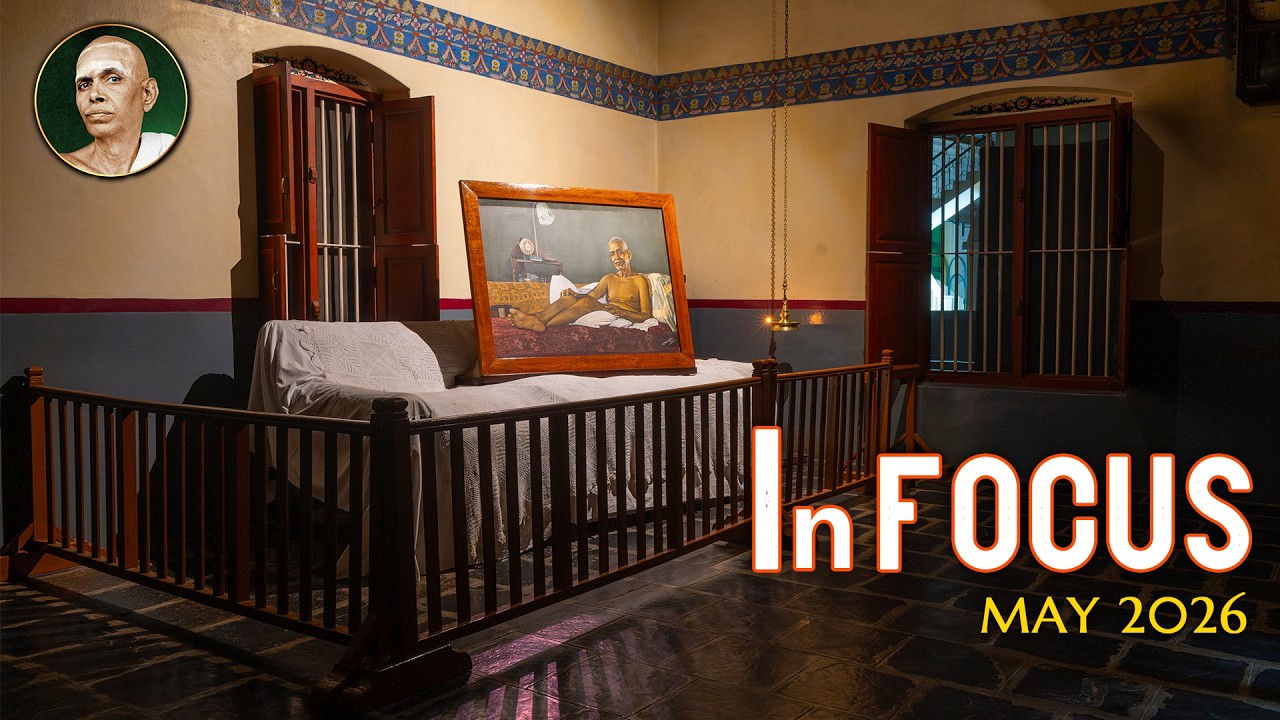
Ashram Video: In Focus - May 2026

Catch up on the latest events, daily life, and special moments at Sri Ramanasramam. Watch our newest "In Focus" monthly wrap-up video below.

Sri Ramana Maharshi Ashram: In Focus - May 2026

Watch directly on YouTube

Obituary
Skandasramam group photo

Sri Seenappa was born on 10th October 1957 into a family that had been closely associated with Bhagavan for three generations. He was born as the 4th son of the late T.R. Krishna Moorthy (Typist Kittu) and Saraswati. TNV was close friends with Typist Kittu who was typing the legal matters for the Ashram. Young Seenappa studied at the Danish Mission Higher Secondary School, Tiruvannamalai, and after completing his SSLC, began his career assisting his father as a job typist and stamp vendor. In 1979, he became an instructor at a typewriting institute.

He was married on 25th January 1993 and remained closely connected with the Ashram during Sri T. N. Venkataraman's tenure and thereafter.

An ardent devotee of Arunachaleswarar and Bhagavan, Seenappa also served as a trustee of the Karthigai Utsava Vedaparayana Trust, founded one hundred years earlier by his grandfather, Sri Sundararama Ghanapatigal.

Sundararama Ghanapatigal had been drawn to Bhagavan from the Virupaksha days, often climbing the Hill to sit near Bhagavan at Virupaksha Cave. At that time, he was in charge of the Tiruvannamalai Veda Patasala, which had about thirty-five students.

Feeling it appropriate that Veda Parayana should be performed daily in Bhagavan's presence, Sundararama Ghanapatigal arranged for a few devoted students to chant the Upanishads in the morning and Rudram and Chamakam in the evening before Bhagavan. When a complaint was lodged against him for bringing his students to recite at another institution, he approached Chinnaswami and suggested that the Ashram establish its own Vedapatasala. Chinnaswami agreed, provided Sundararama Ghanapatigal would take charge as teacher and arrange for students. Since he was already serving as teacher in the town Veda Patasala, Sundararama Ghanapatigal felt it would not be appropriate to take formal charge of the Ramanasramam Vedapatasala. Instead, he sent qualified former students and continued to supervise the work informally.

Later, when the Mother's Shrine was under construction, Seenappa's uncle, the Sanskrit pandit Sri Raju Sastrigal, a close friend of Sri Kavyakantha Ganapati Muni, helped design the Sri Chakra Meru to be carved in stone, as well as the puja vidhi for the Sri Chakra Puja. When the panchaloha idol of Sri Yogambal was cast, an image of Sri Lakshmi seated on a lotus was also made. Sri Bhagavan blessed this icon and presented it to Raju Sastrigal. It remains a treasured vigraha in Tiruvannamalai and a central feature of the puja room of Sri Seenappa's eldest brother. Similarly, the family also received from Bhagavan a Meru Chakra, like that installed in the Mother's Shrine.

Such was the deep lineage of devotion in Seenappa's family—devotion both to the Veda and to Bhagavan Ramana—which continued into the present day. Seenappa regularly organised Sri Rudra Japa and Parayana, as well as abhishekam and puja, at Sri Arunachaleswarar Temple at the request of Bhagavan's devotees. During Karthigai Utsavam, he accompanied the processional deities throughout the night and helped devotees of Sri Bhagavan have smooth and hassle-free darshan.

In keeping with family tradition, Seenappa was of great assistance to Ramanasramam in its daily transactions with banks and in liaising with local officials on Ashram-related matters. He was also a reliable support in religious matters, not least of all, for the late Sri Appichi Mama, former Ashram head priest.

Seenappa lost his wife in May 2021. He continued performing Nitya Siva Puja until his last day and remained ever helpful to others, without expectation. He merged peacefully with Sri Arunachaleswarar and Sri Bhagavan on 21st April 2026 at around 4 pm at his home near the Big Temple. A gentle, humble, self-effacing soul of few words, Sri Seenappa will be missed by the devotees, the Ashram management, and all who knew him. —

Obituary

Smt. Dhanya Helmi Komarek (1945-2026)

Skandasramam group photo

Born just after the war, on 16 August 1945 in Ulm, Germany, Helmtraud Komarek was the daughter of German-speaking parents expelled from Czechoslovakia at the end of the war. Known to all as Helmi, she later received the name Dhanya from Sri Mata Amritanandamayi, a fitting name in light of her boundless generosity and deep commitment to serving those in need.

An artist by temperament and training, Dhanya first came to India overland by car in the early 1970s. She travelled widely—in Greece, the United States and India—pursuing her artwork along the way. In 1983, she settled in Scotland, where she lived at the Findhorn Foundation, acquiring valuable skills in community life and service while managing a child care centre.

In the mid-1990s, Dhanya raised funds to establish Sri Sai Dhanya Vidya Mandir School in Puttaparthi, Andhra Pradesh, for disadvantaged children. Within its first two years, the school grew to more than 200 students. Dhanya served there for fourteen years.

During this period, she came to know of Bhagavan Sri Ramana and began visiting Tiruvannamalai. She took up Bhagavan's teaching with devotion and was fond of quoting phrases from the Ramana literature. In 2007, she settled at Arunachala and, two years later, married Robert Dodds, Jr., a longtime Ramana devotee. Together they made Arunachala their permanent home.

During her weekly pradakshinas, townspeople would call out to her as she walked through the streets, for she was widely known and loved. She made a point of greeting those living on the sidewalks and helped them in whatever way she could, fully present and interested in whoever she met. People from abroad would send her money to distribute to the needy, and she never withheld support because of a person's limitations or circumstances but met all with equality, warmth and empathy.

In early April, Dhanya fell ill. On 25th April, test results revealed metastatic cancer. Never inclined toward intrusive medical intervention, she chose not to undergo treatment. But on 8th May, she agreed to be taken to Rangammal Hospital for testing. Calm and relaxed, she interacted warmly with the nursing staff and with the many who came to see her. On Monday morning, 11th May, at the age of eighty, Dhanya merged peacefully at the Feet of Holy Arunachala. She is survived by her husband, Robert, and her nephew, Andreas, and will be greatly missed by local children and by all who knew her. —

Footer

On 1st September 2026, Saranagati begins its 20th year. Marking this milestone, the publication is launching a website in response to requests to make Saranagati articles and content more accessible. The site includes a complete pdf archive of Saranagati issues published thus far for free downloading. Over time, this archive is hoped to become Google searchable, once traffic to the site begins and the uploaded files are indexed. It is hoped that all two hundred plus Saranagati issues will be available for a general Google search in about 4-5 months. The website can be found at: saranagati.online. —