

The Mountain Path is the official journal of Sri Ramanasramam, Tiruvannamalai.
Mountain Path is dedicated to Bhagavan Sri Ramana Maharshi
Mountain Path - Founded 1964 By Arthur Osborne
Editor: Dr. Venkat S. Ramanan, President, Sri Ramanasramam
This is the web version of the 'Mountain Path' Journal
The aim of this journal will be to set forth the traditional wisdom of sanatana dharma with emphasis on Vedanta, as testified and taught by the great sage Sri Ramana Maharshi, and to clarify his path for seekers in the conditions of our modern world.
CONTENTS
- Divine Names of Arunachala - S. Lazar
- From the Editor’s desk
- Bhagavan and the Mysticism of Arunachala - Dr. S. Ram Mohan
- Maharshi – The Ardhanari - Kays
- From the Mountain Path Archives - Krishna Bikshu
- Advaita Primer - Part Twelve - M. Giridhar
- Tirukkuṛaḷ: The Wisdom of Sage Tiruvaḷḷuvar - M.R. Kodhandram
- Essence of Sri Ramana Paravidyopanishad - V. Krithivasan
- Gadhi’s Way Out of Illusion - Neera Kashyap
- Muruganar in His Own Words - Part Seven - Hari Moorthy
- The Eternal Self: Beyond Body and Birth - D. Thiyagarajan
- The Hidden Meaning Behind Namaskaram - Madhusdhanan S
- Alphabet - Advait Shrivastav
- Keyword: Hṛdaya - Part Three - Ramesh Iyer
- The Divine Sage Janabai - Nabaji Siddha
- Nondi’s Corner and Youth Corner
- Question & Answer
- Book Review - M. Giridhar
- Ashram Bulletin
Divine Names of Arunachala
39. |
ॐ क्षमारूपिणे नमः |
OM kShamaaruupiNe namaH |
|
Embodiment of forgiveness. |
The Sufi mystic Rumi said that “forgiveness is the fragrance that flowers give when they are crushed.” For many devotees of Bhagavan, there are certain stories that we hold on to as beacons of reassurance in seemingly dark times[cite: 2]. They remind us that, while we must endeavor to follow our guru’s path, should we fail, His grace will not abandon us[cite: 3]. This author keeps the story of Perumal Swamy close to his heart.
Perumal Swamy was one of Bhagavan’s earliest attendants. He served the Maharshi with unwavering loyalty, ensuring that his guru enjoyed a clean, peaceful environment on the hill, free from unwanted intrusion[cite: 5]. However, over time, his devotion became corrupted, and he slipped onto a path of bitter arrogance. He began to feel that he alone was in charge of Ramanasramam and went as far as to attempt to legally seize the ashram ownership for himself. At other times, he manufactured false stories about Bhagavan, or brought men into the hall to insult him to his face.
Eventually, the karmic fruits of Perumal Swamy’s attacks ripened. He lost his court case against the ashram and found himself suffering from severe illness. Desiring to apologize, he came to the hall, where he was greeted with the utmost disdain by all present — except, of course, Bhagavan. Perumal Swamy pleaded, “Bhagavan, I am going to hell!” The Maharshi’s response is one of the most poignant demonstrations of the Jnani’s mystical reach, and His unwavering, impossibly tender love for the wayward jiva. Bhagavan, smiling, replied, “I am there also.”
We may feel, at times, that we have disappointed God or Guru — we look at their picture and project our own feelings of shame or guilt upon them. But in these moments, they are calling us, asking us to notice the glance of grace that never wavers; the mystical silence that permeates Arunachalam.
— S. Lazar
FROM THE EDITOR'S DESK
The Practice of Contentment
--In the Yoga Vasistha, the classic Advaitic text often cited by Bhagavan, Sage Vasistha says to Rama,1
"There are four gate-keepers at the entrance to the Realm of Freedom. They are shanti (self-control or quietness of mind), vichara (spirit of inquiry), santosha (contentment) and satsanga (good company). The wise seeker should diligently cultivate the friendship of these, or at least one of them."
I first read this book many years ago, and it left a deep impression on me. In this editorial, I'd like to reflect on one of those gatekeepers --- contentment --- and the importance of cultivating it intentionally and methodically as a spiritual practice.Contentment: A stepping stone to desirelessness
In "Who Am I?" Bhagavan explains that desirelessness is not just a means to wisdom (jnana), but wisdom itself.
26. What is the relation between desirelessness and wisdom? Desirelessness is wisdom. The two are not different; they are the same. Desirelessness is refraining from turning the mind towards any object. Wisdom means the appearance of no object. In other words, not seeking what is other than the Self is detachment or desirelessness; not leaving the Self is wisdom.
A jnani who is desireless, is by nature, content. Bhagavan's own life was the most eloquent expression of contentment. From the moment of his Self-realization at the tender age of sixteen, he never again sought anything for himself. Living for decades at the foot of Arunachala, often with minimal food, clothing, and comfort, he never showed the slightest trace of dissatisfaction.
Reminiscing upon the days when he lived on begging alone, Bhagavan extolled the bliss offered by the such a state of absolute desirelessness,2
"You cannot conceive of the
majesty and dignity I felt while so begging. I felt like a king and more than a king. I have sometimes received stale gruel at some house and taken it without salt or any other flavouring...and passed on supremely happy and in a state
of mind in which even emperors were mere straw in my sight. You can't imagine it. It is because there is such a path that we find tales in history of kings giving up their thrones and taking to this path."
To live like Bhagavan, utterly free of desire, is a lofty ideal. Contentment is a gentler step, accessible here and now, and a quality we can consciously cultivate. Contentment is a peaceful acceptance of what is, a feeling of no lack in the present moment. One may still have desires, but they no longer agitate the mind.
Living examples of contentment
We all know people who radiate such contentment. Biographies of the early devotees who lived with Bhagavan bear testimonies to contentment as a foundational strength in their sadhana. An aunt who, though widowed at a young age, lives a contented life of prayer and service. A colleague not bothered by promotions or raises, is content doing good work. A mother at peace raising children without regret over an unfulfilled career. An elderly neighbor with a modest pension and in poor health, yet content and grateful for a full life.
Cultivating contentment is a core pillar of the Hindu way of life. A Hindu who follows a dharmic life naturally withdraws from the world once their worldly responsibilities are fulfilled. The knowledge and wealth gained in the first two phases of life (brahmacharya and grihastha) are used to pursue the spiritual life in the last two (vanaprastha and sannyasa). We can see this echoed in the lives of so many devotees of Bhagavan. Even kings, as eulogized in the Srimad Bhagavatam, embraced this way of life, withdrawing to the forest after entrusting the kingdom to their sons.
There is a beautiful reference to this in Somerset Maugham's classic, The Razor's Edge, which was inspired by his meeting with Bhagavan: Larry Darrell, the spiritual seeker at the heart of The Razor's Edge, travels to India after turning away from conventional life in America. While there, he meets a senior Indian civil servant, likely a high-ranking official in the Finance Ministry, who is dignified, wealthy, and well-respected. During their encounter, Larry learns that the man is planning to give up everything at the age of fifty: his job, family, property, and all possessions, in order to become a wandering sannyasi. What strikes Larry most is the lack of drama around the decision. The official's wife and children accept it as a part of life. There are no arguments, no tears, no interventions. It is understood and even honored that when a man reaches a certain stage of life, he may naturally choose to renounce the world in pursuit of spiritual realization. A couple of years later, Larry meets the same man again in a southern temple --- dressed simply, walking barefoot, and wholly content. He recognizes Larry and greets him warmly. He's on a pilgrimage to holy sites across India, and he looks peaceful and fulfilled.
Some people are blessed with the vasana for innate contentment. But for most, it is a quality cultivated over the course of one's life. Clearly, contentment does not depend on wealth, status, success, or even good health. It arises from something deeper -- a settled heart. As we grow in spiritual maturity, we begin to value and strive for this precious state. Yet, we often falter and fall short.
Why do we struggle to be content?
First, we misunderstand the true nature of happiness and the purpose of life. We believe fulfillment lies in satisfying our desires, but life repeatedly proves otherwise. A dream home soon loses its charm, and we begin to long for a larger one in a more upscale neighborhood. A long-awaited promotion brings brief joy, but before long, we find ourselves chasing the next milestone. Such is the nature of the mind: to seek endlessly, never resting in contentment. What the mind is drawn to and pursues is shaped by our vasanas, the latent tendencies from past lives. For some, these manifest as a drive for wealth, and for others, the desire for fame or relationships.
Second, we measure ourselves by comparison. Our self-worth - our careers, homes, cars, the colleges our children attend - often depends on where we think we stand relative to others. A child may get into a top university, but if a friend's child is accepted into a more prestigious one, unease sets in. Comparison has always been part of human nature, but today's world amplifies it. We are constantly bombarded with curated glimpses of others' lives on phones, screens, and social media, wherein only the best is showcased. Even in spiritual circles, comparison creeps in subtly: Am I progressing fast enough? Should I be more detached, more disciplined, more like that radiant devotee? Over time, this habit of comparing quietly erodes our peace and makes contentment feel like a distant dream.
That is why we must turn to Bhagavan, the greatest of Gurus, whose grace and guidance offer the most practical means to overcome our inner struggles.
Bhagavan's tools to cultivate contentment
Adopt gratitude and love of God and Guru
In verse 7 of Arunachala Nava mani malai, Bhagavan says,
"Annamalai! As soon as Thou didst claim me, my body and soul were Thine. Can I then lack anything? I can think only of Thee (hereafter), not of merit and demerit, O my Life. Do as Thou wilt with me, then, my Beloved, but grant me only ever-increasing love for Thy (dear) Feet!"
Accept life as a gift of God. Acceptance doesn't mean passivity; it is surrendering the ego's insistence that things be different. When we accept life as Bhagavan's will, inner resistance drops and contentment blooms. Recognize the futility of desire and offer the fruits of action to God.
In verse 2 of Upadesa Saram, Bhagavan says,
"The fruit of action passes. But action leaves behind the seed of further action leading to an endless ocean of action and not at all to moksha."
Actions driven by desire leave behind seeds for fresh vasanas, the root of restlessness. In this way, craving continually feeds discontent. Bhagavan offers the remedy for this malady in the very next verse.
"Disinterested action surrendered to the Lord purifies the mind and points the way to moksha."
Realize that happiness lies within. Turn the mind inward
In Who am I, Bhagavan offers the best definition of happiness:
24. What is happiness? Happiness is the very nature of the Self; happiness and the Self are not different. There is no happiness in any object of the world. We imagine through our ignorance that we derive happiness from objects. When the mind goes out, it experiences misery. In truth, when its desires are fulfilled, it returns to its own place and enjoys the happiness that is the Self.
Once you understand this core truth, turn inward and intentionally seek true happiness. When feelings of lack arise, pause and ask yourself, 'To whom has this thought come?' Trace the 'I' thought back to its source, and see how discontent dissolves in that inward turning
Watch desires without feeding them
Bhagavan explains the method very clearly,3
"If a desire can be got rid of by satisfying it, there will be no harm in satisfying such a desire. But desires generally are not eradicated by satisfaction. Trying to root them out that way is like pouring spirits to quench fire. At the same time, the proper remedy is not forcible suppression, since such repression is bound to react sooner or later into forceful surging up with undesirable consequences. The proper way to get rid of a desire is to find out 'Who gets the desire? What is its source?' When this is found, the desire is rooted out and it will never again emerge or grow."
Simplify outer life and minimize wants
We do not need to renounce the world, but simplifying our lifestyle helps calm the mind. Purchase only what's needed to care for the body. Be frugal, and steer clear of waste and overconsumption in things, media, and distractions alike. Bhagavan's extols the bliss of 'No want,'as,4 "I had no cloth spread on the floor in earlier days. I used to sit on the floor and lie on the ground. That is freedom 'No want' is the greatest bliss. It can be realised only by experience. Even an emperor is no match for a man with no want."
Surrender to the Guru or the Self
Offer your discontent, desires, and confusion at Bhagavan's feet. Trust replaces struggle and contentment grows. As Bhagavan says,5 "Surrender, and all will be well. Throw all the responsibility on God. Do not bear the burden yourself."
Fruit of living such a life
In the end, contentment is not about settling for less; it is about settling into what is real. When we turn away from comparison and craving, the mind grows quiet. In that stillness, desires loosen their grip, and actions arise from peace. We become more receptive to grace, more anchored in presence, and less caught in the endless struggle of becoming.
For Bhagavan, contentment was not the goal but the natural fragrance of a life lived close to the Self. It is in contentment that we begin to taste the bliss of simply being. And it is through contentment that the path quietly opens to its true fruit: complete freedom from the restless ego, and abidance in the unchanging peace of the Self.
In humility and devotion,
Venkat S. Ramanan
Bhagavan and the Mysticism of Arunachala
Dr.S. Ram Mohan
Dr. S. Ram Mohan is the author of numerous articles on Bhagavan’s teachings and is currently the editor of Ramanodhayam, the Tamil magazine of the Ramana Kendra in Chennai.
Nature Worship and the Sacred Mountain ParadigmNature worship, in all its multifaceted paradigms, stands as one of the most enduring and predominant forms of religious practice around the world. The latent force within nature has, across civilizations, been revered as the Deus Otiosus --- the indwelling, silent God. Mountains, rising loftily toward the heavens, are viewed as celestial ladders bridging earth and sky. The clouds, borne upon their peaks, are the bestowers of rain and abundance. Volcanic mountains, with their simmering cores, are seen as gateways to the fiery womb of Mother Earth. In cosmogenic myths, mountains are revered as the primordial land masses that first emerged from the primeval waters, symbolizing the birth of terrestrial order from aquatic chaos.
Kalidasa extols the Himalayas as Devatatma --- a divine embodiment with a soul. Pilgrimages to such sacred mountains are treasured spiritual observances. In early civilizations, the worship of high places --- lofty hills and mountains --- often merged seamlessly with the veneration of Earth itself. The Greeks' Olympus, the Mesopotamian Entil Mountains, the Anatolian sanctuary of Mother Cybele, and the Indian Mount Meru are prominent illustrations of this sacred high-place worship. These are conceived as World Pillars, the mythic axes around which the cosmos revolves. Arunachala Hill in South India and Machu Picchu in Peru are contemplated as two poles of this world axis --- sacred sentinels of spiritual polarity.
The mountain deity of ancient Japan, Yama-no-kami, presides as the goddess of agriculture and vegetation, affirming the Earth's fecund vitality. The Israelites, too, associated divine presence with Mount Sinai (Bama in Hebrew), while the hilltop shrines of the Canaanite fertility gods --- Baals and Asherot --- further attest to this sacred elevation. Among these hallowed peaks, Arunachala --- known in Tamil as Tiruvannamalai --- emerges as one of the oldest and most revered spiritual epicenters in India. Sri Ramana Maharshi proclaimed Arunachala to be the spiritual Heart and Centre of the earth.
It is said in the Skanda Purana that when Brahma and Vishnu, embodiments of creation and preservation, debated the supremacy of their powers, a column of light --- boundless and transcendent --- burst through the sky and earth. This column, effulgent and measureless, was Siva. To test their humility, the column asked Vishnu to seek its base and Brahma its crown. Vishnu, the ever-adaptable, assumed the form of a boar and burrowed deep, but found no end. Brahma flew upward as a swan but returned claiming false success, earning thereby Siva's reprimand. This fiery column, cooled and condensed for the sake of devotees, became Arunachala --- the Hill of Fire, the Agni Linga. Thus Arunachala is recognized as the world's largest Siva Lingam. Guru Namasivaya declares it a spiritual cornucopia that magnetizes saints and seekers from all corners of the world. Caves around the hill are believed to be inhabited by siddhas in subtle form, continually radiating spiritual grace to earnest practitioners.
In this cosmic allegory, Vishnu signifies the individualized soul, Brahma the intellect, and Siva the eternal Self (atma). Arunachala, thus, is OM itself --- bestowing liberation upon all who meditate upon it through the path of atma-vichara. Here, the hill is not merely symbolic; it is verily the Siva Linga. Those who perform the sacred Girivalam --- the 13-kilometer circumambulation --- witness five distinct spurs of the hill, each representing one of the five principal deities (Brahma, Vishnu, Shiva, Ganesha, and Shakti) of the Hindu pantheon. On Karthigai Deepam, a massive ghee lamp is lit atop the hill, visible across great distances for several days, drawing countless devotees to its light.
Arunachala: The Spiritual NexusArunachala, the beacon for sages and aspirants across the yugas, continues to magnetize spiritual seekers. Rishi Gautama, Virupaksha Deva, Guhai Namasivaya, Guru Namasivaya, Arunagirinatha, and Seshadri Swami are just a few of the many illumined beings who have been drawn to its sacred embrace.
One may walk in silent reverence through the caves where these seers meditated, feeling the pulse of stillness that vibrates through the very rocks. Virupaksha Cave and Skandasramam, where Sri Ramana Maharshi dwelt for many years, are not merely ruins of the past but timeless portals where the veil between the finite and the infinite is exceedingly thin. The echo of inner silence reverberates even now for those with ears attuned to grace.
The Incomparable Uniqueness of ArunachalaOther holy sites like Varanasi, Kailasa, and Chidambaram are venerated as the abodes of Lord Siva. But Arunachala is not merely His abode---it is Lord Siva Himself. Unlike other places where Siva dances or blesses, here He remains unmoving (achala), drawing Sakti into Him in absolute stillness. Arunachala is the sacred ground of Siva-Sakti aikyam --- their eternal union in silence and love. It is the supreme locus of jnana and moksha. In Chidambaram, Siva performs the cosmic dance as Nataraja; in Varanasi, He liberates by whispering the Taraka Mantra; but in Arunachala, He simply is. The hill radiates an unspeakable stillness, a silence that consumes the seeker's mind.
Ramana and ArunachalaTo speak of Sri Ramana is to speak of Arunachala, for their identities are not merely linked---they are non-different. Ramana called Arunachala his Father, his Guru, his Self. In his Five Hymns to Arunachala, particularly in the Arunachala Aksharamanamalai --- a garland of letters strung with devotion --- Ramana pours the entire ocean of Advaitic wisdom into the chalice of bhakti. "You who came in the guise of a hill to arrest my mind, dwell in my heart," he sings. Here, Siva is no longer a god apart but the Self within.
The ashram of Sri Ramana lies like a calm eddy near the torrent of worldly time. Its walls echo the footsteps of seekers from every corner of the globe. Yet the true ashram is Arunachala itself. "Be still, and know," said Ramana --- not through assertion, but his example. His very gaze transmitted the silence of the Hill. Words fell away. Only the presence remained. Sri Ramana once said, "In the end, there is nothing to do, nothing to attain. Simply abide as you are." Arunachala whispers the same truth --- not in language, but in its luminous silence. It burns away the seeker, not with fury but with love. The fire of Arunachala is cool. It scorches away illusion, not the soul.
There is no need to become anything before approaching Arunachala. Its grace does not require credentials. One must only be sincere. Even a single thought of Arunachala can liberate one. Sri Ramana affirmed this with the conviction born of his own awakening. The Hill calls not the qualified but the chosen. To speak of Arunachala is to fall into silence. Every description is a deflection. Yet the attempt is sacred. For in praising the Hill, the mind turns inward, which itself eventually leads to liberation.
Sri Ramana Maharshi's teachings constitute the most sublime philosophical articulation of Arunachala's power. He distilled Vedic metaphysics into a single method: atma-vichara --- the inquiry "Who am I?" The Hill became both the object and subject of this inquiry. When he said "Arunachala is the Heart of the world," he meant that within the human being, the same mountain-spirit resides in the cave of the heart.
Girivalam: Sacred CircumambulationCircumambulating the sacred hill is a deeply revered spiritual journey. Devotees undertake this barefoot pilgrimage with deliberate, mindful steps---said to be as gentle and measured as those of a royal maiden in her ninth month of pregnancy. Along the path, a multitude of divine temples, holy shrines, serene ashrams and sacred spurs of the hill adorn the landscape, each radiating its own spiritual energy. Most revered among them are the eight sacred Siva lingams, known as the ashta lingams, positioned in alignment with the cardinal directions. Unlike temples built with human hands, Arunachala is svayambhu --- self-born, self-luminous. It is not a representation of divinity; it is the divine. More than a physical act, Girivalam is an inward pilgrimage. With each step, the aspirant offers the ego unto the Hill. With each breath, the silent syllable "Arunachala" dissolves thought into stillness.
In subtle lore, it is said that those who circumambulate Arunachala not only receive merit for this life, but for countless incarnations. Both in outer pilgrimage (parikrama) and inner pilgrimage (vichara), the aspirant circumambulates the axis mundi --- ascending toward the summit of Self. The act purifies vasanas, dissolves the knots of karma, and bestows glimpses of the inner Self.
To circumambulate Arunachala is to reenact the inward journey. The path begins with duality --- one walks around. But with each step, the circle tightens. The walker becomes the walked. In perfect maturity, the hill disappears --- only the Heart remains. This is not poetry, but the lived experience of those who have walked barefoot in surrender.
Festivals at ArunachalaArunachala witnesses a grand thirteen day festival every year. On the tenth day. This annual festival commemorates Siva appearing as a column of light. A massive lamp is lit on top of Arunachala Hill, visible for miles, and is a focal point of the celebrations. The fire atop Arunachala on Deepam Day is no mere ritual --- it is a cosmic reenactment of Siva's form as light. The flame symbolizes the formless awareness in which all forms rise and dissolve. The sight of the hill crowned in fire is etched forever in the hearts of those blessed to behold it --- an image that kindles the fire of jnana within. In addition to this festival, numerous other festivals such as the arudra darisanam and Sivaratri are celebrated.
Meditating on ArunachalaAn ancient Sanskrit verse asserts: "By seeing Chidambaram, by being born in Tiruvarur, by dying in Kasi, or by merely thinking of Arunachala, one attains liberation." Sri Ramana's Arunachala Ashtakam opens with the confession that Arunachala, even in his childhood, had cast its silent spell on his soul. This resonant remembrance of Arunachala, which appeared within Venkataraman as the silent japa "Arunachala, Arunachala," catalyzed his self-enquiry at age sixteen and led him to abide permanently in the Self.
Sri Ramana composed the Marital Garland of Letters with each couplet ending in this sacred refrain of "Arunachala Siva." Though Bhagavan gave no formal mantra diksha, the name "Arunachala" itself serves as the world's gift---bestowing liberation as jnana panchakshari, the five-syllable liberating mantra. He even decodes the esoteric meanings of the syllables of A-ru-na-cha-la in Navamani Malai, affirming that the mere remembrance of the name leads to liberation. In Aksharamanamalai, Sri Ramana extols Arunachala's power to annihilate the ego: "O Arunachala! The moment I thought of you, I was caught in your net of grace --- can it ever fail?" Verse after verse, he reiterates that the mere thought of Arunachala is itself a path to liberation.
Arunachala's Antipode: Machu Picchu and the Global AxisEvery point on Earth has its antipode --- and so does Arunachala. As noted by Sadhu Arunachala (Major Chadwick), Bhagavan once remarked, "There must be a mountain exactly opposite Arunachala --- its polar counterpart." Arunachala's coordinates (12°13′ N) align almost precisely with Machu Picchu in the high Andes of Peru.
The Incas revered Machu Picchu as the dwelling of Pachamama, the Great Mother, a name closely resembling Pachaiamman, the South Indian name for Parvati. The temple city's layout is astrologically designed and reflects the sacred geometry of the Sri Chakra. On the psychic plane, many mystics have independently affirmed that the feminine shakti is palpably potent there.
In standing before Arunachala, the individual stands at the threshold of the universal. Each rock, each cave, each lamp, each footstep is an invitation: to rest as awareness, luminous, boundless, and silent. The journey to the summit is never realized on a map --- but in the treasury of the heart. The pilgrimage is a single step of Self-recognition: "I am That."
Arunachala is not merely a hill --- it is the deepest and the original sign --- not the signpost. It cannot be reached; but only known by letting go. To be still before the Hill is to be held. To think its name is to fall into the open sky of Grace. To live by its magnetism is to live from the Heart of the world. Thus, Arunachala is not just a geographical hill, but a cosmic fulcrum --- a sanctum of divine energy, revered across civilizations, drawing souls toward the luminous stillness of the Self.
Maharshi – The Ardhanari
KAYS
Achalam (Sivam) and Aruna (Sakti) --- these are eternally and inextricably united, just as fragrance dwells inseparable in the flower, like the meaning in the word, and the light in the flame. The principle of the Mother is not apart from the principle of the Atman; She is its luminous revelation as compassion, love, and grace.
Bhagavan Ramana Maharshi can be considered as the living embodiment of the Ardhanarishvara principle, which symbolizes the perfect union of the masculine (purusha) and feminine (prakriti) energies, represented by Siva and Sakti. According to the Sankhya philosophy, the latter is the material cause of this universe, whereas, the former is the efficient cause of the universe. While prakriti is the root of all creation, purusha is the silent unmoving witness (sakshi).
While Ardhanarishvara is traditionally a deity, Ramana Maharshi's life and teachings reflected this non-dual reality in a profound way.Bhagavan, who ever remained as "the form of the luminous and motionless Hill," 1 was also an unfathomable ocean of Grace.2
He was the perfect Ardhanari --- he was the blazing fire of jnana in the truth of Advaita, and the embodiment of love and grace in the leela of this world. He was truly Siva beside Siva, and another Ardhanari beside the Ardhanari that is the Hill. Muruganar extols this with divine fervor,"Our Mother, the very form of Grace, abiding as one with Thee as Ardhanari; O Venkata Ramana, Flame of Arunachala, the Bliss of Turiya." 3 Jagadeeswara Sastri says,
"He who is the Father as the unwavering flame of jnana,
The Mother as the eternal spring of the milk of Bliss,
And both as one --- as wealth unsought --- seeks and claims us
By Grace, to Him!"4
Though unmoving, the Supreme moves by its own Power --- a paradox Bhagavan praises in Akshara mana malai: "O Arunachala, there dwells in Thee a wondrous Power that is not other than Thee."
This power --- the very essence of Grace --- ordains creation, sustenance, concealment, involution, and liberation. This power personified is Devi Herself. The Durga Suktam hails Her again and again as Agni and as Brahman. She is Rudra's very essence, for in the heart of 'Rudram' --- the heart of the Vedas --- She abides as 'Sivā.'5 She is the Whole, the Supreme Knowledge (vidya), Brahman Itself: sat is Brahman, and that vidya is Parameshwari.6
Grace is nothing but Sivanubhuti --- the living experience of Siva. That is the meaning of calling Her the form of Grace.7 It is She who bestows the mystical light of wisdom. Ganapati Muni proclaims in Uma Sahasram, his hymn of 1000 verses praising the Mother: "Experience of Pure Being is obtained only by Thy grace." Bhagavan emphasized again and again the Self-revealing immediacy of grace.8 In that Self-awareness, one realizes Sakti is Siva and Siva is Sakti. She is "the fire-born from consciousness," 9 "the form of the ocean of Grace," and "Brahma Vidya"10 itself.
The Fire of Consciousness consumes all; chidagni --- the Flame of awareness --- is the Self's effulgence. This svarupa is Devi's abode. She is nirdvaitā 11 --- beyond all duality --- and dvaitavarjitā12 --- without any second.
In the devotee, faith flowers into grace. Devi, the embodiment of causeless compassion, kindles devotion in the soul, evoking obeisance in body, speech, and mind. Her Sakti transforms mere life into love, and love into a pious rage --- a divine madness that consumes the ego. From Her boundless grace arises the re-collection of one's vision --- a return to the Source. She proves Herself the source of the river of ego, the 'I' thought. It is said, 13 "The one who enquires into the source of awareness as 'I' abides in Thy abode --- the nectarine Satchidananda Atman."
This is the soul's at-one-ment with the divine. Grace is thus both root and fruit, origin and fulfilment. Grace is God, is Self, is Light. It draws beings inward to the indivisible One where heaven and earth have merged.
"The ignorant prate that Love and Siva are two;
But none knows that Love alone is Siva.
When men know that Love and Siva are one,
Love as Siva they ever remain."14
Ardhanari signifies haragowri yogam --- Sakti withdrawing the manifold projections of the mind and merging back into Siva. The festival of Karthikai Deepam celebrates this eternal union --- Sivam and Sakti as One.
In the Kena Upanishad, when devas became arrogant, a pillar of light appeared from earth to sky. Failing to grasp its mystery, Indra approached the light. But it disappeared and he saw Devi, who revealed that the light was yaksha. Thus Adi Sankara sings of Siva as "the form of yaksha with matted locks."15 Devi is the form of jnana and is the nectarine form of chit --- of consciousness --- neither male nor female nor neuter. She is pure Awareness, of which Bhagavan said, "Arunachala is the embodiment of Light transcending male, female, and neuter." 16 Manickavasagar hails Sivam as,
"The Male, the Female, and neither --- the ambrosial Fount yielding infinite Grace."17
Similarly, Ramalinga Vallalar sings,18
"You are One and Two and None of these.
Though a Female, your basis is the Male Power.
Being the Mother, I exhibit boundless grace.
Yet I alone remain, transcending all."
Devi --- the Radiance of Grace --- leads the soul back to its source, even as light leads to the Sun. Her Grace has, in countless instances, imparted divine wisdom. Thirujnanasambandhar was nourished by the milk of the Divine Mother. Ramalinga Adigal recounts, "I fed on the ambrosia of milk and gained the Feet twine."19 He further describes a vision, "At that sacred door stood Anandavalli, my Mother I beheld Her Grace I received and ambrosia I partook of By Her Grace which held me up I saw the presence of Nataraja."
Abirami Bhattar, while bathed in the ecstasy of this effulgence, declared it to be a full moon day, though standing in the darkness of the new moon. And lo - grace revealed a full moon in the sky! Adi Shankara praises Devi, singing, "O Mother! Out of sport, Thou hast divided the One Absolute into two --- jiva and Siva --- and again merged the jiva into Siva."20
The descent of Mahasakti transformed Bhagavan into Ardhanari --- drinking the quintessence of jnana-rasa, fountain of knowledge, abiding ever as Brahman and as infinite grace. He spoke yet remained in luminous silence. Ganapati Muni prays in Uma Sahasram,"May Devi Gowri, who is ever equally compassionate like Ramana Maharshi --- who, having realized sarvatman, rains grace on all --- remove my ignorance." 21
Bhagavan's seeming inactivity actually represents an intense activity of Grace. Thus, Ganapati Muni calls him māyāmanuşya --- the Lord in human garb22 --- and lilāmānava --- divine play by a human.23 His own words24 declare how Arunachala, in the form of mother and father, nurtures the individuals, but then saves these individuals from drowning in the deep ocean of worldly illusion by drawing them to Himself. The verse concludes by marvelling at Arunachala's grace.
In his mere presence, grace was at work, transforming a jiva into Siva, a nara into Narayana. Silent, he was the Father --- in Leela, the Mother. Devi assumes "the form of Guru." 25 It is said in the Suta Samhita, "I hail the guru-form of devi who abides in the Heart, who showers grace upon those who worship her within, who shines in secrecy and bestows Gnosis."26
Guru is grace made manifest. He was indeed the Lord of grace, whose love rained from every pore. Sivaprakasam Pillai rightly hails, "May the Feet of Siva, who came as human grace, live forever." His gaze moistened by mercy calmed mental
storms. In the hearts of seekers, the light of Uma shone through his eyes. His silence implanted wisdom. His words were messages of Truth. His presence subdued the senses and melted hearts. His grace blazed like hidden fire, shaping a
path of glory. Even distant cries for help were answered in time. He became one in all just like what Kabir said, "I am one with the ONE, ONE becomes All.
None else is there; all are mine, I am all."27
To the distressed, he was āptaḥ --- the unseen guide, tōṉḏṟāt tuṇai --- companion without appearing. Sadhu Om said, "Bhagavan, as God Arunachala, scattered the Sakti of Grace over the world --- becoming Father and Mother to all."28 Therefore, Jagadeeswara Sastri declares, "Amba Śrī Ramaṇasvarūpiṇi!"29
Bhagavan embodied a mother's sweetness, a father's care, a guru's discipline, a lord's compassion, and a king's justice. He fed his children --- human and animal --- and kept the kitchen fire as ablaze as the fire of jnana. By his very presence, the flowers of jiva blossomed into Siva. His stillness was action; his silence, teaching; his life, grace.
Thus does Bhagavan ever remain --- the unmoving mount of sacred grace, Arunachala, radiant with the eternal flame of truth. The deepam lit atop the Hill is no mere annual ritual; it is the visible emblem of the supreme mystery --- the union of Sivam and Sakti, of absolute Stillness and boundless Power, of the Self and its own effulgent Light. It is a silent proclamation that the Self alone is real, and in its stillness lies the infinite dynamism of Grace. Arunachala, as Bhagavan declared, is not merely a hill of stone, but the Heart of the world --- the seat of true Knowledge and final Liberation.
Bhagavan Ramana, the living deepam of gnosis and grace, shines on, calling all with a wordless invitation. He summons not through discourse or spectacle, but through the silent power of presence --- drawing each heart inward to its own source. In this gracious beckoning, every soul becomes a rightful heir to the treasure of spiritual fulfillment, of abiding peace and luminous clarity. Though Sakti operates inwardly, Bhagavan's outer form --- the Hill, the name, the teachings --- remains as a compassionate refuge for the devoted.
His realization was not an intellectual understanding but a direct experience of the Self, which transcends all dualities, including gender, individual, and cosmic. He consistently pointed to the ultimate oneness, where there is no separation between the individual self, God, and the world. This echoes the essence of Ardhanarishvara, which teaches the inseparability of Siva (consciousness/being) and Sakti (energy/manifestation).
Ramana Maharshi's silent presence and emphasis on self-enquiry led seekers to recognize the source of all phenomena within themselves. In this realization, the perceived distinctions between observer and observed, male and female, ultimately dissolve into the one, undivided reality. Therefore, he did not become Ardhanarishvara in a literal sense, but his very being and teaching exemplified the integrated, non-dual truth that the Ardhanarishvara form represents.
To the ego, He may appear silent; to the Heart, He ever speaks. To the seeker, He is the unerring guide; to the surrendered, He is sweetness itself. In the Sadguru, all opposites dissolve --- time and timelessness, effort and grace, self and Self.
The mountain path archive
Above Orthodoxy and Unorthodoxy
Krishna Bikshu
This article appeared 60 years ago in the October, 1965 issue of Mountain Path. The author of this article, Krishna Bikshu authored Ramana Leela, an authoritative biography of Sri Ramana in Telugu.
The Maharshi was criticised by some in his lifetime for being orthodox, by others for being unorthodox. There were literalist Brahmins who would not go to his Ashram because it was not orthodox, modernists who would not go because it was. A profound explanation was given by the late Sundaresa Iyer, himself an orthodox Brahmin, whose obituary appears in our issue of April, 1965, "Bhagavan was above orthodoxy and unorthodoxy. He was higher than Manu and could not therefore be bound by Manu. He was himself the source of orthodoxy and therefore whatever he did or said was orthodox because he did or said it, whether according to the sastras or not."
The Maharshi was establishing a spiritual path open alike to Brahmins and non Brahmins, Hindus and non-Hindus; and he knew when and by whom and to what extent traditional orthodoxy had to be observed or dispensed with. Krishna Bikshu elucidates the Maharshi's attitude in the following article, showing from the wealth of his observation during his long association with the Master, how both the blind defenders and the blind attackers of orthodoxy were liable to be offended by it.
An upholder of formal orthodoxy was speaking accusingly to Sambasiva Rao, late secretary of the Sri Ramanasramam Committee:
"We learn that your Guru, the Maharshi, does not observe the rules prescribed by the sastras for daily conduct or the regulations governing the life of a sannyasin."
"No, he does not," Sambasiva Rao agreed.
"We learn also that he has received no formal initiation into sannyas."
"No."
"And we hear that he chews a pan, sits on a sofa with a mattress on it, drinks coffee and is accessible to untouchables."
"Yes, that is so."
"Then we can't accept his way of life. He may be a great man, but he sets a bad example and people will naturally imitate him. Thereby they incur sin which must be imputed to his leadership."
This was the view held by many orthodox pandits who could not see the Spirit for the letter. It is true that in Sri Ramanasramam many of the sastraic injunctions are not followed. The Ashram is built upon a former burial ground (which in itself is irregular) and therefore no part of the Vedas except the Sri Rudra Sukta should be recited there;and yet it contains a Veda Patasala (school for learning to chant the Vedas). Not only that, but there is also a temple in which the worship of the Siva Linga and Sri Chakra is performed with full daily ritual including Vedic mantras and other holy texts. From this one might well conclude that Bhagavan considered the sastras and all scriptural injunctions useless. But it was not always so. I have observed incidents which showed how he discriminated between one case and another according to the need.
For instance, Major Chadwick, who, not being a Hindu, was not subject to the sastras, asked Bhagavan once whether eating onions was not an impediment to spiritual progress, and Bhagavan agreed that it was. Chadwick thereupon gave up onions completely. But they still continue to be used in the Ashram kitchen. He took meticulous care to see that the injunctions of the sastras were carried out in the building and consecration of the Ashram temple.
In the lifetime of Bhagavan there was a screen across the dining hall separating the Brahmins from the others. Bhagavan himself sat against the wall at right angles to both and in view of both. This is important to remember for the incident that follows. The screen implied an interdict on interdining between Brahmins and non Brahmins. One day a relative of Bhagavan (and therefore a Brahmin) demanded to eat among the non-Brahmins but the Sarvadhikari (Ashram manager) would not allow it. They were disputing about it when Bhagavan came on the scene and asked what was the matter.
" He says that he has no caste," the Sarvadhikari told him: " that all are equal in the presence of Bhagavan and that he is simply a human being not bound by the shackles of caste, creed, clime or colour."
"Oh, is that so?" Bhagavan said, looking surprised: "then in that case you are wrong to insist that he should eat with the Brahmins." But then, turning to his cousin, Bhagavan remarked,
"But you too are wrong. These people here feel that they are non-Brahmins. You have no caste feeling, so how can you sit among them? There is only one person here who has the feeling of being neither Brahmin nor non-Brahmin, and
that is myself. So," calling to the attendant, "place a leaf-plate for him by my side; let him sit with me." The young man was shocked by the implications of this proposal and immediately took his place at the Brahmin side.
Now let us consider the standpoint of those who condemn all orthodoxy. A visitor once said to me: "I hope your Bhagavan is not hide-bound, following all the rules of Hindu orthodoxy?" I replied cautiously: "Let me understand you before committing myself to an answer. First of all, do you believe that Bhagavan is a realized man? And secondly, what do you mean by Hindu orthodoxy?"
"How can I say whether he is realized or not? You say he is. And as for orthodoxy, you are only pretending not to know. I mean all the rules that govern your daily conduct---eating, sleeping, bathing etc., and your social conduct among yourselves and towards others: the rules that were made for you by the so-called Sages of ancient times, Manu and the rest."
"You are right insofar as neither you nor I can exactly evaluate the position of Bhagavan," I said: "But as for orthodoxy, have you ever investigated the purpose of the Sages in laying down these rules of life? Have you tried to understand them? Or have you tried to follow them and noted the results in a scientific spirit?"
"What!" he exclaimed, "If primitive people invented nonsensical superstitious rules and called them dharma, am I to follow them without proof or logic? That's impossible."
"Then you are unscientific," I replied. "Before you condemn a law you should first follow it and find out by experiment whether its results agree with what is claimed for it. Anyway, I will explain it to you. The ancient Hindus recognised four aims in life, which they called purusharthas. These are: dharma, artha, kama and moksha. Dharma is the law of being; wealth (artha) has to be earned and life enjoyed (kama) according to dharma. The final result will be Moksha, that is Liberation from bondage. He who follows this course is an integrated personality. He has harmonized his prana or vital force with his mind and characteristics of samskaras. A man acts according to his samskaras, that is his tendencies inherited from past lives. His inclinations result from the reaction of these past tendencies to the present environment. They should be directed to the achievement of the purusharthas culminating in moksha. The ancient Seers or Rishis had the vision to see the implications of every word, gesture or act of a man and on this basis framed rules which would, they said, if properly followed, help him to achieve his purpose in life. He could pursue the true goal either in society or as a sannyasin outside society, but only by following the rules. His earthly life should be so conducted as to lead to the final goal of moksha."
"Spiritual endeavour to achieve this indicated end is called sadhana and he who dedicates his life to it is a sadhaka. It involves cultivation, control and final conquest of body, emotions, senses and the entire ego and leads to Liberation. The Seers have noted the whole discipline required to this end. Control is a hard task. Control of a running horse can only be achieved step by step, and so it is with the ego. It is the Liberation towards which it leads that is the justification of sadhana. The ancient Seers did not claim to have invented rules for it, only to have seen the result of spiritual, emotional, mental and physical disciplines on a man. They laid down the law of being and working of all aspects of the human personality. That is why the smritis that go by their names are said to be merely suhrut sammita [good advice], advising as a friend, not compelling as a ruler. They merely indicate the road leading to the required end. If you break the rules they adumbrate they do not punish, only you do so at your own peril, that is peril to the success of your venture."
"Take the question of food --- just one among many rules. Modernists tell us that the food we eat has nothing to do with our spiritual progress; but the Chandogya Upanishad says that the subtlest part of the food you eat becomes your mind. Bhagavan said the same, and it is indicated in the last sentence of his book, Self-Enquiry. And Krishna in the XIth Canto of the Bhagavata lays down the several types of purity necessary for the sadhaka, one of them being pure food. Even if we think the opinions of modern reformers outweigh the statements of the Vedic Rishis, the Maharshi and Sri Krishna, should we not be scientific and give what they say a fair trial and note the results?"
"Returning to the question of the Maharshi: it is true that he did not personally follow all that is laid down in the scriptures regarding food, but he did not need to, since he was not a sadhaka but a mukta, having already achieved the Goal. It is true also that he allowed a good deal of licence to his followers, but that does not necessarily mean that he approved of it; simply that his way was rather to influence than to command.
The true command should come from within, leading to voluntary, not enforced, right action. He never ordered Devaraja Mudaliar to become a vegetarian, but when the latter was hesitating whether to do so or not, wondering whether he would find the food sufficiently nutritious, and asked Bhagavan's advice (as he relates in his book My Recollections of Bhagavan Sri Ramana, Bhagavan assured him categorically that he would. Another example: once when my brother Sri Venkatesa, author of a Hindi book on the Life of Bhagavan, came to the Ashram he was offered coffee and told that he could drink it safely as it was Bhagavan's prasad. Like many sadhakas he did not take coffee, finding that it disturbed his equanimity, so he hesitated. Before accepting it he asked Bhagavan outright, "Am I to take this as your prasad?" Bhagavan immediately replied, "No. These people want to drink coffee and so to justify themselves they offer it first to me and then call it my prasad."
There was a still more extraordinary case in the early years of the Ashram. Some of the sadhakas used to take bhang (a hallucinatory drug sometimes used by sadhus), and they also would offer it to Bhagavan first to justify themselves. Bhagavan would accept it when offered and it had no effect on his serenity of mind, since he had no mind to be disturbed. Once they offered some to Sri Kavyakantha Muni also, thinking thereby to justify its use by sadhakas, since Bhagavan was not a sadhaka but a mukta. Sri Ganapathi Muni saw through their trick, however, and was about to curse them for their audacity, but the motherly spirit awoke in his wife, who was present on the occasion, and she induced him to leave the scene, so that the miscreants escaped punishment.
Two things may be deduced from these examples: one that adventitious aids to sadhana, such as pure and sattvic food, are very important and not to be despised or neglected; the other that Bhagavan did not adhere rigidly to the rules himself or enforce them strictly in his Ashram but approved of people who did follow them. In fact he disapproved of both extremes, of exaggerated formalism on the one hand and hedonistic laxity on the other. Indeed, on one occasion when Bhagavan was asked to define the true Brahmin he included among the qualifications the ability to cook his own food so that he would not have to break his caste dharma when wandering in search of knowledge.
In a general way his mode of life did, after all, conform with the pattern of the sastras. He would rise with the calling of the birds, as prescribed by them. He would hear the early morning chanting of the Vedas, take his bath, etc., and then engage in his normal routine activities. The shades of evening would find him absorbed in contemplation of the Self, again as laid down by the sastras. He neither over-ate nor starved. He followed the Gita precept about keeping to a proper diet, his waking time following a proper mode of life, sleeping properly and spending his waking time properly. The Bhagavata devotes a full canto to the daily routine followed by Sri Krishna as a model for his clansmen. When they failed to follow it and took to drunkenness a catastrophe ensued leading to their complete extermination. But all these rules of life are really advice given to one whose sincere purpose in life is the quest of Liberation. How many of us can truthfully lay our hands on our hearts and assert that this really is our goal in life? Sadhana for many of us is no more than a hobby or a secondary interest. Times have indeed changed since the Seers laid down the rules of life. Insofar as a pleasurable worldly life is now all the purushartha we follow we can indeed call them primitives and dispense with their guidance.
The brunt of the modernist attack is against the rules of varna dharma, commonly called caste. And to gladden the heart of modernists it must be admitted that Bhagavan did not follow the social code laid down by the sastras, since he allowed non-Brahmins untouchables and foreigners free access to him and sponsored the daily chanting of the Vedas with all sitting shoulder to shoulder listening to them. But he knew what he was doing. Those who came to him were his people, independent of the accident of birth. And, as I mentioned above in connection with the incident at the dining hall, he himself belonged to no caste and could not be bound by caste rules. Indeed he actually stated this once in a deposition he made to a commission that came from a law court to interview him in connection with a fraudulent claim someone had made to ownership of the Ashram. Asked about caste, he asserted that he was atiasrami, that is outside the framework of the four varnas and the four asramas or stages of life. Indeed, one could say that there was no individual Ramana; and it is noteworthy that he never signed his name. There was no individual to sign. The individual Ramana had become extinct and merged in the Universal. Therefore it is futile to ask whether we, as individuals, can model ourselves on his conduct. There is a warning and a paradox in this. He was the highest model of rectitude and wisdom, and yet we cannot model our personal and social conduct entirely on him, since we are seekers and he was not, and we are therefore bound by obligations from which he had become free. He was and is the Brahman and had therefore nothing to achieve and required no discipline as an aid to achievement. This paradox is explained in the Bhagavata in a warning given by Suka Deva to Parikshit, "Transgression of the normal dharma by the spiritually perfect is an exception and they are too eminent for it to bring about their downfall. Fire devours everything but is not said to be polluted thereby. One who is not at that final eminence should not even dream of doing such things. If he is obstinate enough to try he will perish."
Advaita Primer
Importance of Dharma - 2
Part Twelve
M. Giridhar
Introduction
In the first article of this series, we explored the importance of studying Advaita Vedanta. In subsequent articles, we examined key concepts, including jīva (individual self), nirguṇa Brahman (Brahman without attributes), jagat (world), and saguṇa Brahman (īśvara or Brahman with attributes) and how the ultimate reality (Brahman) is devoid of distinctions and that the individual soul (atman) is fundamentally one with it. In this article, we delve into the concept of dharma and its importance.
One of the most intricate aspects of dharma is balancing personal aspirations with collective responsibilities. Modern life often presents conflicting priorities. Should a corporate leader prioritize shareholder profits or environmental sustainability? Should a parent choose career advancement or time with their children? Dharma provides the discernment to navigate these dilemmas by emphasizing balance and contextual appropriateness.
For instance, the principle of non-violence (ahimsa), a cornerstone of dharma, resonates deeply in today's movements for peace and animal rights. Similarly, the concept of selfless action (niṣkāma karma) inspires modern leaders and change-makers to prioritize the collective good over personal gain.
Vidura, in the Mahabharata, stresses the importance of the greater good over individual desires. He advises that one should sacrifice personal interests, even loved ones, for the well-being of the community, and, in turn, sacrifice the community for the protection of the nation. At the highest level, one must always protect their ātma (innermost self), even if it means giving up everything else. This teaching highlights that conscience is the supreme guide, and preserving a guiltless, peaceful conscience is the ultimate goal. A pure conscience brings inner peace, achieved only by adhering to dharma --- the moral law that guides action.
Dharma's Ultimate Goal: Moksha
The metaphysical aspect of dharma is explored in the Upanishads, which identify it with the ultimate truth and reality. The Brihadaranyaka Upanishad declares: "There is nothing higher than dharma." This profound statement underscores dharma's role as the ultimate regulator of life and the cosmos. The Katha Upanishad acknowledges the subtlety and depth of dharma, describing it as difficult to comprehend and accessible only to those who tread the path of wisdom and self-realization. In the Bhagavad Gita, Lord Krishna proclaims: "Whenever there is a decline in dharma and a rise in adharma, I incarnate to restore balance." This verse highlights the divine commitment to upholding dharma as a fundamental cosmic principle. It assures humanity of divine intervention when the balance of righteousness is disturbed.
Despite its profound significance, following dharma does not guarantee immediate happiness or material success. This truth is vividly illustrated by the contrasting fates of Duryodhana and Yudhishthira at the conclusion of the Mahabharata war. As Duryodhana lay dying, he mocked the Pandavas, asserting that despite being on the wrong side of dharma, he had lived a life of luxury and indulgence. Conversely, Yudhishthira, who upheld dharma unwaveringly, was burdened with the task of ruling a kingdom shattered by loss, filled with widows and orphans. Yudhishthira's adherence to dharma did not bring him instant joy or triumph, but it granted him solace. His peace stemmed from the knowledge that he had acted righteously, even at great personal cost. He repeatedly advised, "Strive to understand the nuances of dharma. Strive to uphold dharma. Through dharma, uplift yourself and live peacefully." This reflects the Mahabharata's emphasis on the long-term rewards of dharma, even when immediate outcomes may be painful.
Detachment from the outcome, a principle deeply rooted in Advaita, serves as a guide for individuals seeking spiritual liberation and emotional equanimity. This idea emphasizes the importance of acting with sincerity and effort while simultaneously letting go of expectations regarding the results. The tradition offers profound insights into how detachment can lead to a life free from suffering, ego, and emotional instability. The idea of detachment from the outcome is predominantly framed through the concept of nishkama karma, or selfless action. This philosophy resonates deeply with Krishna's teachings in the Bhagavad Gita (2.47), where he counsels Arjuna: "You have a right to perform your dharma, but you are not entitled to the fruits of your actions."
This verse serves as a guiding principle for living a life of purpose without the bondage of expectation. Krishna highlights several key points. First is the right to action, wherein one must fulfill their responsibilities and duties. Though duties may be performed with utmost care and dedication, there should be no entitlement to the results, as the outcome is not under one's control and should not be the primary focus. Thus, there should be non-identification with the results; one should not see themselves as the sole cause of success or failure, recognizing that outcomes are influenced by multiple factors. Even when desired outcomes are not obtained, detachment does not mean passivity or avoidance of responsibility; rather, it involves action without attachment to results.
Krishna emphasizes the importance of focused effort, free from attachment to results. He advises Arjuna not to perceive himself as the sole cause of the results, nor to avoid action due to fear of failure. Krishna's analogy of the gardener is particularly insightful: a gardener may plant seeds and nurture them, but the harvest ultimately depends on factors beyond their control, such as weather and divine will. This teaching highlights a critical balance: action rooted in responsibility, tempered by detachment from outcomes.
Draupadi's wisdom in the Vana Parva of the Mahabharata further reinforces the importance of perseverance amidst uncertainty. She emphasizes that while effort is indispensable, the results of any endeavor are influenced by two additional factors: fate and the grace of God. Draupadi teaches that individuals must diligently perform their dharma, regardless of the uncertainty surrounding the outcomes. Her perspective underscores that the essence of dharma lies in effort, not results. Success or failure, favorable or unfavorable outcomes, are ultimately governed by a combination of past karma and divine will. By remaining steadfast in their duties but detached from the outcomes, individuals align themselves with the principles of dharma.
Kunti adds depth to this concept by acknowledging the unpredictability of results. She observes that the consequences of actions become apparent only after the deeds are performed. Therefore, wise individuals engage in their duties with determination, understanding that success and failure are fleeting. Kunti encourages resilience, equanimity, and faith in eventual success, embodying the essence of dharma as a journey of consistent effort and inner balance.
Krishna's teaching of nishkama karma is central to the path of karma yoga, the yoga of action. It teaches that when actions are performed with complete dedication and sincerity, but without attachment to personal gain, the mind becomes free from the dualities of success and failure, pleasure and pain. This path not only purifies the individual but also aligns them with a higher cosmic order, where actions are seen as offerings to the divine.
Furthermore, nishkama karma challenges the ego. The ego thrives on the desire for recognition, success, and the fruits of one's labor. By renouncing the outcome, one dissolves the ego and can act with humility and dedication to dharma. This concept is also linked with bhakti yoga (the yoga of devotion), where actions are performed as a form of devotion to God, with no desire for personal rewards.
As Bhagavan Ramana Maharshi states in Talk 58 in Talks with Sri Ramana Maharshi,
Even if interpreted as varnasrama dharma the significance is only this much. Such dharma bears fruit only when done selflessly. That is, one must realise that he is not the doer, but that he is only a tool of some Higher Power. Let the Higher Power do what is inevitable and let me act only according to its dictates. The actions are not mine. Therefore the result of the actions cannot be mine. If one thinks and acts so, where is the trouble? Be it varnasrama dharma or loukika dharma (worldly activities), it is immaterial. Finally, it amounts to this: sva = atmanah (of the Self); para = anaatmanah (of the non-self). Such doubts are natural. The orthodox interpretation cannot be reconciled with the life of a modern man obliged to work for his livelihood in different capacities.
A man from Pondy interposed: sarva dharmaan parityajya maamekam saranam vraja (leaving all duties, surrender to me only).
Sri Bhagavan: (All) sarva is only anaatmanah (of the non-Self); the emphasis is on ekam (only). To the man who has a strong hold of the eka (one), where are the dharmas? It means, "Be sunk in the Self."
Dharma: A Path to Lasting Peace and Fulfillment
Dharma is a guiding force that may not always yield immediate happiness but offers lasting inner peace and sustains societal harmony. Whether through Krishna's teachings, Yudhishthira's reflections, or the wisdom of Draupadi and Kunti, all inspire individuals to act with integrity, perseverance, and detachment from results. This understanding of dharma leads to enduring fulfillment, even amidst life's uncertainties.
Dharma is not merely a religious or philosophical concept; it is the very essence of existence. It integrates the individual, society, and the cosmos into a harmonious whole, offering a blueprint for living a life of meaning and purpose. Whether through the profound insights of the Upanishads, the ethical teachings of the Mahabharata, or the practical wisdom of the Bhagavad Gita, dharma continues to inspire and guide humanity toward its highest potential.
By understanding and practicing dharma, individuals can transcend the limitations of ignorance, align with the eternal truths of existence, and contribute to the flourishing of all life. In the words of the sages, "Dharma protects those who protect it." Let us, therefore, honor and uphold this timeless principle, ensuring its legacy for generations to come.
Shankara places significant emphasis on non-attachment (vairagya) as a key aspect of the path to enlightenment. He often underscores that attachment is the root of suffering. The reality of suffering (dukkha) is inherent to life, and this suffering arises from attachment and craving---the desire for pleasure, the avoidance of pain, and the longing for permanence in an impermanent world. The cessation of this suffering can only be accomplished by eliminating attachment through the proper practice of dharma.
This idea is echoed in the Bhagavad Gita (2.62-2.64) wherein it is shown that attachment leads to desire and the only way to be free from attachment is to control the mind. Similarly, the cultivation of equanimity balances detachment with compassion and wisdom. Equanimity goes beyond mere emotional neutrality; it involves a deep understanding that all beings are subject to the laws of impermanence and karma. With this wisdom, one can engage fully in life without becoming overwhelmed by the highs and lows of results or circumstances. Detachment, therefore, is not about disengaging from the world but about engaging without being ensnared by expectations.
The focus on duty (dharma) and selflessness (nishkama karma) encourages acting with devotion and responsibility while surrendering the fruits of one's labor to a higher power. It emphasizes that every individual must act according to their role in life, but without selfish desires or expectations.
The emphasis on non-attachment stresses the elimination of craving and desire in all forms, teaching that freedom from attachment leads to the cessation of suffering and ultimately to enlightenment. This practice involves a constant awareness of the impermanence of life and disciplined mental training to cultivate equanimity and mindfulness.
Detachment is not the renunciation of action but the renunciation of the ego's attachment to the results of action. The individual learns to move through life with a sense of peace, acting out of duty or compassion, but free from the turmoil that arises when outcomes do not meet expectations. This inner stability becomes a source of enduring strength and clarity.
In a practical sense, detachment from the outcome offers numerous benefits for modern life. By focusing on the process rather than the results, individuals become less susceptible to disappointment, frustration, and stress. Success and failure are seen as part of a larger journey, not as defining moments, fostering emotional resilience. Such a mindset nurtures patience and allows one to persevere even when progress seems slow or setbacks arise.
When attention shifts from the results to the task at hand, the mind becomes more present, allowing for greater efficiency and effectiveness in action. This enhanced focus leads to improved outcomes. By relinquishing the desire for personal gain or recognition, one's actions become more selfless and aligned with a higher purpose, whether that be spiritual growth or serving others.
The practice of detachment cultivates a sense of freedom ---freedom from suffering, from the need for validation, and from the anxieties that stem from uncertainty. This detachment does not lead to indifference but rather to active engagement with life in a way that is harmonious, compassionate, and liberated from the binding force of expectation. It empowers the individual to live with authenticity and inner contentment, irrespective of circumstances.
Conclusions
Dharma is the heartbeat of Indian philosophy, a living principle that adapts to the needs of time and context while remaining rooted in eternal truths. In Advaita Vedanta, dharma serves as the preparatory ground for the ultimate realization of oneness.
The concept of dharma, though ancient, holds timeless relevance. By harmonizing outer action with inner growth, dharma provides a framework for a prosperous, just, and spiritually fulfilling world. While dharma governs life within the realm of duality, it ultimately points beyond itself. This progression is beautifully encapsulated in the Upanishadic verse: "Dharma leads to purity, purity to meditation, and meditation to liberation. As the river flows to the ocean, surrendering its identity upon merging, so does the seeker practicing dharma transcend individuality, dissolving into the infinite."
Let us live with integrity, selflessness, and a commitment to the greater good, allowing dharma to guide us toward the highest realization of our being. In embracing dharma, we cultivate harmony within ourselves and in the world around us. Whether navigating life's challenges or seeking spiritual awakening, dharma lights the path, ensuring that every step we take aligns with the rhythm of the cosmos. The discrimination, dispassion and detachment that we learn from Bhagavan's life can enable us to see that happiness does not come from outside and thus we learn to derive joy from the one thing nobody can ever take from us --- our own Self.
Tirukkuṛaḷ: The wisdom of Sage Tiruvaḷḷuvar
M.R. Kodhandram
M.R. Kodhandram is a postgraduate from the IIT Madras. He has lived in Tiruvannamalai for the past 22 years and has published two commentaries in English on Andal’s Tiruppavai and Bhagavan’s Upadesa Saram. He has also written commentaries in English on Bhagavan’s Bhagavad Gita Saram, Atma Bodha, Aksharamanamalai, Dakshinamurti Stotram and Guru Stuti, and the great Tamil scripture Tirukkuṛaḷ
5. Family Life
41. இல்வாழ்வான் என்பான் இயல்புடைய மூவர்க்கும்
நல்லாற்றின் நின்ற துணை.
ilvāzhvān enbān iyalbuḍaiya mūvarkkum
nallāṭṛin ninḍṛa tuṇai.
Meaning
The householder is the firm support for the good care of the three naturally linked people (parents, children and life partner).
[இல்வாழ்வான் என்பான் = the householder is; நல்லாறு = நல்வழி or நல்ல வழியில் (கவனித்துக் கொள்ள வேண்டும்) = to take good care; நல்லாற்றின் நின்ற துணை = the firm support for the good care; இயல்புடைய மூவர்க்கும் = of the three naturally linked people]
Commentary
The householder is duty-bound to take good care of his parents, children and spouse, who are the three naturally linked people in one's life. He should always give them firm support in all possible ways. When the parents become old, they have to be looked after well by their children. You cannot push them into an old age home and say that you will pay the bill every month. You need to keep them with you and look after all their needs in a loving and responsible manner. This is the way to repay our debts to them and express our gratitude for all that they have done for us and the sacrifices they have made in bringing us up and supporting us in all possible ways in a selfless and unconditional manner, till we are able to support ourselves. If you do not do this sacred duty when it falls to your lot, you would surely have to pay the price for it when you yourself become old. Such is the way the Law of Karma works.
You should take good care of your children till they become capable of looking after themselves. You need to provide them with good education and values in life so that they grow up into good human beings with good character. Otherwise, they would grow up into bad children and be a burden to society, and you will be blamed for not bringing them up in a proper manner.
You also need to take good care of your life partner. She is the one who takes care of you, your family and the children. She makes a lot of sacrifices in taking care of the family and raising the children. It is therefore your bounden duty to look after her well, and you cannot shirk it under any circumstances. It is a mutual care, and both must traverse the journey of life together through thick and thin. In the case of the wife, instead of parents, she should take good care of her in-laws.
Thus, Sage Tiruvaḷḷuvar is showing the obligatory duties of a householder so that we may lead a responsible life and fulfil all our duties in a perfect and timely manner. Leading such a life alone would elevate us and give us peace and happiness.
42. துறந்தார்க்கும் துவ்வா தவர்க்கும் இறந்தார்க்கும்
இல்வாழ்வான் என்பான் துணை.
tuṛandārkkum tuvvā davarkkum iṛandārkkum
ilvāzhvān enbān tuṇai.
Meaning
The householder is the patron of the renounced, the poor and those who are dead (to the world).
[துறந்தார்க்கும் = the renounced; துவ்வாதவர்க்கும் = the poor who have no means to eat or enjoy life; இறந்தார்க்கும் = those who are dead; இல்வாழ்வான் என்பான் துணை = the householder is the patron]
Commentary
One may wonder how a householder can be a support for the dead. He can probably help in cremating the body or help the family of the deceased, but that is not the intention of Sage Tiruvaḷḷuvar in saying that the householder is the patron of the dead. Dead here refers to those who are infirm due to old age and disease. They will be unable to move and will be very weak and bedridden, probably due to paralysis, cancer, or even coma. In fact, this is one of the meanings of the word 'dead' given in the Dictionary. Their life is deathlike. We can also probably include the handicapped people who badly need the support of society.
There is also another meaning for the phrase 'dead to the world'. It refers to one whose mind has subsided in the Self or one who is totally engrossed in his tapasya to realise the Self like the great rishis. Such people are the jnanis and Mahatmas who, though living in the world, are dead to the world due to total detachment and absorption in the Self. This was the way Bhagavan Ramana lived when he first came to Tiruvannamalai as a 16-year-old boy. His stay at Patala Lingam in the Arunachala Temple, Gurumurtham, Virupaksha cave, etc., are examples of his total detachment from the world, including his own body. As he was only focused on his Self, he could not take care of himself. So, Nature provided him with dedicated devotees to take care of his bodily needs as he was destined to be a great Sadguru to guide humanity on the path of Liberation.
Thus, the householder should take care of such great people and earn their blessings. The householder is also the support for the renounced and the poor. Those who have renounced family life for the sake of spiritual pursuits and live as ascetics need the support of the householder for their food and other needs, and it is the duty of the householder to provide for them. They would then receive their valuable blessings, which would help them in their progress. The poor and the downtrodden also need to be supported by the householder, as they may not be able to afford food or other essentials. When we are helpful and useful to others, our life would surely be elevated by the punya karmas generated.
43. தென்புலத்தார் தெய்வம் விருந்தொக்கல் தானென்றாங்கு
ஐம்புலத்தாறு ஓம்பல் தலை.
tenpulattār deyvam virundokkal tān-enḍṛāṅgu
aimpulattāṛu ōmbal talai.
Meaning
It is very important for the householder to take good care of the five categories of people ― ancestors, God, guests, relatives and our Self.
[தென்புலத்தார் = ancestors; தெய்வம் = God; விருந்து = guests; ஒக்கல் = relatives; தான் = ourself; என்று, ஆங்கு = அசைகள், both are expletives; ஐம்புலத்தாறு = ஐம்புலத்து ஆறு --- ஐம்புலத்து = five types (of people), ஆறு = அறம் = இல்லறம், householder life; ஓம்பல் தலை = it is very important to take good care]
Commentary
The Kuṛaḷ refers to the pancha-maha-yagnas prescribed in our Shastras as obligatory for all householders. The word tenpulattār refers to our ancestors, to whom our Shastras enjoin us to do the prescribed annual rites or tarpaṇa. Here, the word literally means 'the souls who have gone by the southern path or dakshiṇāyana', which refers to those who have not attained mukti, who are known as pitṛs. Such souls, who may be our parents or grandparents, will be waiting in the after-world for their rebirth. The purpose of their worship through tarpaṇa is to make them happy through their fond and grateful remembrance so as to obtain their blessings.
The householder should also take care of the Gods who are represented by saints and sages who are the Mahatmas or divine people who help others in their spiritual development. Sages are jnanis who have realised their Self, and Saints are very close to their supreme destination. We have to go and take care of their needs because they will not approach us and seek anything from us on their own accord. By taking care of them we would earn their blessings which are invaluable for our spiritual progress. Here, தெய்வம் also means devas, who are the demi-gods. It means to worship the devas through offerings made in yagnas and homas to obtain their blessings.
In addition, we have to take good care of the guests, relations, and, of course, ourselves, which includes our family. Our culture considers guests as God, and our scriptures say Atithi devo bhava. In earlier times, there used to be a raised platform (திண்ணை) at the entrance of many houses to accommodate travellers as there were no hotels or lodges. The householder was supposed to go out and invite such people inside and feed them as guests before they took their meals.
If we take care of our guests properly, starting with food, they would be happy, and we would earn much punya karmas in the process. We have to take care of our relatives too and help them whenever they are in need. Relatives are linked to us through our parents, and only through mutual help we would able to lead a happy life. It is normally the relatives who come to our help when we are in trouble. Thus, we need to strengthen such relationships for our own benefit. The term ஒக்கல் not only means relatives but also family, which includes our parents, children, grandparents, etc.
Finally, we have to take care of our Self which means that we should strive for our spiritual development. This is the true purpose of life, and all other duties only subserve this purpose. We also have to take care of our health, as unless we are in good health and cheer, we will not be able to take care of our family and others. We need to lead a disciplined and balanced life in order to fulfil all our duties and achieve the purpose of life. Thus, the householder is enjoined to take good care of these five categories of people, and by taking care of them, he would earn much punya karmas that would elevate his life.
44. பழியஞ்சிப் பாத்தூண் உடைத்தாயின் வாழ்க்கை
வழியெஞ்சல் எஞ்ஞான்றும் இல்.
pazhiyañjip pāttūṇ uḍaittāyin vāzhkkai
vazhiyeñjal eññānḍṛum il.
Meaning
No deficiencies will ever arise in the life of one who adopts the policy of faultless (earning) and (generous) sharing.
[பழி அஞ்சி = fear of faults, to be faultless; பாத்தூண் = sharing food; உடைத்தாயின் = having, adopts; வாழ்க்கை = life; வழி = முறை, policy, practice; எஞ்சல் = deficiencies, shortages; எஞ்ஞான்றும் இல் = will never arise]
Commentary
Here, Sage Tiruvaḷḷuvar is teaching us how we should lead our life. We should earn our wealth in a faultless manner and conduct ourselves beyond reproach. We should earn our money through fair means without causing harm to others, including other living beings. Thus, it should be earned in a virtuous manner. Only the money earned through fair means will give us happiness. We should also share our food with others who are needy. Though only food is mentioned in this Kuṛaḷ, it also includes money and materials. When we share our food and wealth with others, we would be happy, and the punya karmas earned will elevate us. If we keep everything for ourselves, our life would only be dull. That is why there is the custom of giving gifts to others on various occasions. Thus, we should generously share our food, money and materials with those who are in need and for this, we should reserve a portion of our income for serving others. We can give food to our servants and feed the poor regularly. Food can be shared even with our neighbours, and this will strengthen our relationship with them.
Sage Tiruvaḷḷuvar says that if we conduct ourselves in the manner outlined above, we would always be able to lead a life without shortages. When we give to others regularly, nature will see to it that we do not have any shortages. It is like a well from which if we constantly draw water, it will keep getting replenished. Thus, we should develop the habit of giving and feeding others, and this will elevate our life and make us happy. Moreover, giving to others will dilute our possessiveness, which will make our ego weaker.
45. அன்பும் அறனும் உடைத்தாயின் இல்வாழ்க்கை
பண்பும் பயனும் அது.
anbum aṛanum uḍaittāyin ilvāzhkkai
paṇbum payanum adu.
Meaning
If love and duty-consciousness exist in family life, it would provide character and benefit to it.
[அன்பும் அறனும் உடைத்தாயின் இல்வாழ்க்கை = if love and duty-consciousness exist in family life; பண்பும் பயனும் அது = it would provide character and benefit to it]
Commentary
Here, Sage Tiruvaḷḷuvar is defining the way one should conduct their family life so that it would have good quality and be beneficial for their progress. First of all, there should be love in the relationship between the members of the family ― husband, wife, children, in-laws, parents, etc. If there is mutual love, there will be understanding, and this will establish a good relationship between each other. Love is the basis for any relationship to thrive. In family life, everybody has duties to be fulfilled. The husband has duties towards his wife, children and parents; the wife has duties towards the husband, children, in-laws and guests; the in-laws have duties towards their son, daughter-in-law and grandchildren; and the children have duties towards their parents and grandparents. If all of them lovingly perform their respective duties without expectations, there will be harmony and happiness in family life. Each one would be able to help the other in times of difficulties, and thus they would be able to face all their problems together and fulfil all their karmas smoothly.
Otherwise, it will be unbalanced and overloaded on one individual (most likely the wife) who will be constantly suffering and once in a while will break down, physically and mentally. If the daughter-in-law does only her own work and takes care of only her children and husband, then it will be like how a student does excellently in a couple of subjects but fails in other exams. Then he will not be promoted to the higher class. Thus, evolution will not take place. They have to come back again and again to the same class to learn their lessons thoroughly. This is how samsara continues for people.
This is what everyone in the family should realise and conduct themselves accordingly. This is the strength of family life. In the proper performance of duties, each one would be able to evolve and achieve the purpose of life. This is the benefit of family life. Thus a family that works together, thrives together, creates a supportive environment for individual and collective growth.
(To be continued)
Essence of Sri Ramana Paravidyopanishad
Part 7 – Unreality of the world
Annotated by V. Krithivasan
Mr. V. Krithivasan is a highly accomplished author of many articles and was the editor of Ramana Jyothi, the magazine of the Ramana Kendram in Hyderabad. He has been associated with the Kendram in various capacities for over forty years.
84. बुद्धो गुरुर्वक्ति जगन्मृषात्वं स हेतुकं स्वानुभवानुरूपम्।
सत्योपदेशं तमिमं मुमुक्षुः सच्छ्रद्धयालम्ब्य यतेत सिद्ध्यै।।
buddho gururvakti jaganmṛṣātvaṃ sa hetukaṃ svānubhavānurūpam‖
satyopadeśaṃ tamimaṃ mumukṣuḥ sacchraddhayālambya yateta siddhyai‖‖
Meaning
The Sage teaches the unreality of the world in accordance with his own experience, giving reasons supporting it. The disciple who aspires to become free should accept this teaching with perfect faith and strive for the goal.
Commentary
Bhagavan has always maintained that the standard of Reality is permanence, immutability and Self-luminosity. Anything that does not adhere to these standards cannot be called 'Real.' Dependent and conditional reality does not qualify as Real. Since the world is seen at one time and is not seen at other times (as in deep sleep) it is tagged as unreal by Vedanta and Bhagavan. Bhagavan's logic is irrefutable as can be seen in this conversation,1
Bhagavan, answering a question on the unreality of the world says, "You want somehow or other to maintain that the world is real. What is the standard of Reality? That alone is Real which exists by itself, which reveals itself by itself and which is eternal and unchanging. Does the world exist by itself? Was it ever seen without the aid of the mind? In sleep there is neither the mind nor the world. When awake, there is the mind and there is the world. What does this invariable concomitance mean? You are familiar with the principles of inductive logic, which are considered the very basis of scientific investigation. Why do you not decide this question of the reality of the world in the light of those accepted principles of logic?"
In this verse, Dr. Lakshmana Sarma says that the unreality of the world is not merely a logical conclusion reached by the jnani but also his own experience. There is a very profound incident in Bhagavan's life that brings out this fact. This has been recorded by Sadhu Om and published elsewhere.2
Sri Niranjananda Swami, the Sarvadhikari of Sri Ramanasramam, desired that the first major biography of Sri Bhagavan should be written in Tamiḷ. But at the time, B.V. Narasimha Swamy was gathering information and facts in order to write a good biography of Sri Bhagavan in English. However, even before this English book was published, a Malayalam scholar came one day to have darshan of Sri Bhagavan. As soon as he saw Sri Bhagavan he was inspired to write his biography, since he had the habit of writing the life story in Malayalam of any great soul he happened to meet. So immediately after arriving he began to gather information from some local people about Bhagavan.
Not being familiar with Bhagavan or the understanding that the Self-realization of a jnani is itself his real greatness, some people naturally imagined that Bhagavan should possess all sorts of supernatural powers (siddhis) and they therefore spread rumors which attributed such powers to him, thinking that they were thereby glorifying him. Unfortunately, it was only from this type of people that the Malayalam scholar quickly gathered biographical information on Bhagavan. Then, within a day, he edited all his notes and completed writing the biography.
Now, according to his biography Bhagavan was a householder -- a lawyer from Madurai who had three children. It was also reported that Sri Ramana exhibited a number of siddhis in various places. In this way, many fantastic but untrue incidents were contained in that biography. When he had finished writing it, the Malayalam scholar brought the biography to Sri Bhagavan.
Among those living with Sri Bhagavan at that time, no one knew Malayalam except Kunju Swami and he happened to be absent on that day. Therefore, Bhagavan, who was himself well versed in Malayalam poetry and literature, read the whole biography from beginning to end, stopping only here and there to correct some spelling mistakes, and then returned it to the author without altering even a single statement or idea. Thinking that the biography he had written was correct in every respect, having been seen and corrected by Sri Bhagavan himself, the author was very happy.
The next day Kunju Swami returned to the Asramam and the devotees all eagerly told him, "This new devotee has written Bhagavan's biography in Malayalam. Bhagavan has also gone through it and approved it after making all the necessary corrections." With great surprise and joy, Kunju Swami received the biography from the Malayalam scholar and began to read through it. But when he saw the many untrue reports written in it, he was unable to bear it. He went to the author and tactfully said to him, "Many statements in this biography are totally incorrect! I am afraid that you have not gathered your information from the proper sources." But with great confidence the author replied, "There is not even a single mistake in it. See, Bhagavan himself has corrected it with his own pen wherever it was necessary".
Without saying anything further, Kunju Swami brought the biography to Sri Bhagavan and complained, "O Bhagavan! Your own handwriting is found here in many places, so you must have seen this. But how can this all be true?"
"Are all these other things true (pointing to the world), and is this alone false?" replied Sri Bhagavan with a peaceful smile.
Though this sounds humorous, we should notice the profound teaching that lies hidden in it. From his reply it is clear that the ever-attained experience of Sri Bhagavan, who teaches that the world is a mere false appearance, is that even the ego, the individual who sees the world, is itself false. Those who do not know the Self cannot but feel slighted and angry if some historical facts in their life, which would have otherwise given them fame and glory, were omitted or written about in a distorted manner.
In this world, which is full of so-called great ones who strenuously seek praise and publicity for self glorification, how exalted is the greatness of Bhagavan Ramana who was completely indifferent to any amount of disparaging words written about him! In Bhagavan's view, even the biography we now have, which records his life as we saw it with our own eyes, is as true as this Malayalam biography.
87. भातीदं अज्ञानतमोविलासे न भाति सुज्ञान महाप्रकाशे।
सच्चेदिदं भाति कुतो न तुर्ये सत्यात्मनश्चित्प्रभया प्रदीप्ते ।।
bhātīdaṃ ajñānatamovilāse na bhāti sujñāna mahāprakāśe‖
saccedidaṃ bhāti kuto na turye satyātmanaścitprabhayā pradīpte‖‖
Meaning
The universe that we see shines in the dense darkness of Ignorance but does not shine in the Great Splendour of the light of Self-awareness. If this universe were to be real, why does it not shine in the Supreme state, illumined by effulgent Consciousness?
Commentary
It is not alone in sushupti does the world disappear, it disappears in the state of samadhi also. That is, neither in total darkness (sushupti) nor in effulgent light (samadhi) can the world appear. What is common between these two states is the subsidence of the mind. In the famous metaphor of serpent and rope, the illusory appearance of the snake takes place only in dim, failing light; nothing is visible when there is total darkness, and the rope is seen clearly when there is bright light to eliminate the illusion. The world is perceived only in the mode of Ignorance, which is nothing but the mind. Mind superimposes the world on the Self -- like images on a cinema screen. When ignorance goes due to the experience of the light of Awareness, the world also disappears.3
The world, like snake in rope, thief in
A stump, mirage in air, has no
Real existence. Seeming to be,
Mere appearance is its nature.
90. पदे परस्मिन् भुवने विनष्टे यच्चिन्मयः स्वो लसति स्व भासा ।
शान्तः स एवाद्वय एककः सन्नित्यस्मत् आचार्यनिरूपितार्थः ।।
pade parasmin bhuvane vinaṣṭe yaccinmayaḥ svo lasati sva bhāsā ‖
śāntaḥ sa evādvaya ekakaḥ sannityasmat ācāryanirūpitārthaḥ ‖‖
Meaning
The peaceful Self, which shines by the light of its own nature as pure Consciousness in the Supreme State where the world is lost, is the sole Reality. Such is the proven teaching of our holy Guru.
Commentary
In the supreme state of turiya, the perception of a world as separate from oneself, is absent (bhuvane vinashte). Since mind alone is the cause of the split of the One Consciousness into subject and object and since it has subsided totally in the state of turiya, the world characterized by multiplicity and variety is also absent. This is described by the aspirant as a state of 'void.' In a conversation with Devaraja Mudaliar, Bhagavan says,4
First one sees the Self as objects, then one sees the Self as void, then one sees the Self as Self; only in this last instance there is no seeing because seeing is being.
This verse closely follows the Mandukya Upanishad statement describing the Supreme state of turiya,
…… एकात्मप्रत्ययसारं प्रपञ्चोपशमं शान्तं शिवमद्वैतं चतुर्थं मन्यते स आत्मा स विज्ञेयः
……. ekātmapratyayasāraṃ prapañcopaśamaṃ śāntaṃ
śivamadvaitaṃ caturthaṃ manyate sa ātmā sa vijñeyaḥ
…… that of which the essence is the knowledge of the oneness of the Self, that in which the world ceases to exist, the peaceful, the benign, the non-dual which is called the turiya; that is the atman. That is to be known.
In the upcoming articles, we will explore how the verses depict consciousness and delve into the interplay of the trinity --- jiva, Ishvara, and the world. These three arise together, dissolve together, and are inseparable. Their existence is contingent upon the existence of the mind, implying that one cannot be deemed real while considering the others illusory --- they must be regarded with equal reality or unreality.
(To be continued)
Gadhi’s Way Out of Illusion
Neera Kashyap
The highly sophisticated Sanskrit composition Yoga Vasishtha is a blend of Advaitic philosophy and vivid Indian folklore - a text through which poignant philosophical ideas are transmitted through stories, making the ideas familiar and digestible to a well-educated audience capable of receiving the highest spiritual philosophy. The story of the Brahmin Gadhi gives the reader entry into the abstract concept that 'the world is an illusion' in such a way that it helps us to understand what it feels like to practically experience the world's unreality for ourselves.
Like Gadhi, we may not accept this teaching for a long while. But, like Gadhi, we are compelled to accept the world's illusory nature through the presence of thoughts and images that are made to feel real --- so real in their intense volatility that realizing that they are illusions is the only way to regain our innate peace. The difficulty with illusion in relation to visual phenomena has been expressed by art historian Sir Erich Gombrich: "Illusion, we will find, is hard to describe or analyze, for though we may be intellectually aware of the fact that any given experience must be an illusion, we cannot strictly speaking, watch ourselves having an illusion." 1
We now narrate the story. In Kosala, there was once a learned and dispassionate Brahmin named Gadhi who practiced austerities for self-purification. After eight months of rigorous tapas, Lord Visnu appeared and offered him a boon. Gadhi asked to behold Visnu's own illusory powers which delude all beings, keeping them in ignorance. Visnu granted him the boon, adding that Gadhi would himself abandon the illusory perception of objects. Several days passed, with Gadhi immersed in bliss following the darshan of Lord Visnu. One day, he went to the river for his bath, and as he immersed himself in the water, he had a vision of himself dead, mourned by his grief-stricken wife and mother and surrounded by relatives. His body was carried to the crematorium and burnt after the funeral rites.
Still immersed in the river, Gadhi saw himself as a fetus in the womb of a tribal woman, "surrounded by filth and flesh in the woman's body" in a region known as Bhutamandalam. He was named Katanja, and he grew into a robust young man -- a good hunter leading a nomadic life. He married a dark untouchable woman, had many children, and gradually grew old. One by one, he lost all his family and friends to death. Disgusted, he wandered alone in the wilderness until he stumbled upon a prosperous kingdom where the king had just died with no offspring. In accordance with tradition, the richly caparisoned royal elephant was on a mission to find a suitable successor. It picked up Katanja with its trunk and, thus he was anointed King Gavala in the city of the Kiras. No one was aware of his origins as an untouchable.
Setting aside his humble origins, Gavala ruled the kingdom for eight years, justly, wisely and with compassion and purity. One day, unadorned with his royal insignia, he wandered out of the palace and, finding a group of tribesmen singing familiar songs, he began to sing with them. One of the older tribesman happened to recognize him and addressed him as Katanja, thereby identifying him as an untouchable. This encounter was witnessed by several people.
Though the king repudiated the tribesman's greeting, his ministers, the royal household and servants all refused to touch him, just as if he were a putrid corpse. The community leaders held counsel, decided there was no expiation for this pollution other than death, raised a huge pyre and threw themselves on it. As disorder and anarchy reigned, Gavala saw realized that he was the root cause of it all --- and so, he too cast himself into the flames. The scorching spasms of his burning body awakened Gadhi in the water.
Freed from the illusionary vision, he regained his consciousness as Gadhi. However, he remained puzzled at having seen a wife and mother mourn his death, as Gadhi's own parents had died when he was an infant and he had not married. After a few days, he had a Brahmin visitor who mentioned that in the Kira country, an untouchable had been king for eight years until his origins were discovered. The untouchable had immolated himself along with hundreds of Brahmin ministers. Reflecting on the fact that what he had taken for a hallucination had in fact occurred for other people, Gadhi felt compelled to verify the story for himself.
Reaching his village, he saw his house he had owned as a tribesman. It was in a terrible state: the skeletons of animals which had been consumed by his family were strewn all about. Gadhi confirmed the story of Katanja (King Gavala) and his ultimate self-immolation with the villagers. Journeying next to the city of the Kiras, Gadhi saw all the places he had envisioned and learned about the untouchable king who had died twelve years earlier. Seeing the new king, he felt he was witnessing his own kingship as Gavala. It was as if he was experiencing a waking dream, an illusion --- a magic net of hallucinations.
He remembered that Lord Viṣṇu had granted him the boon of witnessing illusion's power --- and now he realized that this was precisely the experience he was currently having. Lord Visnu appeared again before him. Gadhi asked the Lord: "How is it that the hallucination I saw in a dream is also seen in the wakeful state?" In brief, Visnu explains that illusions are nothing but the Self perceived by the mind that has not been purified and which has not realized the truth. What is seen as hallucination and what is seen as factual reality are both hallucinations. This is the truth. Because the mind is not fully enlightened, it clings to the illusion of objective perception.
To reassure himself, Gadhi returned to Bhutamandalam, the village of the tribesman, to hear the same stories repeated. This convinced him even more that he had actually been there. Greatly puzzled, he propitiated Lord Visnu again. The Lord reappeared and explained further:
"These incidents were merely reflected in your mind, though they occurred independently of you --- just as a crow alights upon a coconut tree and, at that very moment, a coconut falls. It seems connected, but the two are unrelated. Hence, they narrate the same story which you believe to be yours! But such coincidence is not rare. Sometimes the same illusion is perceived by many. Sometimes, many people share the same dream. Several individuals may undergo a shared hallucination: a group of drunkards might simultaneously feel that the world is spinning around them. Confusion can arise with respect to time as well. Time is a construct of the mind --- dependent on certain phenomena bound in mutual causation."2
Visnu vanished. Gadhi's mind was even more agonized. Once again he prayed to the Lord, who appeared before him for the third time to explain: "Whatever you saw in Bhutamandalam and Kira was possibly true. The tribesman Katanja was indeed born some time ago. All this was reflected in your consciousness. Even as the mind sometimes forgets what it actually experienced, it also thinks it has experienced what it has never seen. Just as one sees dreams and visions, one experiences hallucinations even during the waking state. Though Katanja lived several years ago,in your own experience, his life was occuring in the present."3 Then Lord Viṣṇu elaborated the final teaching: "This Maya is spread out in all directions. He who remains established in the center is free from delusion." Gadhi thereafter engaged himself in intense meditation and eventually found peace and lived as a liberated sage, freed from fear and sorrow.
In analysing this story, the first question one may ask is why Gadhi asked Visnu for the boon of seeing the illusory powers of the Lord. It is likely that, despite Gadhi's symbolic wisdom and purity as a Brahmin, he had still to confront his latent vasanas, to cleanse himself so the Self could shine through. In his first vision of his own death---mourned by a wife, a mother, and other family members --- he is puzzled: how can his visionary self have a wife and mother, when he himself has never known either? This is his first encounter with samsara --- a mild encounter that hints of the mind's attachment to family and marital living. His death is also vividly described, thereby creating a tension between illusion and reality, though Gadhi is aware that he is seeing an illusion: "The pyre that was covered with a net of flames gorged on dry wood made a chata chata chata sound as it cracked open the pile of bones, and the membranes and blood vessels popped open, as a clump of hollow bamboo sticks cracks open when an elephant steps on them, so that the sap runs out on all sides." 4
Gadhi's next illusion is more drastic, as he descends further into samsara. He sees himself as a fetus in the womb of a tribal woman, 'surrounded by filth and flesh in the woman's body.' In time, he grows up to be a robust young man --- a nomad, a hunter, virile --- who goes on to father a large family. During this life, there is no apparent knowledge of suffering until his closest friends and family all perish. It is the suffering of loneliness that compels him to wander away in search of a new existence. When Katanja is chosen to be King Gavala by a royal elephant, he acquiesces to his new role by masking his origins as an untouchable. His latent tendencies allow him to rule wisely. But his 'original sin' as an untouchable is revealed to everyone's horror. It is experienced both as a collective death as well as through the personal disgrace of dethronement. As Gavala falls into the fire, the painful spasms of the burning of his own body awaken Gadhi in the water. It is suffering that awakened him to the illusion of the mind, and the desire to investigate the truth is ignited when he learns from his guest that what he had envisioned in the water actually happened. When suffering becomes too intense, we yield to the need to investigate the root of the suffering to transcend it.
Affirming a devotee's definition of tanha to mean the desire to end successive births, Bhagavan said, "How does the desire arise? Because the present state is unbearable. Why? Because it is not your true nature. Had it been your real nature, no desire would disturb you. How does the present state differ from your real nature? You are Spirit in truth. However, that spirit is wrongly identifying itself with the gross body. The body has been projected by the mind; the mind itself has originated from the spirit. If the wrong identification ceases, there will be peace and permanent indescribable bliss."5
So begins Gadhi's self-investigation - not on his own initiative, but through the puzzlement invoked by the recounting of recent events by his guest. Gadhi's investigation begins in the world of the untouchables. There is a mythological parallel between demons and untouchables, for both were said to eat human flesh. Thus, their position was outside the human pale. The demonic illusory power being deeply ingrained in this world, the untouchables were demons, so their village was the home of demons - a hell. Gadhi's horror is to experience the hellish nature of the untouchables' existence when he returns to visit Katanja's village for the first time: "The village was littered with cut-up bits of monkeys and birds. Vultures flew into nets made of strings of moist entrails stretched to dry. Children clutched in their hands balls of flesh crawling with flies. The houses were strewn with splattered brains." 6 While the illusion mires him violently in samsara, Gadhi's life, nonetheless, remains dedicated to moksha.
Continuing his investigation, Gadhi journeys to the Kira kingdom and, on making enquiries of the past, he notes that twelve years have passed since Gavala's self-immolation. This signals that time is a concept of the mind. On seeing the new king, he feels as if his own kingship was of some previous birth. Thus, "To Gadhi, his persona as an Untouchable is far more real than his persona as a king -- which is merely a mask within a dream, twice removed from even apparent reality - but both are equally unreal in comparison with his true persona as a Brahmin. For the Hindu, the chain stops with the Brahmin, the linchpin of reality, the witness of the truth. To the extent that the Brahmin represents purity and renunciation, he is real, safely outside the maelstrom of samsara and illusion."7
It is Brahmin Gadhi who performs austerities and prays to Visnu again and again to clear his confusion, even when he knows that Visnu has granted him the boon of seeing illusion and seeing through it. Visnu begins by giving Gadhi the Vedantic perspective that nothing at all is real, and one might therefore just as well substitute one illusion for another, since they are all equivalent. However, this serves primarily to confuse Gadhi. Visnu returns to speak of the theory of the archetypes -- of the same dreams and hallucinations experienced by many; of coincidental connection; of time as a concept of the mind that appears when certain phenomena get linked in a mutual causal relationship. When Gadhi finds this teaching, as well, too difficult to understand, Visnu gives him a more believable version of the doctrine: "There was a real untouchable, but it was not Gadhi; Gadhi somehow tuned into the experiences of this other man."
In his first visit, Visnu spoke of the life of the untouchable (and the life of the king) being all maya; in his third visit, the untouchable episode was merely bhrama, a mistake interjected into what was otherwise, for all intents and purposes, a real life. The confusion loosened; grace reigned.
It took Gadhi two investigations into Bhutamandala, one to the Kira kingdom, three visitations of Visnu and plenty of tapas in between to finally realise the peace and liberation of the Self freed from the illusions of the mind. As Lord Visnu proclaims in his final teaching to Gadhi: "This maya is spread out in all directions --- he who remains established in the center is free from delusion."
Bhagavan Sri Ramana Maharshi spoke of the nature of the world as perpetual change, a continuous interminable flux. He said a dependent, non-self-conscious, ever-changing world cannot be real. In his compassion towards us, our need being similar to Gadhi's need --- to see illusion in order to get out of illusion --- Bhagavan also said, "The aspirant starts with the definition: that which is real always exists; then he eliminates the world as unreal because it is changing. It cannot be real; 'not this, not this.' The seeker ultimately reaches the Self and there finds unity as the prevailing note. Then, that which was originally rejected as being unreal is found to be part of the unity. Being absorbed in Reality, the world also is Real."8
Thus, in Bhagavan's compassionate wisdom, we are shown the paradox of illusion and reality. What first appears as a fleeting, deceptive world --- ever-shifting and ungraspable --- is rightly negated by the earnest seeker as unreal, for it lacks the permanence of Truth. Yet this very negation, born of discernment, leads inward to the changeless Self, the substratum of all appearances. There, in the still heart of Being, duality dissolves and unity reigns. And in that unity, the world --- once cast off as illusion --- is revealed anew, not as separate or false, but as a radiant expression of the Real. In this sublime vision granted by grace, the unreal is not destroyed but understood properly: the wave (world) is not apart from the ocean (Self). Thus Bhagavan guides us from delusion to Truth, from fragmentation to wholeness, from the restless flux of appearances to the peace of the undivided Self, where all is found to be That.
Muruganar in His Own Words
Seven
Cooing His Glories
Hari Moorthy
Hari Moorthy is well-versed in the teachings of Bhagavan Ramana with special emphasis on the poetry of Muruganar
Tamil poetic tradition has long drawn inspiration from the plaintive "coo" of the peacock, using it as a metaphorical vehicle to praise deities, promote ideals, and yearn for spiritual liberation. From the earliest Sangam anthologies (circa 300 BCE-300 CE) through medieval Bhakti compositions, poets attuned themselves to the bird's rich vocal repertoire. They wove nuances of their lyrical invocations into its triumphant fanfare, mournful calls, and insistent love-songs.
In classical Tamil poetry, these devotional peacock-cries are collectively termed as அகவல் (Ahaval), literally meaning "inner utterance." Ahaval signifies both a spontaneous outpouring of the heart and a metaphorical addressing of the Supreme. Composing their devotional verses to the tune of peacock's coo, poets made a direct appeal for divine grace.
Remarkably, the sound of one of Tamil's most distinctive prosody meters, ஆசிரியப்பா (āciriyappā), is called the same: Ahaval. This meter, characterized by its rolling cadence and internal rhymes, is one of the oldest, perhaps the easiest, grammatical structures used by poets of the Sangam era, mirroring the resonant rise and fall of the peacock's cry. Its rhythmic structure lends itself beautifully to songs of praise, lament, and philosophical musings alike, where mourning paves way to hope, questioning deepens the faith, and every utterance gets one step closer to perfect silence.
One of the most celebrated hymns in Tiruvasagam is Kīrttit Tiru-Ahaval (கீர்த்தித் திருஅகவல்), composed by Manickavasagar at Chidambaram. Spanning 146 eloquent lines, it is placed second in the anthology, its rolling āciriyappā meter echoing the devotional peacock-cries.
Centuries later, Muruganar paid homage to this masterpiece by using both its title and its prosodic framework for the third section of his magnum-opus, Sri Ramana Sannidhi Murai. There, in a wonderful 366-line ode, he celebrates the glory of Bhagavan Sri Ramana and His serene presence, His timeless teachings, and the countless small incidents of grace woven into His daily life. While suffused with Muruganar's own devotional love, the poem also preserves vivid historical details: some dawn-till-dusk encounters at the foot of the hill, as well as quiet moments when seekers flocked to be bathed in Bhagavan's silent gaze.
Kīrtti (கீர்த்தி) signifies glory or greatness, and true to the spirit of its title, Kīrttit Tiru-Ahaval, Muruganar offers a glorious tribute to Bhagavan's divine majesty. In lines flowing with nectar-like sweetness, he weaves words of praise, capturing the magnificence of Bhagavan's presence.
அசல நடத்தால் அடியேன் அகத்துக்
குசலம் உசாவும் குரைகழல் எங்கும்
விளங்குஅருட் சத்தி விலாசத் தாலே
களங்கமில் அன்பரைக் காக்கும் பொருட்டால்
பொன்னம் பலத்திற் புனித மாகத்
துன்னும் பலப்பல தொல்பதி தோறும் (1-6)
Meaning: Within the sanctuary of my heart, He dances as the unmoving presence, the pure 'I-am-I,' and through His grace, He ever inquires after this devotee's well-being. His supreme Shakti, as a refuge to all surrendered devotees, spreads like a celestial dance through every sacred corner of creation, including the radiant golden courtyard of Chidambaram.
The opening phrase, அசல நடம் (acala naṭam, 'unmoving dance'), beautifully captures the highest truth through the use of paradox. It speaks of Bhagavan as one whose stillness is dynamic but whose dance takes place in tranquil silence. In this silent movement, He shines in the inner recess of the heart as 'I-am-I,' and His grace extends tenderly to the devotee, ever-inquiring into their well-being. To speak of Bhagavan's glory is to begin and end with His sacred silent presence in the heart of every devotee, radiating the supreme path He revealed.
Expanding on the theme of Bhagavan's omnipresence and omnipotence, Muruganar's next verses elegantly allude to the Tiruvasagam poem1 of the same name from which he has drawn inspiration, which opens with the following verse:
தில்லை மூதூர் ஆடிய திருவடி
பல் உயிர் எல்லாம் பயின்றனன் ஆகி
எண்இல் பல்குணம் எழில்பெற விளங்கி
மண்ணும் விண்ணும் வானோர் உலகும்
துன்னிய கல்வி தோற்றியும் அழித்தும்...
Meaning: Dancing with His sacred feet at Thillai,2 He sustains all life throughout the cosmos. Endowed with countless divine qualities and abiding in every being, He performs His cosmic dance to create and dissolve the earth, the heavens, and all celestial realms.
With poetic subtlety and reverence, Muruganar draws a parallel to Manickavasagar's composition at Chidambaram, noting that the supreme Shakti of Lord Shiva begins her cosmic dance from the effulgent golden courtyard. Yet, he simultaneously offers a deeper, inward meaning: this supreme power, which grants refuge to all who surrender, abides in the radiant presence of the singular Self. Moving further, Muruganar reveals the oneness of Shiva and Shakti, an inseparable union shining through the lines that follow.
சேய்பிணி தீரச் சிந்தை பொருந்தித்
தாய்மருந்து உண்ணும் தகைமை போல
திரண்ட அருள்கெழு சிற்பரை தன்னின்
இரண்டறும் ஒன்றாய் இணைந்த சிவத்தொடு
அநாதி உறவால் அளித்த உயிர்த்தொகை
இனாத பவப்பிணி இகந்த மெய்ஞ்ஞான
அமுத வாழ்க்கை அடைவான் அரும்பரன்
சமுகம் ஏய்ந்து சயசய வெனத்தன் (9-14)
Meaning: Just as a mother takes medicine so it may reach and heal her ailing child through her milk, the Universal Mother, Shakti, inseparably united with Shiva, the very form of grace in eternal oneness, approaches the Lord to protect all the beings nourished and sustained by her. To bestow upon them the supreme knowledge that ends the cycle of birth and death and usher in the life of eternal wisdom, She offers Her praise, hailing Him with the sacred cry, 'Jaya Jaya'"
With the analogy of a mother taking medicine for the sake of her ailing child, Muruganar offers a direct glimpse into the incomparable compassion of the Universal Mother, ever eager to nourish and protect all beings. It is She who approaches the Lord on behalf of all beings, seeking refuge for all in His infinite grace. At the surface, the image of a nurturing mother is emotionally immediate and universally understood. Muruganar uses this analogy not simply to appeal to sentiment, but to present a metaphysical truth: the individual Jiva is never an independent agent in its own liberation, because the Divine Mother actively (and relentlessly) works, through grace, for the elevation and salvation of all beings.
Two great truths emerge from these lines: (1) It is a fallacy to believe that individual beings can attain supreme knowledge exclusively by their own effort, because such realization dawns only through the grace bestowed by the Universal Mother; and (2) She is inseparably united with the Supreme Being, Lord Shiva. To perceive them as separate entities only reveals an incomplete understanding of divine perfection.
Moreover, to bring this cosmic truth closer to the heart of the reader, Muruganar tenderly humanizes the Universal Mother, depicting her in loving dialogue with the Father, as She praises Him on behalf of all beings. Yet, it is essential to recognize that these beings are not separate from the Mother herself. Any appearance of separation is but an illusion woven by the ignorant mind. Thus, the dialogue between Mother and Father is not one between two deities or entities, but the tranquil dance between self-effulgent stillness and the dynamic surge of love, between the unmanifested awareness and its manifested, infinite cosmic play. Muruganar further explains how the Lord chooses to grant Her prayers.
நாட்டமே வாயா நடமே மருந்தாத்
தேட்டமாய் உண்டு சிந்தை மகிழ
வலம்புரி ஆதி அலம்பவை மாய்த்துச்
சிலம்பெழும் ஓசை கலின்கலின் எனஇக்
கலி காலத்தும் காதலர் காணச்
சலியா திருந்தே சலிக்கவும் பெறூஉம்
அற்புதப் பெற்றி ஆரும் பரமன்
சொற்பதம் கடந்து சுடரும் தொல்லோன் (15-22)
Meaning: With the sole intention of aiding devotees, He speaks; and with His cosmic dance as the medicine to heal them, He bestows His grace through both word and movement, bringing joy both to Himself and to His devotees. He removes the threefold impurities (ego, action, and delusion) from the hearts of His devotees, and dances in triumph, the victorious sound of His anklets ringing 'Galeen, Galeen,' echoing the end of their suffering. In this dark age of Kali,3 out of compassion for His loving devotees, He assumed the wondrous form of Lord Ramana. Yet, He is none other than eternally pure effulgence, beyond the grasp of speech or thought.
For Bhagavan Ramana, words were rarely necessary, and yet, when they were employed, they served a single purpose: to uplift and liberate true seekers of infinite wisdom. The 'cosmic dance' evokes Shiva's Ananda Tandavam4 at Chidambaram, where movement itself is an act of revelation and dissolution. In this context, the dance is metaphorical, representing Bhagavan's subtle, unseen grace that resonates through the silence of Arunachala. It is both vibrant and still, like the paradox of 'acala naṭam,' which means unmoving dance. His very presence, radiating stillness, becomes a silent choreography through which karmas are burnt and hearts are steadied. The anklets symbolize victory, joy, and divine play. His cosmic dance produces the sound, "Galeen, Galeen," echoing the dissolving of past burdens of His devotees: the triumph over darkness. It is the sound of silence breaking through inner noise, a rhythm only the heart can perceive.
The Kali Yuga is marked by spiritual forgetfulness and attachment to the external. Yet even here, the Lord does not abandon the world. Instead, He descends in an accessible form. The presence of Bhagavan amongst us is not only miraculous in the mythic sense, but also sublime in the quiet radiance of His presence, the ordinariness of His life hiding the extraordinary truth He embodied. His silence, often more powerful than sermons, became the guiding light for countless seekers groping in the darkness of this age.
In unveiling the divine presence of Lord Ramana in human form, Muruganar masterfully prepares the poetic stage to sing the glories of His golden effulgence. As a consummate poet and devotee, he offers this sacred context to help the reader recognize the direct relevance of contemplating Bhagavan's glory. In essence, Bhagavan's earthly presence was not incidental. It was solely for the upliftment of contemporary seekers adrift in the turbulent age of Kali, where doubts and delusions cloud the mind, and clarity and wisdom are seldom within reach. Through his verses, Muruganar gently guides us down the path to rediscover that radiant source of grace that is always alive within.
(To be continued)
The Eternal Self: Beyond Body and Birth
D. Thiyagarajan
We inherently strive to keep our bodies healthy through wholesome food, consistent exercise, and various other beneficial practices. This fundamental drive stems from a profound truth: our mental well-being, much like a masterpiece painting yearning for a solid wall, is intricately reliant upon our physical health. When our bodies falter, our minds frequently become overwhelmed and exhausted. Consequently, the deep-seated attachment to our physical form, or deha abhimana, remains a primary concern for the vast majority of us.
Even those who embark on pilgrimages to seek out a self-realized Guru invariably gravitate towards great beings who are still embodied. The moment such an enlightened being sheds their physical form, a collective lament arises: "The Guru has vanished! How can we now receive their profound grace?" This prompts an immediate search for another embodied Guru or a new great being. We are, by and large, convinced that only a living, breathing jnani can impart authentic spiritual instruction and guide us on our path.
When we speak of something that is imperishable and eternal, it inherently validates the existence of its antithesis: something perishable and transient. What, then, is this fleeting entity that perishes? It is this very body that succumbs to death and decays. Yet, even as the body undergoes this inevitable dissolution, the atma (our true Self) remains eternally imperishable and unblemished.
Our human condition often leads us to grapple with the pervasive fear of death --- the fear of our own demise, or the profound sorrow associated with the passing of those dear to us. Paradoxically, as long as we, as the conscious 'I,' exist, death, in its finality, cannot truly touch us. And once death has occurred, the departed individual is, by definition, no longer affected by it.
Even the formidable Arjuna, a warrior undefeated in battle, clutching the mighty Gandiva bow, found his spirit deeply disturbed by the mere contemplation of death. His fear was not for his own life; rather, he was profoundly distressed by the agonizing prospect of taking the lives of his own kinsmen. This poignant struggle is eloquently depicted in the Vishada Yoga chapter of the Bhagavad Gita. It is a universal truth that until we truly comprehend something at its core, the overwhelming fear associated with it will relentlessly cling to us. To dispel Arjuna's profound anguish, Krishna meticulously elucidates the fundamental nature of death: "When the body is severed or slain, it simply loses its capacity and vitality, and thus, it dies because it can no longer sustain life. However, there is no death for the human soul. You are merely extinguishing the physical form. Death is the fate of the body, never of life itself. Even if you refrain from killing them, their physical bodies are destined to perish one day."
After countless years of arduous spiritual practice, Indra, the king of the gods, finally approached Prajapati with a profound inquiry: "Lord, this physical body is destined to die; it is perpetually afflicted by death. Yet, this very body serves as the sacred abode for the deathless, bodiless Self. Nevertheless, the living being residing within this body remains acutely affected by the duality of pleasure and pain."
Prajapati, in the wisdom of the Chandogya Upanishad, then unveiled the profound Advaitic truth to Indra with utmost clarity:
One who remains bound by attachment to this transient body can never truly attain liberation from the swings of pleasure and pain. However, one who has achieved liberation from the confines of the body --- that is, one who has realized and truly known this atma --- is utterly untouched by the vicissitudes of pleasure and pain. All realms and all desires effortlessly manifest for such a liberated being. This is the timeless process by which desires and illusions gradually dissipate, eventually leaving only the pure atma. It then shines forth in its pristine, non-dual glory.
In Madurai, a young boy named Venkataraman, devoid of any apparent distinction, was unexpectedly gripped by a profound, personal experience of death. It was through this seminal event that transformative thoughts arose within him, eventually shaping him into Bhagavan Ramana Maharshi: "What is this transient body?" and "What truly dies?" These existential inquiries resonate deeply with Indra's ancient question.
Instead of succumbing to the paralyzing fear of death, young Venkataraman contemplated with remarkable clarity: "This body is inevitably destined to die, is it not? A dead body is ceremoniously cremated. Yet, the profound 'I' associated with this body does not perish. I am experiencing the very nature of this 'I.' Therefore, 'I' am not this body. It is a consciousness that exists beyond the physical form. Death cannot, by its very nature, touch it. It is imperishable." This profound realization blossomed within him at a remarkably young age, transforming him into a fully Self-realized sage. It is for this very reason that Bhagavan Ramana never ascribed any ultimate importance to the perishable physical body.
He eloquently taught: "One cannot escape the inherent fear of death if one clings to the mistaken notion that they are born. But if one truly realizes that the atma is eternally existent, and that only the body undergoes the cycles of birth and death, then all their sorrows will utterly vanish. The relentless arising of thoughts is, in fact, the root cause of all suffering."
Birthdays and the Eternal Self
In 1912, as Bhagavan resided serenely on the slopes of Arunachala, his devoted followers wished to commemorate Ramana Jayanti --- his birthday i.e., the birth of his body. To those eager to celebrate, he composed two poignant verses, designed to subtly guide them away from attachment to the body (deha abhimana), "What grand celebration should one truly make of one's birthday? Even on one's birthday, one does not escape the cycle of birth."
The profound essence of these verses lies in this: you who have chosen to commemorate your annual birthday, pause and reflect upon what your true birthplace actually is. Our authentic, spiritual birthday occurs when we consciously step into that boundless, eternal life that transcends both birth and death. To joyously celebrate a birthday that merely recurs once a year, without lamenting the unfortunate fact that this physical body has come into being and that we have consequently been cast into this worldly existence, is akin to meticulously decorating a lifeless corpse. True wisdom lies in knowing the atma and dissolving oneself completely into its boundless essence.
Although Bhagavan initially expressed strong opposition to the celebration of birthdays, he later assented when Vasudeva Sastri and other earnest devotees humbly pleaded with him. Ramana Jayanti has been celebrated ever since that year.
Among a particular community in Kerala, there exists a curious custom: when a child is born, they shed tears of lamentation, and when someone passes away, they celebrate with the jubilant sounds of the Nadaswaram (a traditional wind instrument used for joyous celebrations). Bhagavan remarked, "Truly, one should lament the advent of this birth, for in it, one loses their natural state of bliss, rather than celebrating it!" He reiterates this very idea in the 11th verse of the Upadesa Undiyar Anubhandam (Reality in Forty Verses, Supplement): "Where was he born, in whose Brahman-source? He who diligently sought where 'I' was born, He alone is truly born; he is ever new, He is the Lord; seek him daily."
The Gita's Essence Through Ramana's Gaze
Professor Kulkarni, in his insightful article titled "Bhagavan Ramana and the Bhagavad Gita," beautifully articulates Bhagavan's unique approach,
Bhagavan frequently quoted verses from the Bhagavad Gita and expounded upon them in his own unparalleled manner, illuminating the very hearts of his questioners with his profound explanations. His interpretations of the Gita were truly distinctive. They possessed remarkable clarity and an innate power to penetrate deeply, working within the very fabric of the listeners' minds. This was because he embodied the Gita; it was his very life. Consequently, much like Bhagavan Krishna himself, he was uniquely empowered to explain it with undeniable authority. His explanations were always rooted in his direct, lived experience.
In our contemporary world, a prevalent misconception exists: that everyone must necessarily encounter an embodied jnani, and that only such a Guru possesses the capacity to bestow Self-realization upon devotees. Let us delve further into Kulkarni's article,
Bhagavan meticulously selected 42 verses that encapsulated the entire essence of the Bhagavad Gita and compiled them. Another earnest devotee once requested a single verse that contained the comprehensive essence of the Gita, as it was practically impossible to commit all 700 verses to memory. Bhagavan then graciously recited the twentieth verse of the tenth chapter. Its profound meaning unfolds as follows:
'I am the Self, Arjuna, dwelling deeply within the hearts of all beings; I am the very beginning, the sustaining middle, and also the ultimate end of all beings, know this.'
A devotee once inquired: The Gita instructs us to live life from beginning to end.
Maharshi: Yes, a performance without an actor. Sri Krishna himself served as a quintessential example of a Karma Yogi.
On another occasion, a devotee asked: Surely a divine vision is indispensable to truly apprehend the glory of God, but these ordinary eyes can only perceive ordinary sights, can't they?
Maharshi: Oh! Is that truly so! You aspire to witness the dazzling brilliance of a crore suns, do you not?
Devotee: Can one not perceive the brilliance of a crore suns?
Maharshi: Can you even perceive one sun adequately? Then why do you harbor such a desire to behold a crore suns?
Devotee: It can be seen through a divine vision.
Maharshi: Precisely! First, truly find Krishna within yourself. Then all other problems will spontaneously resolve.
Devotee: But Krishna is no longer physically alive.
Maharshi: Is that truly what you have gleaned from the Gita? Did not Krishna explicitly declare, "I am eternal?" Do you honestly believe that his physical body constituted Krishna?
Devotee: He imparted teachings to others only when he was alive. Therefore, those in his immediate vicinity attained Self-realization. So, I too seek an embodied Guru.
Maharshi: In that case, did the Gita suddenly become useless after Krishna relinquished his body? Did he ever refer to his physical body as Krishna? Did he not consistently proclaim, "I was not, I am not, etc.?"
Bhagavan then meticulously clarified that divine vision is, in fact, the luminous illumination of the atma itself.
In this insightful conversation, Bhagavan, employing unwavering logic and reason, without any trace of leniency, skillfully dispels the pervasive ignorance that ordinary individuals harbor regarding the true nature of Krishna. He unequivocally states that Krishna is the omnipresent atma, eternally dwelling within the very core of one's heart. Elsewhere, he states, "The body is born, The body dies; The body does not know, It is not in sleep," and "Cast off the mistaken notion that you are the body."
The Body as a Burden: Ramana's Profound Metaphor
Sivaprakasam Pillai, in his concise Sri Ramana Vacanasara, has elegantly encapsulated Bhagavan's core teaching in just 44 lines: that if one relinquishes all attachment to the physical body, one's true nature will inevitably shine forth in its pristine glory.
Devaraja Mudaliar vividly recounts in his diary entry of January 18, 1946, in the book, Day by Day with Bhagavan, how Bhagavan lucidly explained the concept of the body as a burdensome load:
The conversation naturally gravitated towards various methods of Kayakalpa (an ancient system of rejuvenation). Bhagavan spoke knowledgeably about certain Kalpas formulated from camphor and neem trees that were reputedly a hundred years old. After discussing these fascinating remedies, he remarked, 'Who would willingly undertake so much arduous trouble merely to maintain this physical body? As the sacred scriptures profoundly declare, the most formidable disease that afflicts us is this very body itself. For someone to meticulously consume medicines with the sole aim of strengthening this body and prolonging its life is tantamount to deliberately taking medication to make one's inherent disease a permanent fixture. We are constantly burdened by the weight of this body. Just as a weary coolie carrying a heavy load eagerly anticipates quickly laying it down, so too should we devoutly expect to lay down the burdensome weight of this body.
Sadhu Natanananda, who meticulously and concisely compiled Bhagavan's essential teachings as Upadesa Ratnavali, also emphatically reiterates the absolute necessity of abandoning attachment to the physical form (Upadesa Ratnavali, 51):
"Those who are attached to the excrement-box are worse than pigs that are attached to excrement."
Even in his final, earthly days, when his devoted followers were consumed by grief, believing that Bhagavan was nearing his physical end, he gently reassured them, "Where can I possibly go? I am always right here." Through his continuous, pervasive presence, he perpetually conveyed to his grieving devotees the profound truth that "Bhagavan is not merely a body."
Duncan Greenlees, in his evocative essay Ever Present, eloquently describes Bhagavan's enduring presence:
Ultimately, all physical phenomena are destined to dissolve. Therefore, there is no legitimate place for sorrow here. That rare and precious body whom we so dearly cherished, that physical form known as Bhagavan, which radiated like an invaluable treasure within the depths of our hearts, being composed of the five fundamental elements, must in the fullness of time inevitably separate and gracefully merge back into those respective elements. The outer form that captivated and delighted our eyes for such an extended period must indeed, eventually, vanish from our sight.
Similarly, even Lord Krishna, in His divine wisdom, to further intensify the profound love of his devotees, the Gopis, deliberately concealed his physical form from their yearning gaze. He then dispatched Uddhava, His messenger, to help them grasp the profound truth that the Gopis could perpetually reside in Krishna's divine presence and incessantly feel Krishna dancing within the innermost chambers of their hearts. He sent Uddhava to convey to them that the outwardly sought form, which they yearned for with such intense longing, could, in reality, be perceived by the inwardly turned eyes as His blissful form dwelling within the heart.
We, too, found ourselves in a remarkably similar predicament. In April 1950, the inevitable occurred. That rare and hallowed body, which for so long had been the very epicenter of our thoughts and the focal point of our heart's vision, vanished from our physical sight. Can it truly be said that he died? Death for Bhagavan? Such a word holds no meaning whatsoever in this context. How can one who forever dwells omnipresently within the universe ever truly die? 'Do you all truly believe I am departing? Where, indeed, can I go? I will always be here with you.' This sacred promise he bestowed upon us, gently preparing us for what the world perceives as separation. Here in Tiruvannamalai, we who were blessed with his darshan, holding fast to the profound promise he so lovingly gave us, continue to feel his undiminished, perpetual presence."
Balancing Worldly Life and Spiritual Realization
In today's world, which is relentlessly centered around the demands of material pursuits, it is an undeniable reality that only by maintaining our physical health and actively participating in the world can we safeguard ourselves and ensure the economic well-being of those who are dependent upon us. Simultaneously, spiritual aspirants who consciously detach from the ephemeral attachments of worldly life and earnestly engage in genuine spiritual seeking can, through diligent effort, gradually strive to realize the profound truth that the atma is eternally distinct and separate from the physical body.
Spiritual aspirants who consciously detach from the ephemeral attachments of worldly life and earnestly engage in genuine seeking can, through steady effort, strive to realize that the atma is eternally distinct from the body. With the boundless grace of Guru Ramana---who lived in a body for 54 years without identifying with it, acting as a Karma Yogi and teaching through exemplary right action and silent presence --- they may gradually transcend bodily limitation and truly know the atma, the Self.
The Hidden Meaning behind Namaskaram
Madhusudhanan S
In the Bharatiya culture, it is customary to greet one another with Namaskaram (also known as Namaskar or Namaste). This gesture involves bringing the palms together in front of the chest and gently bowing the head while uttering the word Namaskaram. It is a universal expression of goodwill, extended to all --- family, friends, elders, and even strangers. But beyond its external form, this greeting holds a deeper spiritual and emotional resonance, fostering authentic connections rooted in love and respect.
According to our scriptures, there are five traditional forms of greeting, and Namaskaram is among them. The word Namaste is derived from the Sanskrit terms Namah, meaning "bow," and te, meaning "to you." Thus, it conveys the meaning: "I bow to you."
This act is not merely one of courtesy or etiquette; it carries a spiritual connotation. When we say Namaste, we are not only humbling ourselves, but also inviting the dissolution of ego in the presence of another. The gesture of joining the palms at the heart and bowing the head symbolizes a meeting of hearts and minds, offered with sincerity, love, and humility.
On a deeper level, Namaskaram or Namaste acknowledges the fundamental unity of life --- the divine presence, or the Self, that dwells in all beings. By greeting others in this way, we honor the sacredness within them. This spirit of reverence is also reflected in devotional greetings such as "Ram Ram," "Jai Shri Krishna," "Radhe Radhe," and "Om Namo Bhagavate Sri Ramanaya," each expressing respect for the divine essence present in the other.
There is a saying: "Whether or not you believe in a God outside, always bow down to the God within." Namaskaram becomes a living symbol of this teaching. When we bow in greeting, we are simultaneously bowing to the divine Self within us.
Bhagavan Sri Ramana Maharshi says, "If the mind remains in the Heart, the 'I' or the ego, which is the source of all thoughts, will go, and the Self, the Real, Eternal 'I' alone will shine. Where there is not the slightest trace of the ego, there is the Self."1
In Tamil, having a strong personal ego is often referred to as Thalaiganam --- literally, "head weight." When one bows the head in Namaskaram, bringing it closer to the heart, it symbolically suggests that the ego, the "I," must surrender and merge into the Heart in order to realize the true Self. As Bhagavan teaches, when the mind abides in the Heart, the ego dissolves, and the eternal, unchanging Self alone remains.
Thus, the simple act of Namaskaram carries a profound inner meaning. It is not just a social formality but a sacred practice, a reminder of our spiritual essence and interconnectedness. It is vital that we remember and pass on the significance of such traditions to future generations, for they are the roots that nourish our cultural and spiritual identity.
Alphabet
Advait Shrivastav
There was a city named Alphabet in a country named English. There were many other countries, such as Sanskrit, Tamil, Greek, Latin, etc. on a planet named Speech. Alphabet was a small yet powerful city which had twenty-six habitants. Each was tall, bold, and unique. These people had migrated from the land of Latin to the land of English. Each of these twenty-six persons also had one child. These children were born without a mother. Legend has it that these twenty-six children emerged from a divine blessing.
One day, news arrived in Alphabet that some devotees of a great saint were visiting Speech from planet Earth. This saint was no longer in his physical body. He lived on Earth for seven decades. Seven more decades had passed since his physical departure. He had not moved out of Tiruvannamalai after having arrived there as a teenager but His teachings spread across the globe. Alphabet was excited to host the devotees of this saint just like the other cities of other countries were. Preparations and arrangements started a week before the date of their arrival.
Bharath, Harini, Anand, Gitanjali, Annapoorna, Venkatesh, Adrienne, and Nathan arrived at Alphabet. They were to stay there for two days. The eight devotees travelled across the small city and also to four neighbouring villages on the first day, for the sole purpose of visiting holy places. Most villages in English could not witness these guests due to the constraints of time. The villages were many and each was full of villagers. The villagers were shorter in height and breadth when compared to the inhabitants of Alphabet. Their existence seemed to be of a lower case when compared to the existence of those in Alphabet. The millions of villagers across all villages were born out of the meeting of the children of the twenty-six habitants of Alphabet.
The last day of the devotees' stay in Alphabet arrived. They were to present the crux of their Guru's teachings to the audience that included the twenty-six people. The presentations prepared by each devotee were displayed smoothly. The elaborate presentations took several hours. The Alphabet-ians listened with rapt attention to the visitors and the teachings of their Guru, whom they called the Maharshi. Though the visitors and the Maharshi were unknown to them before that day, Sri Ramana Maharshi had become their favourite in a matter of hours.
"Are there any questions?" Bharath asked after the conclusion of the last presentation.
"Is happiness experienced only by the experience of the Self?" 'H' asked.
"Indeed. Maharshi says: "Happiness is the very nature of the Self; happiness and the Self are not different. There is no happiness in any object of the world,"1 Adrienne replied.
"Is the ego responsible for all suffering one experiences?" 'E' asked.
"Yes, it is. Maharshi says: "The cause of your misery is not in the life without; it is in you as the ego."2 It was Harini who replied on this occasion.
"Please shed more light on the Self and the ego, since one is ever curious about the relationship between happiness and suffering." 'R' wanted more clarity.
Nathan replied, "Let me narrate Maharshi's views: "The mind turned inwards is the Self; turned outwards, it becomes the ego and all the world. The cotton is made into various clothes that we call by various names. The gold is made into various ornaments that we call by various names. But all the clothes are cotton and all the ornaments are gold. The one is real, the many are mere names and forms. The mind does not exist apart from the Self, i.e., it has no independent existence. The Self exists without the mind, never the mind without the Self."3 Nathan saw a satisfied expression on the face of 'R' as he finished quoting Maharshi.
"Does that mean that the Self is the supreme state?" 'A' asked.
"Indeed," Gitanjali nodded.
"Why does the 'supreme' Self allow the ego to function?" 'S' asked.
"This is a good question since we mentioned earlier that Maharshi said the mind turned outwards is the ego and that the mind cannot exist without the Self. One can therefore wonder why the Self cannot stop the mind from going outwards. The answer to this question also lies in Maharshi's teachings. Maharshi says: "The sea is not aware of its waves. Similarly the Self is not aware of its ego,"4 Anand clarified the doubt this time.
No further questions were posed. The devotees left with pleasant smiles after chanting 'Om Namo Bhagavate Sri Ramanaya' multiple times. They were accompanied by the twenty-six listeners to the exit from where the devotees took two taxis to their hotel.
"The teachings of Maharshi are unique," 'U' said to his fellow men as they walked back.
"We must share them with all citizens of English. Our people must become aware of this wisdom," 'V' suggested.
"And we must do this quickly. I would suggest live streaming a video message through our web portal from which all citizens can access the content," 'W' was quick to present his opinion.
"Yes. This seems to be the best way. This would also enable all other countries of Speech to access our message after translating the contents of the uploaded video message," 'T' added.
'I' was silent throughout the conversation. He seemed to be the best student in the gathering who actually understood the teachings of Maharshi. The remaining habitants of Alphabet agreed on communicating with their countrymen and also the foreigners. A machine was taken out from the bag of 'A' to send a message far and wide. The streaming began. All twenty-six persons were in the frame. Twenty-five Alphabet-ians kept moving towards each other to form the words required to construct the message but a problem was soon encountered during the formation of the words. 'I' did not move. It was still. It required no attachment. 'I' was enough in itself. The live streaming was stopped abruptly and the machine was put back in the bag because the message was already sent to Speech through the stillness of 'I.'
KEYWORD
Hṛdaya: The True State
Part Two
Ramesh Iyer
Bhagavan not only sports cheerfully as the sacred mountain of Light, which formerly eluded the vigorous search of Lord Brahma and Lord Viṣṇu, he also fills the hearts of all beings!" 1
Brahman is hidden in hṛdaya like fire in woods. There are certain types of wood which embody the principle of fire in a greater measure than other pieces of wood. Everywhere fire is pervading. If two sticks strike each other, there will be fire in the forest. There is a particular tree called the araṇikā (Premna serratifolia), and when two pieces of wood from this tree are rubbed one over the other, sparks are produced. Sparks emanate even when we strike one stone against another. It shows that fire is embedded everywhere in a subtle, hidden form. As fire is hidden between two fire sticks, as a foetus is hidden in the womb of the mother, the Great Being is hiddenly present in the hṛdaya of all. Every day it is adored, worshipped and glorified by awakened spirits who perform sacrifices day in and day out for contacting this wonderful Being, and by all people who are seeking it. This is the cosmic fire, the eternal fire of Brahman.
This hṛdaya is the spiritual heart located on the right, distinct from the biological heart and is the true state of all beings as elucidated in the first part of this series on hṛdaya. The second part dealt in detail on Bhagavān's two mantras (viz., Ekam Akṣaram and Hṛdaya Kuhara) of Muktakatrayam on hṛdaya. It is important to note here that the word Muktaka means that each mantra / śloka in it is not only comprehensive but also independent of other mantras / ślokas with respect to meaning and chandas (metre).
We will now contemplate on the third mantra of Muktakatrayam.
Bhagavān's Mantra -- "dehaṃ nāhaṃ ko'haṃ so'haṃ"
This third mantra of Muktakatrayam, popularly known as "dehaṃ nāhaṃ ko'haṃ so'haṃ" composed by Bhagavān on 20th September 1927 is not only the quintessence of Vedānta but also eloquently summarises the essence of his teaching. Initially written in Saṃskṛtam, with the amazing ingenuity of using the words dehaṃ, nāhaṃ, ko'haṃ, so'haṃ as first word of every line, Bhagavān soon translated it into Thamiżh and occurs as Śloka 10 in Uḷḷadhu Nāṟpadhu Aṉubanḏham (Supplement To The Forty Verses). This mantra is also a superb work of poetry set in a metre known as śārdūlavikrīḍitam, the same metre used in Śrī Dakṣiṇāmūrti Stotram by Adi Śaṅkarācārya.
The glory of this mantra was commented upon by Bhagavān Himself once thus: "The whole Vedānta can be compressed into the four words, dehaṃ, nāhaṃ, ko'haṃ, so'haṃ." 2
Bhagavān's mantropadeśa to five year old Indira
The five year old Indira, daughter of G.V. Subbaramayya (a close devotee of Bhagavān), is probably the youngest aspirant to receive mantropadeśa directly from Bhagavān. It is wonderful to observe how Indira, fortunate enough to be and move in the presence of Bhagavān was taught this mantra and how she imbibed it quickly. She, indeed, was the most blessed child as the unique recipient of extraordinary Grace. As she was turning the pages of the Telugu translation of Upadeśa Sāram in the presence of Bhagavān, she picked up and read aloud the first words printed in bold type in the four lines of the Saṃskṛta verse composed by Bhagavān, namely, "dehaṃ nāhaṃ ko'haṃ so'haṃ." On hearing it Bhagavān exclaimed, "Very good. That will do. You need not read the rest of the stanza. What you have read is the quintessence of wisdom. Make it your MANTRA." 3 Every time Bhagavān saw Indira, he would ask her to repeat the mantra so that she soon knew it by heart.
Sometime later, little Indira passed away. "Indira was laid up with smallpox for two weeks, and on April 13 (1943), the Jayanti day of Śri Rāma, she shuffled off the mortal coil and attained the lotus-feet of the Lord." 4 Subbaramayya had a samadhi built for her, on which was inscribed the mantra "Deham-Naham-Koham-Soham."
The mantra of jñāna prāṇāyāma
Subbaramayya records, "The description of jñāna prāṇāyāma as dehaṃ-nāhaṃ (Body Not I), ko'haṃ (Who am I), so'haṃ (He am I) was Śrī Bhagavān's own." 5
Śri Muruganar in Guru Vachaka Kovai points out6:
ஆகம் அகம் என்று அற விடலே ரேசகம் மற்று
ஊகமொடு நான் ஆர் என்று உள் செறிவே பூரகம் மற்று
ஏகமாய் நான் அது என்று ஏய்தலே கும்பகம் என்று
ஆக உயிர் ஒருக்கம் ஆம்.
ākam aham eṉḍṟu aṟa viṭalē rēchakam maṭṟṭṟu
ūkamoḍu nāṉ ār eṉḍṟu uḷ cheṟivē pūrakam maṭṟṭṟu
ēkamāy nāṉ adhu eṉḍṟu ēythalē kumbhakam eṉḍṟu
āka uyir orukkam ām.
Meaning: Completely renouncing the notion 'I am the body' is rēchaka; diving within with the enquiry 'Who am I?' is pūraka; and being the non-dual Self as 'I am That' is kumbhaka -- such is jñāna prāṇāyāma.
The jñāna prāṇāyāma mantra's मूलं (original version) as penned by Bhagavān in his hand-writing is:
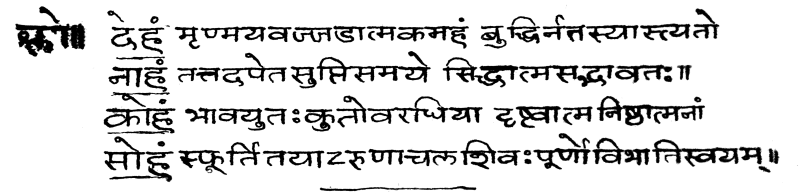
Thamiżh version of the mantra in Bhagavān's hand-writing is:
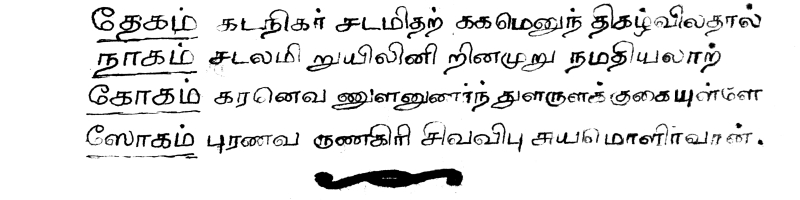
We will use the Saṃskṛtam version as the basis here for our contemplation:
देहं मृण्मयवज्जडात्मकमहं बुद्धिर्नतस्यास्त्यतो
नाहं तत्तदपेत सुप्तिसमये सिद्धात्म सद्भावतः ।
कोऽहं भावयुतः कुतोवरधिया दृष्टवात्म निष्ठात्मनां
सोऽहं स्फूर्ति तयाऽरुणाचलशिवः पूर्णो विभातिस्वयम् ॥
dehaṃ mṛṇmayavajjaḍātmakamahaṃ buddhirnatasyāstyato
nāhaṃ tattadapeta suptisamaye siddhātma sadbhāvataḥ ‖
ko'haṃ bhāvayutaḥ kutovaradhiyā dṛṣṭavātma niṣṭhātmanāṃ
so'haṃ sphūrti tayā'ruṇācalaśivaḥ pūrṇo vibhātisvayam ‖‖
Being an important & glorious mantram, let us look at पदच्छेद (resolution of a sentence into its constituent parts, viz., word-wise break-up) of this mantra so that we can dwell on the meaning of the words of this mantra for understanding its significance.
देहं मृन्मय वत् जड आत्मकं अहं बुद्धिः न तस्य अस्ति अतः
न अहं तद् तद् अपेत सुप्ति समये सिद्ध आत्म सत् भावतः ।
कः अहं भाव युतः कुतस् वर धिया दृष्ट्वा आत्म निष्ठ आत्मनां
सः अहं स्फूर्तितया अरुणाचल शिवः पूर्णः विभाति स्वयम् ॥
dehaṃ mṛnmaya vat jaḍa ātmakaṃ ahaṃ buddhiḥ na tasya asti ataḥ
na ahaṃ tad tad apeta supti samaye siddha ātma sat bhāvataḥ ‖
kaḥ ahaṃ bhāva yutaḥ kutas vara dhiyā dṛṣṭvā ātma niṣṭha ātmanāṃ
saḥ ahaṃ sphūrtitayā aruṇācala śivaḥ pūrṇaḥ vibāti svayam ‖‖
This mantra of four lines has three important sections, viz., dehaṃ-na ahaṃ, kaḥ ahaṃ-kutas and saḥ ahaṃ each one corresponding to rēchaka, pūraka; and kumbhaka of the jñāna prāṇāyāma. We will take up each of them separately in detail.
Rēchaka - dehaṃ-na ahaṃ - I am not the body
Meaning of the words in the first line: dehaṃ = body; vat = like; mṛnmaya = clod (lump of clay); ātmakaṃ = true characteristic nature of; jaḍa = insert / insentience; ahaṃ buddhiḥ = I-ness / I sense; na = not; tasya = to it; asti = there is; ataḥ = therefore.
The first line thus indicates that the body is inert like a mud pot, not conscious of its own existence and therefore there is no I-ness to the body.
Meaning of the words in the second line: supti samaye = (even) during deep sleep; tad = that (body) apeta = (we are) disentangled / free from; bhāvataḥ = being / endure; siddha = established; sat = existence; ātma = Self; tad = Hence; na ahaṃ = not I.
During deep sleep, the body exists and functions but we are disentangled from it and even when we are not aware of the body (and its functions), we do endure as established in the ever existent Self. Hence I am not the body.
Māṇḍūkyopaniṣad declares the state of deep sleep as7:
एवानन्दमयो ह्यानन्दभुक् चेतोमुखः
evānandamayo hyānandabhuk cetomukhaḥ
ānandamayaḥ = Full of bliss; ānandabhuk = Experiencing Bliss and cetomukhaḥ = Path to Self-awareness.
It is all bliss during deep sleep. The happiness of deep sleep is greater than all other forms of happiness or pleasure born of sense-contact. It is filled with ānanda, bliss, delight, satisfaction. We go to the blessedness of eternity and infinity in sleep. What is the instrument through which we enjoy this ānanda? Not the senses, not the mind. This ānanda is our real nature.
First two lines of jñāna prāṇāyāma conclude that I am not the body. Here the body includes not just the gross physical body but also subtle (sūkṣma) and causal (kāraṇa) bodies. Bhagavān says "The gross body which is composed of the seven humours (dhatus), I am not; the five cognitive sense organs, ... I am not; ... the five vital airs, ... I am not; even the mind which thinks, I am not; the nescience too, ...I am not." 8
Śaṅkarācārya in his Tattvabodha states9:
स्थूलसूक्ष्मकारणशरीराद्व्यतिरिक्तः
sthūlasūkṣmakāraṇaśarīrādvyatiriktaḥ
The Self is that which is other than gross, subtle and causal bodies.
Taken together, the meaning of rēchaka part is:
The body is insentient like a pot made of clay, and to it there is no I-ness. And even during deep sleep,when we are disentangled from the body, we do exist as self-established Atman. Therefore, the 'I' is not the body.
Pūraka - kaḥ ahaṃ & kutas - Enquiry of Who am I & Whence am I
Let us turn to our attention to the words of the third line: kaḥ = who; ahaṃ = (am) I; bhāva yutaḥ = (that) exist connected (with ego); kutas = whence (am I)? vara dhiyā = (with) keen discerning intellect; dṛṣṭvā = having seen/known (in their hearts); ātma niṣṭha ātmanāṃ = Self firmly abides in the Self.
If the body is not the I, who is the one who springs up as "I"? Enquire with keen intent and dive deeply with a sharp intellect, "Who am I that is united with ego?" and "Whence am I?, that is from where does the ego arise? Those seeking thus, see in their hearts that Self is established as the Self.
The Saṃskṛta word ahaṃ, "I", is very suggestive and that the two letters of the word अ and ह are the first and last letters of the Saṃskṛta alphabet and that this fact shows that "I" comprises all. Therefore, if we analyze the concept of "I-ness" or "I am" ahaṃ-vṛtti, we will reach the ahaṃ, because this ahaṃ-vṛtti is intertwined with all the mental concepts or modes, and can also subsist by itself. If the ahaṃ-vṛtti is traced to its Source, it will end in the Self. The ahaṃ-vṛtti was referred to by the French mathematician and philosopher, René Descartes, who said "Cogito ergo sum" (I think, therefore I am) in the year 1637. In a work in 1642, he argued, "I am" (sum) is indubitable. The ahaṃ-vṛtti is the irreducible datum of our experience.
Kumbhaka - saḥ ahaṃ - I am That
Let us continue with the words of the fourth line: sphūrtitayā = throb of "I I"; vibhāti svayam = shines forth itself (self-effulgent) ; aruṇācala śivaḥ = as Aruṇācala Śivaḥ; pūrṇaḥ = Perfect Whole; saḥ ahaṃ = That I am;
Connecting these words with that of third line, the meaning is: In the hearts of those who diving deep with this enquiry, Lord Aruṇāchala Śiva, the self-effulgent and perfect whole, shines as the throb of "I". This firm abidance in the Self is characterized by the word so'haṃ ("I am That").
Bhagavān says10:
भेदभावनात् सोऽहमित्यसौ ।
भावनाऽभिदा पावनी मता ॥
bheda-bhāvanāt sō'hamityasau
bhāvanā'bhidā pāvanī matā
Meaning: Better than viewing Him as Other, Indeed the noblest attitude of all, Is to abide as "I am That".
Bṛhadāraṇyaka upaniṣad states11:
मनसैवानुद्रष्टव्यम् नेह नानास्ति किञ्चन ।
मृत्योः स मृत्युमाप्नोति य इह नानेव पश्यति ॥
manasaivānudraṣṭavyam neha nānāsti kiñcana ।
mṛtyoḥ sa mṛtyumāpnoti ya iha nāneva paśyati॥
Meaning: He goes from death to death. Who? Who sees difference, as it were, in Brahman.
Being as "I am That" with the bhāva (attitude) of non-difference with Lord, the Lord raises the devotee to His level making the devotee perceive everything as Self. So long as the devotee thinks of the Lord as different from the devotee, the Lord also makes him function as an entity different from Him. "I am That", where jiva blossoms as Lord Aruṇāchala Śiva is the final state of jñāna that the seeker must attain. Bhagavān shows the way for it in jñāna prāṇāyāma.
In response to a question on ajapa by a devotee, Bhagavān said: "What is your idea of ajapa? Will it be ajapa if you go on repeating aloud 'so'haṃ, so'haṃ'? Ajapa means to know that japa which goes on involuntarily without being uttered through the mouth. Without knowing the real meaning of that japa, people think that it means repeating with the mouth the words 'so'haṃ, so'haṃ' lakhs of times, counting them on the fingers or on a string of beads."12 He continues, "The vision of the real Self which performs japa of its own accord involuntarily and in a never ending stream like the flowing down continuously of ghee is ajapa."
In summary, the meaning of the jñāna prāṇāyāma mantra is: The body is insentient like a clod (i.e. similar to a pot made of clay), and to it there is no I-ness. In other words, the body does not have any awareness of itself as I. And even in deep sleep,when we are disentangled from the body, we do exist as self-established Atman. Therefore, the 'I' is not the body. Enquire, then, "Who is the one connected with the ego" (i.e "Who am I") and "Whence am I". In the hearts of those who, seeking thus with keen insight (discerning intellect), firmly abiding in Atma, there shines forth Lord Aruṇāchala Śiva as the throb of "I" ("I am That") clearly, which is self-effulgent (spontaneously on its own) and is the one infinite perfect whole. The characteristic of the body, the nature of the Self, enquiry into the source of ego, and finally the throb of "I" directly experienced in the heart as Aruṇāchala are all succinctly explained; thus the entire gamut of the teaching of Vedanta in a single sweep is rendered as one mantra. That Bhagavān taught this mantra to five-year old Indira is a testimony on its simplicity and accessibility to all without any bias.
(Hṛdaya continues to throb...)
MAHA BHAKTA VIJAYAM
The Divine Sage Janabai
Nabaji Siddha
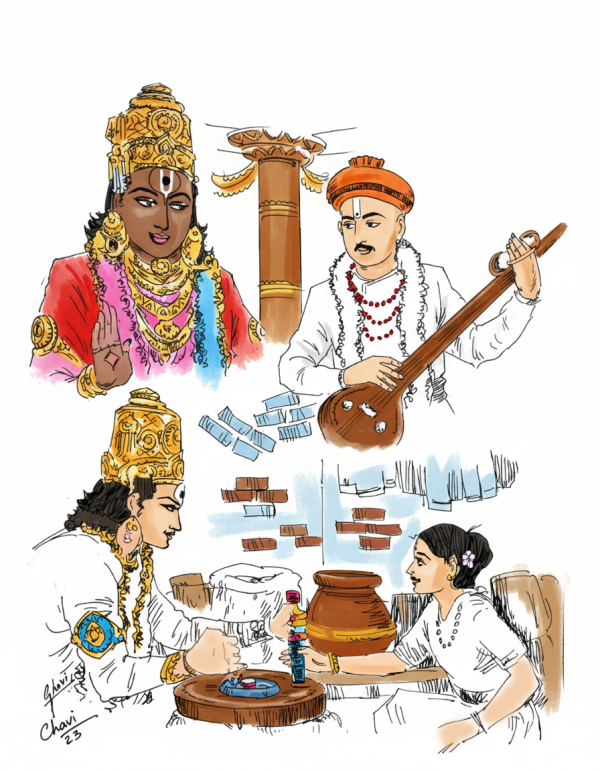
In the hallowed annals of Bhakti, where the sacred and the sublime intertwine, the life of Janabai shines like a resplendent jewel, her unwavering love for Lord Vitthal illuminating the path of devotion for
all to follow. Born in the serene village of Gangakhed, cradled by the holy waters of the Godavari in Maharashtra, Janabai’s earthly sojourn was but a prelude to her celestial union with the Divine. The
daughter of humble parents, her early life was marked by trials that would forge her spirit into an instrument of divine love. Orphaned at a tender age when both her mother and father departed this world, the young Janabai found herself
alone in Pandharpur, standing before the sacred temple of Lord Vitthal, her innocent heart already turning towards the spiritual path that would define her existence.
At the tender age of eight, when most children cling to worldly attachments, Janabai received a divine inspiration that would shape her destiny. A voice from within whispered the eternal truth: that by serving a true devotee of God,
with his mercy, she could attain the Supreme Lord Himself. This revelation became the guiding star of her life, leading her to the doorstep of Sant Namdev Maharaj, where she humbly requested to be accepted as a servant in his
household. Little did she know that this simple act of surrender would blossom into one of the most extraordinary spiritual journeys recorded in the annals of sainthood.
Service as Sadhana
From the moment Janabai entered the sanctified abode of Sant Namdev, her life became an unbroken hymn of service. The saint’s household was no ordinary home but a veritable temple where every action was infused by devotion. Namdev
himself, whose very breath was an invocation of the Lord’s name, radiated a divine aura that permeated every corner of the dwelling. His constant chanting of the holy name created an atmosphere so charged with spiritual energy that even
the walls seemed to reverberate with the sound of “Vitthal, Vitthal.”
Janabai, with the innocence of a child and the fervor of a sage, immersed herself completely in her appointed tasks. She understood the profound truth that serving a saint like Namdev was even greater than serving the Lord directly, for
the Lord Himself takes delight in the happiness of His devotees. With this realization burning in her heart, she undertook every menial task – washing garments stained with the dust of devotion, grinding grain that would become
sanctified food, sweeping floors that had been trodden by saintly feet, and preparing meals that were nothing short of prasad for the divine household.
Her service was not merely physical labor but a sacred dance of devotion. While her hands moved in ceaseless activity, her mind remained absorbed in divine contemplation. The name of Lord Vitthal became the rhythm of her heartbeat, the
mantra that accompanied every movement. So profound was her absorption that, sometimes, while reciting the Lord’s name during her chores, her hands would pause mid-motion as tears of divine longing cascaded down her cheeks. In these
moments, the material world would fade away, and she would stand transfixed, her soul soaring in the celestial realms.
The household of Namdev became her ashram, her gurukul, and her temple. She served not just the saint but his entire family with equal devotion, considering no task too small or insignificant. The grinding stone became
her altar, the broom her sacred staff, the washing ghat her place of meditation. Through this selfless service, Janabai demonstrated the truth that devotion is not separate from duty, that spirituality is not divorced from
daily life, but that every action can become worship when performed with the right attitude.
Devotion Transcends the Physical
As days turned into months and months into years, Janabai’s spiritual experiences deepened in intensity. The constant company of Namdev acted like a spiritual catalyst, accelerating her inner transformation. Without warning, she would
be overtaken by states of divine ecstasy while performing her daily chores. While mopping the floors, she might suddenly find her hands frozen in mid-motion as waves of divine love overwhelmed her. The physical act of cleaning would
transform into a mystical experience, with every stroke of the mop becoming a stroke of the divine chisel shaping her soul.
Her attachment to Lord Vitthal grew into an all-consuming fire of longing. Whenever free from her service duties, she would rush to the temple and stand for hours gazing at the deity, her eyes drinking in the divine form. In these
moments, time stood still. Sometimes the longing would become so intense that she would burst into tears; at other times, the joy would be so overwhelming that she would spontaneously begin to dance, oblivious to the world around her.
These mystical states were not sought after but came unbidden, the natural flowering of a heart completely surrendered to the Divine. Namdev observed these transformations with quiet joy, recognizing that his humble servant was
attaining spiritual heights that even seasoned yogis might envy. Yet Janabai herself remained unaffected by these experiences, always careful not to let her ecstasies interfere with her service. She understood the profound truth that
serving the devotee pleased the Lord more than any personal spiritual attainment.
The Ekadashi nights were events of extraordinary spiritual significance. On these sacred occasions, groups of devotees would gather as darkness fell, transforming the humble abode of Namdev into a celestial court. The air would
thrum with divine vibrations as the kirtan began – some devotees playing drums and cymbals with rhythmic precision, others dancing with abandon, their souls intoxicated with divine love, while yet others sat in quiet
contemplation, absorbing the sacred energies.
Janabai, having completed her service duties, would stand in a corner, her eyes fixed on Sant Namdev, whose face glowed with an otherworldly radiance during these gatherings. As the kirtan progressed, she would lose all sense
of time and space, merging into the ocean of divine sound. The night would pass unnoticed, the boundary between earthly time and eternal now dissolving in the crucible of devotion.
At times, the intensity of her absorption was such that she would forget all worldly responsibilities. One such memorable Ekadashi, she became so immersed in the kirtan that dawn broke without her realizing it. Suddenly aware
that she had neglected her morning duties, she rushed to the riverbank in a flurry of anxiety, worried about how she would complete all her tasks. It was at this moment of distress that the Lord chose to reveal His boundless compassion
in the most unexpected way.
When God Becomes the Servant
As Janabai stood by the Chandrabhaga River, her mind swirling with worries about the unwashed clothes, the unscrubbed utensils, and the unprepared meals, a remarkable event occurred that would become legendary in the annals of
devotional history. An elderly woman appeared suddenly, her presence radiating a strange serenity. Her face, though lined with age, glowed with an inner light, and her eyes sparkled with knowing compassion.
“Why do you worry, dear child?” the old woman asked, her voice carrying an unearthly sweetness. “Go attend to your other duties. I shall take care of washing these clothes.”
Janabai, though taken aback by the stranger’s sudden appearance, felt an inexplicable trust. “But mother,” she replied, “why would you do this for me? These clothes are many, and the task is burdensome.”
The old woman smiled enigmatically. “Only I know the true art of washing,” she said. “The clothes I cleanse never become soiled again.”
There was a profound mystery in these words that Janabai couldn’t immediately grasp. Leaving the clothes in the woman’s care, she hurried back to complete her other tasks, her heart lightened by this unexpected help. When she returned
later, she found all the garments washed to perfection, spread out to dry in the morning sun, looking newer and cleaner than ever before.
Overwhelmed with gratitude, Janabai folded her hands in reverence. “I have never met anyone as kind as you,” she said. “We are strangers, yet you’ve done me this great service. Surely Lord Vitthal has sent you as an answer to my
prayers!”
The old woman’s response was even more mysterious: “I am yours only. Do we express gratitude to our own?” With these cryptic words and a beatific smile, she walked away, adding, “Whenever you need me, just remember me. Whenever you
remember, I shall be there to serve you.”
Before Janabai could question her further or even ask her name, the woman disappeared as suddenly as she had appeared, leaving Janabai in a state of wonderment and longing.
Janabai returned to Namdev’s house with the clean clothes, but her heart was restless with unanswered questions. Who was this mysterious benefactor? Where had she come from, and where had she gone? The woman’s words echoed in her mind,
carrying layers of meaning she couldn’t quite decipher.
Unable to contain her curiosity, she approached Namdev and narrated the entire incident. As she spoke, she noticed tears welling up in the saint’s eyes. When she finished, Namdev clasped his hands in reverence and exclaimed, “O Janabai!
Do you not realize? That was none other than Lord Vitthal Himself who had come to serve His devotee!”
The revelation struck Janabai like a thunderbolt. Emotions surged through her – awe at the Lord’s compassion, shame that she hadn’t recognized Him, and overwhelming love at this demonstration of divine grace. She burst into tears,
crying, “O Lord! You came to me, and I failed to know You! Not only that, You took upon Yourself my humble duties!”
Namdev consoled her, “Janabai, you are most blessed. The Lord has shown you His ultimate love. He who is served by all creation chose to serve you. This is the glory of pure devotion!”
From that day forward, the Lord’s presence in Janabai’s daily life became increasingly tangible. It seemed Vitthal had taken a personal interest in assisting His devoted servant. When she swept the house and gathered piles of dust, she
would turn to find the Lord Himself standing with a basket, ready to collect what she had swept. His divine hands, which hold the entire universe, now helped with the most mundane household tasks.
While grinding grains at the mill, Janabai would often become utterly absorbed in her divine intoxication, singing the holy names of Vitthal with such abandon that the world around her would melt away. Her arms, which had been turning
the heavy stone, would gradually fall still, but her voice would soar higher into the ether. Yet, astonishingly, the rhythmic sound of grinding would continue uninterrupted. The grain still fell into the bowl, ground fine and even, as
if moved by an invisible force. In those moments, it was none other than Lord Vitthal Himself—the Beloved in dark blue—who would step in silently, turning the millstone with His own divine hands, smiling all the while. For He could not
bear that her ecstatic devotion should be burdened by mundane chores. The Lord who governs the cosmos had become a quiet helper in her kitchen, ensuring that her service to Saint Namdev’s household — her sacred duty — was never
forsaken.
And soon, the miracles unfolded like petals from a celestial bloom. The villagers began to whisper, then gather, drawn by the mystical sounds emanating from Janabai’s stone mill. As it turned, it did not just crush grain — it sang.
Melodies poured from the stone as if an unseen harmonium resided within it, each note soaked in bhakti. On days when her body was worn by exhaustion, her broom would lift itself from the corner and continue sweeping the
courtyard, moving as if carried by invisible hands. When devotees came in large numbers to Namdev’s house, her single clay pot of rice — though modest in size — never emptied. No matter how many she fed, there was always more. But
beyond these visible wonders lay a deeper alchemy: Janabai’s heart had so sanctified her world that every object around her was transfigured. The broom, once an instrument of dust, became a wand dispersing ignorance. The grinding stone,
a symbol of toil, became a destroyer of ego. Even the ghat where she washed clothes became a portal to purification, as if her touch had made it a threshold between sin and sanctity.
Yet, amid all these marvels, the most moving miracle was the Lord’s own words. Often, He would appear to her — sometimes disguised, sometimes resplendent in His true form — and say, “Janabai, I am indebted to you. You serve my beloved
Namdev, and in serving him, you serve me.” These words, simple yet profound, would bring tears to her eyes. For the Supreme Being to declare himself indebted to a lowly servant girl revealed the astonishing mystery of divine love. Her
hands, though roughened by work, had touched God’s heart. Her voice, though born of simplicity, had drawn him down from his celestial heights. In the grain she ground, the floors she swept, the pots she stirred — there echoed the secret
of bhakti: that in humble service, performed with love, the finite meets the Infinite, and even the Lord Himself becomes a devotee of His devotee.
(To be continued)
Nabaji Siddha
In the hallowed annals of Bhakti, where the sacred and the sublime intertwine, the life of Janabai shines like a resplendent jewel, her unwavering love for Lord Vitthal illuminating the path of devotion for all to follow. Born in the serene village of Gangakhed, cradled by the holy waters of the Godavari in Maharashtra, Janabai’s earthly sojourn was but a prelude to her celestial union with the Divine. The daughter of humble parents, her early life was marked by trials that would forge her spirit into an instrument of divine love. Orphaned at a tender age when both her mother and father departed this world, the young Janabai found herself alone in Pandharpur, standing before the sacred temple of Lord Vitthal, her innocent heart already turning towards the spiritual path that would define her existence.
At the tender age of eight, when most children cling to worldly attachments, Janabai received a divine inspiration that would shape her destiny. A voice from within whispered the eternal truth: that by serving a true devotee of God, with his mercy, she could attain the Supreme Lord Himself. This revelation became the guiding star of her life, leading her to the doorstep of Sant Namdev Maharaj, where she humbly requested to be accepted as a servant in his household. Little did she know that this simple act of surrender would blossom into one of the most extraordinary spiritual journeys recorded in the annals of sainthood.
Service as Sadhana
From the moment Janabai entered the sanctified abode of Sant Namdev, her life became an unbroken hymn of service. The saint’s household was no ordinary home but a veritable temple where every action was infused by devotion. Namdev himself, whose very breath was an invocation of the Lord’s name, radiated a divine aura that permeated every corner of the dwelling. His constant chanting of the holy name created an atmosphere so charged with spiritual energy that even the walls seemed to reverberate with the sound of “Vitthal, Vitthal.”
Janabai, with the innocence of a child and the fervor of a sage, immersed herself completely in her appointed tasks. She understood the profound truth that serving a saint like Namdev was even greater than serving the Lord directly, for the Lord Himself takes delight in the happiness of His devotees. With this realization burning in her heart, she undertook every menial task – washing garments stained with the dust of devotion, grinding grain that would become sanctified food, sweeping floors that had been trodden by saintly feet, and preparing meals that were nothing short of prasad for the divine household.
Her service was not merely physical labor but a sacred dance of devotion. While her hands moved in ceaseless activity, her mind remained absorbed in divine contemplation. The name of Lord Vitthal became the rhythm of her heartbeat, the mantra that accompanied every movement. So profound was her absorption that, sometimes, while reciting the Lord’s name during her chores, her hands would pause mid-motion as tears of divine longing cascaded down her cheeks. In these moments, the material world would fade away, and she would stand transfixed, her soul soaring in the celestial realms.
The household of Namdev became her ashram, her gurukul, and her temple. She served not just the saint but his entire family with equal devotion, considering no task too small or insignificant. The grinding stone became her altar, the broom her sacred staff, the washing ghat her place of meditation. Through this selfless service, Janabai demonstrated the truth that devotion is not separate from duty, that spirituality is not divorced from daily life, but that every action can become worship when performed with the right attitude.
Devotion Transcends the Physical
As days turned into months and months into years, Janabai’s spiritual experiences deepened in intensity. The constant company of Namdev acted like a spiritual catalyst, accelerating her inner transformation. Without warning, she would be overtaken by states of divine ecstasy while performing her daily chores. While mopping the floors, she might suddenly find her hands frozen in mid-motion as waves of divine love overwhelmed her. The physical act of cleaning would transform into a mystical experience, with every stroke of the mop becoming a stroke of the divine chisel shaping her soul.
Her attachment to Lord Vitthal grew into an all-consuming fire of longing. Whenever free from her service duties, she would rush to the temple and stand for hours gazing at the deity, her eyes drinking in the divine form. In these moments, time stood still. Sometimes the longing would become so intense that she would burst into tears; at other times, the joy would be so overwhelming that she would spontaneously begin to dance, oblivious to the world around her.
These mystical states were not sought after but came unbidden, the natural flowering of a heart completely surrendered to the Divine. Namdev observed these transformations with quiet joy, recognizing that his humble servant was attaining spiritual heights that even seasoned yogis might envy. Yet Janabai herself remained unaffected by these experiences, always careful not to let her ecstasies interfere with her service. She understood the profound truth that serving the devotee pleased the Lord more than any personal spiritual attainment.
The Ekadashi nights were events of extraordinary spiritual significance. On these sacred occasions, groups of devotees would gather as darkness fell, transforming the humble abode of Namdev into a celestial court. The air would thrum with divine vibrations as the kirtan began – some devotees playing drums and cymbals with rhythmic precision, others dancing with abandon, their souls intoxicated with divine love, while yet others sat in quiet contemplation, absorbing the sacred energies.
Janabai, having completed her service duties, would stand in a corner, her eyes fixed on Sant Namdev, whose face glowed with an otherworldly radiance during these gatherings. As the kirtan progressed, she would lose all sense of time and space, merging into the ocean of divine sound. The night would pass unnoticed, the boundary between earthly time and eternal now dissolving in the crucible of devotion.
At times, the intensity of her absorption was such that she would forget all worldly responsibilities. One such memorable Ekadashi, she became so immersed in the kirtan that dawn broke without her realizing it. Suddenly aware that she had neglected her morning duties, she rushed to the riverbank in a flurry of anxiety, worried about how she would complete all her tasks. It was at this moment of distress that the Lord chose to reveal His boundless compassion in the most unexpected way.
When God Becomes the Servant
As Janabai stood by the Chandrabhaga River, her mind swirling with worries about the unwashed clothes, the unscrubbed utensils, and the unprepared meals, a remarkable event occurred that would become legendary in the annals of devotional history. An elderly woman appeared suddenly, her presence radiating a strange serenity. Her face, though lined with age, glowed with an inner light, and her eyes sparkled with knowing compassion.
“Why do you worry, dear child?” the old woman asked, her voice carrying an unearthly sweetness. “Go attend to your other duties. I shall take care of washing these clothes.”
Janabai, though taken aback by the stranger’s sudden appearance, felt an inexplicable trust. “But mother,” she replied, “why would you do this for me? These clothes are many, and the task is burdensome.”
The old woman smiled enigmatically. “Only I know the true art of washing,” she said. “The clothes I cleanse never become soiled again.”
There was a profound mystery in these words that Janabai couldn’t immediately grasp. Leaving the clothes in the woman’s care, she hurried back to complete her other tasks, her heart lightened by this unexpected help. When she returned later, she found all the garments washed to perfection, spread out to dry in the morning sun, looking newer and cleaner than ever before.
Overwhelmed with gratitude, Janabai folded her hands in reverence. “I have never met anyone as kind as you,” she said. “We are strangers, yet you’ve done me this great service. Surely Lord Vitthal has sent you as an answer to my prayers!”
The old woman’s response was even more mysterious: “I am yours only. Do we express gratitude to our own?” With these cryptic words and a beatific smile, she walked away, adding, “Whenever you need me, just remember me. Whenever you remember, I shall be there to serve you.”
Before Janabai could question her further or even ask her name, the woman disappeared as suddenly as she had appeared, leaving Janabai in a state of wonderment and longing.
Janabai returned to Namdev’s house with the clean clothes, but her heart was restless with unanswered questions. Who was this mysterious benefactor? Where had she come from, and where had she gone? The woman’s words echoed in her mind, carrying layers of meaning she couldn’t quite decipher.
Unable to contain her curiosity, she approached Namdev and narrated the entire incident. As she spoke, she noticed tears welling up in the saint’s eyes. When she finished, Namdev clasped his hands in reverence and exclaimed, “O Janabai! Do you not realize? That was none other than Lord Vitthal Himself who had come to serve His devotee!”
The revelation struck Janabai like a thunderbolt. Emotions surged through her – awe at the Lord’s compassion, shame that she hadn’t recognized Him, and overwhelming love at this demonstration of divine grace. She burst into tears, crying, “O Lord! You came to me, and I failed to know You! Not only that, You took upon Yourself my humble duties!”
Namdev consoled her, “Janabai, you are most blessed. The Lord has shown you His ultimate love. He who is served by all creation chose to serve you. This is the glory of pure devotion!”
From that day forward, the Lord’s presence in Janabai’s daily life became increasingly tangible. It seemed Vitthal had taken a personal interest in assisting His devoted servant. When she swept the house and gathered piles of dust, she would turn to find the Lord Himself standing with a basket, ready to collect what she had swept. His divine hands, which hold the entire universe, now helped with the most mundane household tasks.
While grinding grains at the mill, Janabai would often become utterly absorbed in her divine intoxication, singing the holy names of Vitthal with such abandon that the world around her would melt away. Her arms, which had been turning the heavy stone, would gradually fall still, but her voice would soar higher into the ether. Yet, astonishingly, the rhythmic sound of grinding would continue uninterrupted. The grain still fell into the bowl, ground fine and even, as if moved by an invisible force. In those moments, it was none other than Lord Vitthal Himself—the Beloved in dark blue—who would step in silently, turning the millstone with His own divine hands, smiling all the while. For He could not bear that her ecstatic devotion should be burdened by mundane chores. The Lord who governs the cosmos had become a quiet helper in her kitchen, ensuring that her service to Saint Namdev’s household — her sacred duty — was never forsaken.
And soon, the miracles unfolded like petals from a celestial bloom. The villagers began to whisper, then gather, drawn by the mystical sounds emanating from Janabai’s stone mill. As it turned, it did not just crush grain — it sang. Melodies poured from the stone as if an unseen harmonium resided within it, each note soaked in bhakti. On days when her body was worn by exhaustion, her broom would lift itself from the corner and continue sweeping the courtyard, moving as if carried by invisible hands. When devotees came in large numbers to Namdev’s house, her single clay pot of rice — though modest in size — never emptied. No matter how many she fed, there was always more. But beyond these visible wonders lay a deeper alchemy: Janabai’s heart had so sanctified her world that every object around her was transfigured. The broom, once an instrument of dust, became a wand dispersing ignorance. The grinding stone, a symbol of toil, became a destroyer of ego. Even the ghat where she washed clothes became a portal to purification, as if her touch had made it a threshold between sin and sanctity.
Yet, amid all these marvels, the most moving miracle was the Lord’s own words. Often, He would appear to her — sometimes disguised, sometimes resplendent in His true form — and say, “Janabai, I am indebted to you. You serve my beloved Namdev, and in serving him, you serve me.” These words, simple yet profound, would bring tears to her eyes. For the Supreme Being to declare himself indebted to a lowly servant girl revealed the astonishing mystery of divine love. Her hands, though roughened by work, had touched God’s heart. Her voice, though born of simplicity, had drawn him down from his celestial heights. In the grain she ground, the floors she swept, the pots she stirred — there echoed the secret of bhakti: that in humble service, performed with love, the finite meets the Infinite, and even the Lord Himself becomes a devotee of His devotee.
(To be continued)
Introducing Nondi’s Corner
Hello young adults and children!
 Hello young adults and children!
This is Nondi, a monkey devotee of Bhagavan. Welcome to the October 2025 edition of the Children/youth corner.
In this section, I will share stories, anecdotes, puzzles and interesting facts to provide you spiritual nourishment every quarter.
The aim is to inspire and help you blossom into kind, brave and decisive adults.
I look forward to engaging with all of you, all over the world, in the years to come. Please share your queries, feedback and articles with me at mountainpath@gururamana.org
Sincerely,Your friend,
“Nondi”
Pain and pleasure are mental conceptions
Here’s a powerful story narrated by Bhagavan Ramana Maharshi from the Panchadasi (written by Vidyaranya Swami) that brings home a deep truth: our experiences of joy and sorrow often arise not from what actually is, but from what we think. Much of our happiness, pain, pride, or insecurity comes from mental images of ourselves, of others, and of how we believe we are seen. Bhagavan uses this simple tale to point out the futility of such mental constructs and reminds us to question the reality of our thoughts and beliefs.
Suri Nagamma’s reference to Rangaswami in one of her letters highlights his deep dedication to Bhagavan: “After Veda Parayana, Bhagavan had his bath and breakfast and started for Skandasramam accompanied by Rangaswami, who is like Nandi to Lord Siva.”
There were two young men in a village in South India. They went on a pilgrimage to North India. One of them died. The survivor, who had begun earning a wage in the North, decided to return only after some months. In the meantime, he came across a wandering pilgrim whom he asked to convey the information regarding himself and his dead companion to the village in South India. The wandering pilgrim did so, but by mistake changed the names. The result was that the dead man’s parents rejoiced in his safety and the living one’s parents were in grief. Thus, you see, pain or pleasure has no reference to facts but to mental conceptions.1
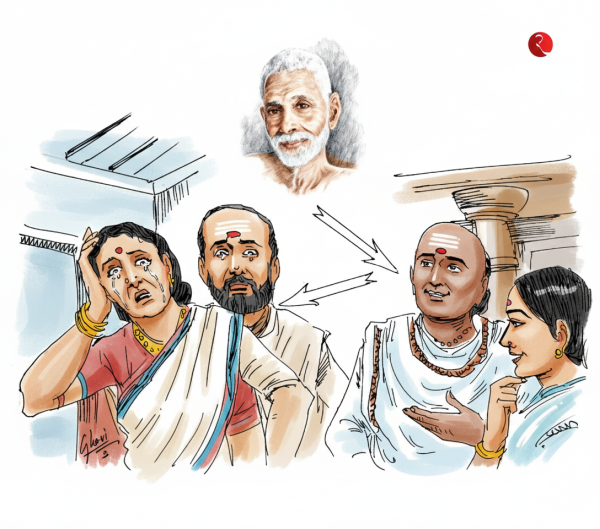
Youth Corner
Commentary
In this personal account, our young friend Lakshya Sharma shares how he came to Bhagavan and what Sri Ramana Maharshi means to him. Lakshya grew up in Delhi NCR where he completed his schooling and undergraduate studies. He now works at American Express as an Analyst in their Risk Management division. He enjoys watching football, listening to music and playing video games.
It seems like yesterday when my mother received a book on Bhagavan from a friend, and the series of events that followed were nothing short of extraordinary.
I remember that my family, especially my father, had been going through a tough phase around the same time that my mother came across Bhagavan’s book. Back then, the future seemed clouded with uncertainty, and hopes for things to get better grew dimmer with each passing day. My mother tried reading the book but was initially left confused and felt that Bhagavan’s teachings were beyond her understanding. However, something prompted her to give it another try, and this time, she became deeply engrossed in the book and Bhagavan’s teachings. She recommended it to my father, but he didn’t pay much attention and carried on with his routine.
One day, my mother, who is fond of podcasts, was listening to a talk by Dr. Sanjay Raghav while my father was getting ready for his morning walk. He was loosely listening in, but soon found himself paying closer attention. He became so engrossed in the talk that he forgot to go for his walk! Eventually, my parents started visiting the Kendram, which, by Bhagavan’s grace, is very close to our home in Hyderabad. From then on, slowly and gradually, everything began to fall into place. It felt as if a divine energy had taken us in.
Now, looking back, I feel that everything happened for a reason, and that this was how Bhagavan intended for us to be drawn into the fold of his grace. My parents would always request me to accompany them to the Kendram. I’ll admit, I was a bit skeptical at first, but I decided to tag along with them on Sundays. Gradually, I began to feel a heavenly sense of peace inside the hall of the Kendram — something I had never experienced before. It felt like I had discovered something within myself that had long been hidden: an inner calm and peace.
After leaving Hyderabad for my job in Gurgaon, I found myself yearning for the peace I had experienced. I visited the Ashram in Tiruvannamalai with my parents, who were already regular visitors. I can only describe the experience as that of visiting heaven on Earth. The Ashram was brimming with positive energy and vibrations, and everything moved slowly and peacefully. I completed the Giripradakshina with my parents. Though it seemed daunting at first, it felt incredibly rewarding. As I walked, my thoughts kept turning to Bhagavan. By the end, a blissful joy had taken over me, bringing a deep and unfamiliar happiness. The Giripradakshina around the beautiful Arunachala Hill with my parents is a memory I will always cherish.
I remember recently going through a rough phase at work, as many of my colleagues were being laid off. I started feeling insecure. It was my first job, and I was unprepared to handle such a situation, but Bhagavan’s teachings came to my rescue. I surrendered to him and held on to my patience. I left everything in his hands and had faith that things would eventually turn out well. Slowly, I noticed that circumstances began to align in my favor as I continued making efforts to improve my situation. This only strengthened my faith in Bhagavan and his teachings.
I feel eternally grateful and blessed to have had Bhagavan welcome me and my parents into his asylum, guiding us every step of the way. I always feel like he is watching over me, no matter what I am going through, and that he will take care of me and my loved ones. I believe deeply that everything happens for a reason, and this journey has only deepened that belief. Although I feel I am still early on my path, I trust that everything will align perfectly in the future, and that Bhagavan will always watch over me on my journey.
Connect with Sri Ramanasramam:
Live Streams and ‘In Focus’ Videos
Sri Ramanasramam offers live streaming of the Sri Chakra Puja on the first and last Friday of each month. Daily live streaming (Monday to Saturday) from 8:00 to 9:30 am and 5:00 to 6:45 p.m. IST continues, and includes the Vedaparayana, puja, and Tamil Parayana. (There is no streaming on Sundays.) To access the videos, please visit: https://youtube.com/@SriRamanasramam/videos
Sri Ramanasramam publishes a monthly “In Focus” video on its YouTube channel showcasing the Ashram’s activities. To watch and subscribe, please visit: https://www.youtube.com/@SriRamanasramam/playlists
Here’s this issue’s Fun Corner
Word Search Puzzle:
Find key terms in Bhagavan’s teaching

| Surrender | Summa Iru | I-thought | Self |
| Advaita | Vichara | Who am I | |
| Jnana | Vasana | Heart | |
| Grace | Atma |
Solve the anagrams for western devotees of Bhagavan

Shloka: Sri Ramana Ashtottaram
Let’s continue to memorize this wonderful composition
by Sri Viswanatha Swami. These are 108 names of
Bhagavan used to worship him. As each name is uttered
by way of invocation, a flower is offered in worship. Let’s
memorize one name at a time and understand its meaning.
Here’s Name 8:
ओं श्रीभूमिनाथस्थलोत्थिताय नमः।
Oṁ Sri Bhūmināthasthalōttitāya namaḥ
Meaning: One who sprang into being in the holy spot of Bhuminatha, or Tirumeninatha. The name of Lord Shiva in Bhagavan’s birth place Tiruchuzhi (Bhuminathar or Tirumeninathar) is the “navel of the universe.”
Solutions to July 2025 crossword puzzle and word scramble puzzle
Western Devotees of Bhagavan
- UGY EHGAU
- RAJOM DHCCKIAW
- RTURAH BRNESOO
- ORLDNA NNIXO
- EAOERNL NAEULIP YOEN
- AULP TNRONBU
- S S HNCOE
- KNFRA RSUEMYPHH
- EMARCIU DNNAFYR
- NTARG FUDF
- LEAL LTALARMI
- CYLU BSONEOR
- NAUCDN EEELNGERS
- GUY HAGUE
- MAJOR CHADWICK
- ARTHUR OSBORNE
- RONALD NIXON
- ELEANOR PAULINE NOYE
- PAUL BRINTON
- S S COHEN
- FRANK HUMPHREYS
- MAURICE FRYDMAN
- GRANT DUFF
- ELLA MAILLART
- LUCY OSBORNE
- DUNCAN GREENLEES
Question & Answer
Question: Bhagavan Ramana Maharshi said, "The individual is miserable because he confounds the mind and the body with the Self. This confusion is due to wrong knowledge. Elimination of wrong knowledge is alone needed. Such elimination results in Realization." What is this "wrong knowledge" (avidyā) whose eradication alone ushers in the glorious dawn of Realization?
Answer: The term, avidyā, in its most insidious and subtle expression, does not merely refer to the absence of knowledge but in the pervasive presence of false knowledge — a distortion so deeply embedded in the fabric of perception that it masquerades as truth. It is not simply ignorance, but a superimposition, a misapprehension, a mistaking of the transient for the eternal, the finite for the infinite, the seen for the Seer.
The World's Enduring Assertion
Among the most enduring expressions of avidyā is the world's relentless and implicit assertion that all knowledge arises solely from, and pertains exclusively to, the external world. Every structure of learning, every edifice of academic thought, and every field of inquiry, however intricate or noble, ultimately finds itself rooted in the conviction that the world — defined broadly to include the body, the mind, the senses, and the universe they interact with — is both the source and the subject of all cognition.
This is the first and most subtle deception avidyā perpetuates: that knowing itself is an emergent property of the material world, and that the world is not only the object of all knowing but its indispensable precondition. It whispers that no cognition is possible without sensory input, that no truth is worth knowing unless it can be empirically verified or rationally deduced, and that consciousness itself is a mere derivative of matter.
And yet, this is not merely an epistemological position but a deeply spiritual bondage. To believe that knowing is restricted to the empirical is to close the doors to the deeper strata of intuitive, direct, and uncaused knowledge — the very knowledge that liberates.
Let us examine the knowledge we call our own. Whether we have mastered the laws of physics, delved into the nuances of political science, or contemplated the mysteries of the cosmos, the content of our knowledge remains invariably bound to the world. All our inquiries terminate at phenomena — observable, nameable, and measurable. Even introspective disciplines such as psychology and cognitive science often reduce the mind to electrochemical patterns, the soul to evolutionary byproducts, and love to hormonal fluctuations.
One might possess encyclopedic information across vast domains, and yet, all such knowledge remains descriptive of appearances, never of essence. The vast stores of worldly wisdom thus serve not only to reinforce the primacy of the world but to affirm, ever so subtly, that the world alone is knowable, and what is not of the world is either unknowable, or worse, non-existent.
This is the subtle grip of avidyā: it does not proclaim itself as ignorance, but as enlightenment. It dresses itself in data, in rigor, in rationality. It applauds objectivity, and in doing so, renders the Subject — the very knower — invisible, irrelevant, or reducible. This is the highest form of ignorance: that which invalidates the Self in the very act of seeking knowledge.
And yet, despite this iron-clad structure of empirical thought, there emerges — unasked, uninvited, and uncaused — a knowing that defies all worldly frameworks. It appears as a flash, a certainty without evidence, a recognition that does not originate from experience, inference, or conditioning. It is spontaneous, silent, and luminous — and it cannot be accounted for by any theory of sense-perception or mental association.
This knowing is not about the world. It is not the product of learning, nor is it susceptible to doubt or correction. It arises from within, unmediated and unconditioned. It is the atma-bodha — the knowledge of the Self by the Self. When such knowing dawns, it does not merely supplement our previous understanding; it annuls it. In that sacred instant, one sees clearly that all previous 'knowledge' was but provisional, circumstantial, and dependent.
An example may suffice. Behold a newborn calf. No one teaches the heart that such vulnerability deserves tenderness; no scripture is required to declare that such life demands protection. One simply knows. That knowing is immediate, irrefutable, and ethical — and it arises not from moral philosophy but from the inmost sanctum of the Self. It is dharma: not as a social construct but as an uncaused alignment with Truth.
This inner knowing differs radically in quality from worldly knowledge. The latter demands validation, corroboration, and is constantly threatened by contradiction. Even the most robust scientific theory trembles at the prospect of a single anomaly. But the knowing of the heart — that sacred intuition — is unwavering. It cannot be proved, yet it cannot be shaken.
You may meet a person and instantly know they are to be loved, that they are your own — without a single piece of 'evidence.' You may read a scripture, and something within reverberates with deep recognition: this is not alien; this is my own voice echoed back. The world may question your certainty, but you do not. This is knowledge, yes, but of a different order altogether — it is jñāna, not vidyā in the conventional sense. It arises not through accumulation but through silence. It cannot be remembered, for it precedes memory. This, precisely, is why sages have declared all worldly knowledge to be ignorance. Not because it is false per se, but because it conceals the truth. It perpetuates a subtle arrogance — the presumption that truth can be constructed, obtained, observed or stored.
The Emancipating Power of Living from the Heart
To abide in the clarity of such heart-knowing is to be freed from the tyranny of the world's definitions. It is not anti-intellectualism, but a placement of intellect in its proper place. Bhagavan Ramana Maharshi described this transformation as the elimination of false knowledge. False knowledge is not error; it is knowledge acquired from outside, stored in memory, and assumed to be identity.
To live by the intellect is to live in fear. For the intellect can only trade in comparisons, projections, and probabilities. It is forever uncertain. One may be certain today and shattered tomorrow by a single revelation, a single betrayal and a single piece of contrary evidence. But the knowing that springs from the Self, though often wordless and evading description, can not refuted; it is inviolable.
And yet, how often we betray this sacred knowing! We trust the world more than we trust our heart. We seek confirmation, validation, and consensus. We silence this to fit into societal molds. We dismiss the subtle voice within because it lacks external approval. In doing so, we reject the very truth that alone could have set us free.
The Root of Suffering
The world, through all its intellectual disciplines, social structures, and psychological frameworks, teaches us one unrelenting lesson: that we are incomplete, and that this incompleteness can only be addressed through engagement with the external. From this fundamental premise arises the entire machinery of human striving — education, ambition, romance, wealth, and even morality — all circling around the assumption that something essential lies beyond us, waiting to be attained. This core belief — that fulfillment lies outside — constitutes the seed of avidyā.
It is avidyā that gives rise to suffering — not merely as an intellectual error but as a deeply embodied disorientation. It is the existential ache of believing oneself to be a finite entity, a name-bound, form-bound, time-bound self, thrown into a world of other such finite forms. When finitude encounters finitude, the inevitable result is friction, anxiety, and decay. All worldly knowledge, no matter how refined, affirms this basic error by implicitly or explicitly asserting the separate, limited existence of the knower. The mind, conditioned by worldly teachings, becomes the gatekeeper of this illusion, reinforcing the idea that identity must be defended, improved, or preserved.
Suffering begins not with pain, but with identification — the moment we declare, "This is me," or "This is mine." A bodily ache becomes suffering only when it becomes "my pain." Loss becomes unbearable only when the lost is clutched as "my possession." The world, then, does not impose suffering; rather, it subtly trains us to adopt the very mechanism that generates suffering: attachment born from identification with the limited self. It is not events themselves, but the internal commentary shaped by avidyā, that turns experience into suffering.
What makes avidyā so insidious is that it hides itself within the very tools we employ to overcome it. Our books, our thoughts, even our prayers often presuppose the duality that avidyā rests upon. "I am here, the Truth is there, and I must reach it" — this very thought is already steeped in separation. Thus, we suffer because we seek resolution through the very instruments that perpetuate the separation we long to end. Even spiritual striving, unless tempered by grace and profound discrimination (viveka), can become just another form of worldly ambition — seeking attainment rather than dissolution.
Moreover, the world's consistent message — that everything is limited and perishable — produces a subtle but powerful undercurrent of dread. If all that I love is destined to perish, if all effort is eventually erased by time, then fear becomes a constant companion. This fear may wear the mask of caution, prudence, or responsibility, but beneath it lies the stark terror of impermanence. And where fear persists, so too does craving for permanence, for control, for immortality. Thus the ego, born from avidyā, feeds itself on the suffering it creates, forever running from death and decay while secretly affirming their power.
This is the tragic paradox: we suffer because we believe we are small, and we remain small because we believe our suffering is inevitable. Yet all the while, the true Self — limitless, silent, ungraspable — shines within, untouched by any of this. The moment we turn inward, relinquishing the demand for validation from the world, even momentarily, a strange light breaks through: a peace that asks for nothing, a joy that arises for no reason, a knowing that needs no proof. It is not the world's promises that end suffering, but the silent disidentification from the premise that the world holds the key to your being. This disidentification is not cold detachment, but sacred clarity. And this clarity is grace.
Thus avidyā thrives because the world — and the knowledge derived from it — deals only in the finite. Every object is limited; every event is transient. The world thus unavoidably speaks the language of loss, decay, and death. Even the most joyous experience is tinged with the anxiety of its passing — from this limitation arises suffering.
The root of suffering lies not in what is happening around us, but in our misidentification with what we are not. The Upanishads do not declare, "You shall become the Infinite," but "You are That." The moment we cease chasing fulfillment and instead abide in the fullness already present, the spell of avidyā breaks, and suffering falls away — not by conquest, but by recognition.
All knowledge of the world is, therefore, inherently sorrowful — not in its content, but in its implication. It constantly reminds you: this too shall end. You are left with nothing lasting, nothing infinite. And yet your heart craves the infinite. Your soul refuses to settle. You yearn for that which is not subject to loss — for sat, chit, ānanda.
This yearning itself is proof that you are not what the world says you are. You are not content with finitude because you are not finite. If the world were your true origin, you would be satisfied with its offerings. But your dissatisfaction is sacred. It is the call of the Infinite within you, seeking Itself.
The Proper Place of Reason and the Supremacy of the Heart
What, then, is the role of reason? Is it to be discarded? Certainly not. Reason has its domain — and that domain is limited. For navigating the mundane, it is indispensable. Use reason to calculate, to plan, to evaluate. But never allow it to dictate your soul's direction. Never consult it in matters of vocation, love, or truth.
To use reason to decide whom to love is not merely inappropriate — it is absurd. To compute whether to walk a path of service is to desecrate its sanctity. These are not calculations; they are revelations. In such matters, be foolish — divinely foolish. Let the heart speak, and let the mind serve.
The Īśāvāsya Upanishad instructs us to know both vidya and avidyā — the knowledge of the world and the ignorance that comes from mistaking the world for the Self — and to transcend both. One must engage in the world but not be bound by it. One must use the tools of the world without becoming their prisoner.
From Knowing to Being
Therefore, you are not asked to renounce the world but to renounce your dependence on its knowledge as final. You are not asked to deny facts, but to deny their ultimacy. The invitation is not to discard worldly learning, but to subordinate it to the inner Self. Let the intellect serve the heart. Let knowledge serve wisdom. Let reason serve surrender. This is the liberation from avidyā — not through accumulation but through recognition, through abiding in that silent, unshakable knowing that arises from within, causeless and complete.
Nothing obstructs you but your belief that knowledge must come from elsewhere. The final truth is this: you already know. You have always known. That sacred knowing is not in memory, nor in theory, nor in borrowed scripture. It is in you, as you. It is the Self, shining in and through all appearances. Be free of your knowledge. Not because knowledge is wrong, but because you are more than it. Do not be so certain. Remain a little empty. Remain open. Remain inwardly silent, because only then does the infinite reveal itself — not as a theory, not as a goal, but as your very nature. Let us end with a poem.
"The Silence That Knows"
Your measured paths betray your trust.
What you would seek in word and line
Was never bound by space or time.
No star shall chart the Self you are,
No thought shall catch that hidden star.
It shines not from, but through the veil —
A light too close for eye to hail.
You search with books, with reason’s flame,
But Truth has neither form nor name.
It rises not from cause or creed,
But flowers in the heart’s pure need.
Abandon all you’ve come to hold —
The borrowed truths, the stories told.
For knowing clings, and clinging blinds;
The Real is lost in grasping minds.
Let go the claim, “I understand.”
The Self is not a thing so planned.
It is the silence, vast and clear,
That waits when all the rest is fear.
O pilgrim, pause where knowledge ends,
And stillness walks without pretence.
The path dissolves beneath your feet —
And You, the Truth, at last, shall meet.
BOOK REVIEW
WHO AM I?: Swami Sarvapriyananda.
https://www.amazon.in/Who-Am-I-Swami-Sarvapriyananda-ebook/dp/B098XYKY16
In the modern cacophony of self-help guides and spiritual quick fixes, few books manage to cut through the noise with both philosophical depth and practical clarity. Who Am I? by Swami Sarvapriyananda does exactly that.
Originally delivered as a series of stirring talks at IIT Kanpur (https://www.youtube.com/playlist?list=PLMHoCLt8JpDoLjdhFdZVnXelvRU0Lw_Fe) that have received several million views, this concise ebook — Who Am I? — distills their essence.
At the core of this book pulses the seventh mantra of the Mandukya Upanishad — a timeless murmur from the depths of ancient wisdom that gestures toward turiya, the fourth state of consciousness. Beyond waking,
dreaming, and deep sleep, turiya remains ineffable, known only through what it is not and hinted at through what it eternally is. The mantra speaks in paradox, its silence more eloquent than words.
In its refusal to define, the mantra does not instruct — it invokes. It does not conclude — it begins.
Though no longer than a breath—compact as a seed—it has borne vast branches of reflection. Gaudapada's karika listens to its stillness, Shankara's bhashya traces the contours of its subtle truths, while Anandagiri's
tika casts soft light over its obscurities. Countless other commentaries have emerged, weaving centuries of philosophical contemplation into this slender thread of revelation.
To the reviewer, this is not just a scripture — it is lightning bound in syllables, a gateway without threshold, and offers an accessible gateway to one of humanity's most perennial questions: Who am I?
Swami Sarvapriyananda, a renowned monk of the Ramakrishna Order and the current head of the Vedanta Society of New York, is known for his brilliant ability to communicate the profound tenets of Advaita Vedanta to global audiences. Drawing from a wide range of sources — from ancient Upanishadic wisdom and Shankaracharya's commentaries to the teachings of Sri Ramana Maharshi — he delivers this book not as an abstract theoretical treatise but as a lived philosophy, urging readers to engage directly in Self-enquiry and inner discovery. This is a concise book with expansive depth.
Though the ebook version is fewer than 150 pages, Who Am I? is anything but light. It distills complex metaphysical ideas into digestible insights without diluting their essence. Swami Sarvapriyananda begins with the deceptively simple premise: our everyday sense of Self is built upon assumptions. He challenges the reader to examine these assumptions through the lens of the three states of consciousness — waking (jāgrat), dreaming (svapna), and deep sleep (suṣupti) — as outlined in the Mandukya Upanishad.
The pivot of the book, however, is the exploration of the fourth state, or turīya — the silent witness that lies beyond waking, dreaming, and deep sleep; yet is the unchanging ground that underlies and illuminates the other three states. It is not a mystical realm to be attained; it is the ever-present background of our awareness, already here and now. The brilliance of Sarvapriyananda's approach lies in how he connects this abstract metaphysical idea with tangible personal experience. Sarvapriyananda draws on examples from daily life, such as how we experience the dream world while asleep and how we can be aware of the absence of mental activity in deep sleep. These examples are used to demonstrate the unreliability of transient experiences as the basis for identity. The conclusion is profound yet simple: the witness Consciousness is not the waking person, the dreamer, or the sleeper, but is the Self (turīya) .
Bringing Insight Into Daily Life
Swami Sarvapriyananda's academic background and monastic training allow him to present layered Vedantic concepts in stages that respect both intellect and intuition while maintaining logic and attention to detail. The text encourages applying the awareness of Self to everyday living — discovering divinity within, fostering compassion, and transcending fleeting identities. Rather than an ivory-tower discourse, the book anchors high philosophy in relatable situations—stress, identity crisis, search for meaning. It acts as a bridge between introspection and lived experience. The text maintains the rich connection to tradition that includes Upanishadic texts, Ramana Maharshi's compositions, and deep Advaitic principles. The gentle nods to Shankara, Ramana, and the Mandukya mantra ground the exploration in a venerable context. Thus the Self-enquiry method gives readers a practical tool. It's not just theory — it becomes a daily introspective habit.
Bridging the Philosophical and the Practical
Throughout the book, Swami Sarvapriyananda continually brings the reader back to experiential understanding. While drawing from the subtle teachings of Advaita Vedanta, he avoids dogmatic jargon and instead communicates with warmth, simplicity, and clarity.
One of the central methods emphasized in the book is Self-enquiry (ātma-vichāra), the spiritual practice advocated by Sri Ramana Maharshi. The practice revolves around tracing the sense of 'I' back to its source i.e., the Self (turīya) — asking earnestly, "Who am I?" Each time a thought arises that lays claim to the identity—"I am the body," "I am the mind," "I am happy," "I am angry" — the seeker is encouraged to step back and inquire into who this 'I' truly is.
Rather than answering the question intellectually, Sarvapriyananda encourages readers to turn attention inward, to the pure subjectivity that knows all states but is unchanged. He beautifully unpacks how this inquiry is not a logic puzzle to be solved, but a shift in awareness — away from identification with body-mind complexes toward a recognition of the silent, ever-present witness — Pure Consciousness.
The Role of Consciousness
The fundamental question of consciousness has been examined for several millennia in Indian philosophical literature, but has significantly attracted the attention of scientists only in the last few decades. The question that needs to be grappled with is this: how can a physical system such as the brain and nervous system generate first person experience and feelings? There are five broad perspectives regarding the relationship between matter and consciousness.
The first is the materialist view, espoused by the chārvāka school and echoed by many modern scientists. According to this standpoint, matter is fundamental, and consciousness arises merely as a by-product of material processes, particularly within the brain.
The second view, upheld by most theistic traditions — including the dvaita vedānta school and all Abrahamic religions — holds that Consciousness (God) is primary, the ultimate reality, and that matter and the phenomenal world are its creations or expressions.
A third, more recent position suggests that consciousness cannot be reduced to brain activity; it is irreducible in principle. This dualist framework proposes that both matter and consciousness are fundamental, co-existing realities that interact—a view reminiscent of Sāṅkhya and Yoga philosophy, where Puruṣa (consciousness) and Prakṛti (matter) are distinct yet interdependent principles. Some contemporary scientists have also begun to suggest that consciousness might not be exclusive to living beings, but rather a fundamental property of all matter, present from the subatomic to the human.
The fourth perspective emerges from Nāgārjuna's Madhyamaka philosophy. He asserts that consciousness and matter are not independently real, but rather arise dependently, like two haystacks leaning upon each other—neither existing on its own, yet each giving apparent support to the other.
The fifth approach is the vision of advaita vedānta. Here, neither does matter give rise to consciousness, nor does consciousness generate matter. Instead, there is only one non-dual Reality — pure Consciousness. The apparent division between subject and object, Self and world, is an illusion born of ignorance. In truth, Consciousness alone is, appearing as multiplicity while ever remaining One. Thus consciousness is primary, the fundamental reality in which the body, mind, and world appear and disappear.
Language, Tone, and Style
The language of Who Am I? is one of its greatest strengths. Sarvapriyananda adopts a tone that is both scholarly and intimate. He never talks down to the reader, nor does he get lost in academic abstraction. Instead, he builds a quiet intimacy, gently guiding the reader through what can otherwise be dense and esoteric material.
His frequent use of anecdotes, metaphors, and rhetorical questions makes the text lively and personal. For example, he compares the mind to a movie screen — though many characters appear and many events unfold on the screen, the screen remains untouched. In the same way, pure consciousness underlies all our experiences without being affected by them.
This pedagogical style is not accidental. It mirrors the traditional Upadesha or teaching method in Vedanta, where the guru leads the disciple from the known to the unknown through direct inquiry and contemplation. For the
modern seeker, this style is both refreshing and deeply impactful.
While Who Am I? is rooted in the Advaita tradition, Sarvapriyananda does not ignore the role of devotion (bhakti) or ethical living. In fact, he subtly reminds the reader that Self-realization is not a passive
withdrawal from life, but a flowering of awareness that brings with it compassion, equanimity, and inner freedom. He cites the Mandukya Upanishad not as an abstract scripture, but as a living voice of truth. Likewise, Ramana
Maharshi's teachings are interwoven seamlessly — not as idolized doctrine but as direct experiential pointers. This balanced integration of scriptural fidelity with psychological relevance makes Who Am I? stand apart from many
modern books on non-duality, which often tend to either dilute the tradition or present it in dry intellectual tones.
Who Should Read This Book?
At just over 100 pages, the book strikes a rare balance — brevity without skimping on philosophical rigor. Its structure and tone make it a joyous read for both novices and seasoned spiritual explorers.
This book is ideal for a wide range of readers, including beginners, who will it an excellent introduction to Vedantic enquiry bereft of overwhelming Sanskrit terminology and metaphysical jargon. Seekers will appreciate the book's synthesis of scriptural authority and direct experience, as well as its clear homage to the Mandukya Upanishad, Gaudapada's Kārikās, and Ramana Maharshi's method of enquiry. Most importantly, this book is for those who are sincerely willing to explore the nature of Self not merely as an idea, but as the central mystery and possibility of human life. It would be remiss not to note that this book is not a comprehensive manual on advaita vedānta. It focuses narrowly and intentionally on the core question of Self-identity and does not delve into broader cosmological or theological themes such as Māyā, Ishvara, or the doctrine of karma. Such questions are extensively answered in Swami's numerous lectures online.
Conclusion: A Gem for the Spiritual Seeker
In the closing pages of Who Am I?, Swami Sarvapriyananda quietly insists that the answer to the question "Who am I?" cannot be given by any book — not even this one. Instead, he urges the reader to turn inward and see for themselves. This humility and confidence — that true knowledge arises from direct seeing rather than secondhand beliefs — mark the book's deepest value.
In a world that constantly tells us to become someone, achieve more, define and defend our identities, Who Am I? gently invites us to inquire into the very nature of Self. Who is this "I" that experiences the world, that dreams at night, that says "I don't know" and "I want to know"? When all labels are dropped — when body, mind, and memory are set aside — what remains? The answer, as the book suggests, is not a thing but a presence — silent, vast, untouched. It is not an attainment but a recognition. And it is always, already here.
Who Am I? by Swami Sarvapriyananda is more than a book; it is a spiritual mirror. Readers may find not just information but transformation — a reawakening to that which is, and always has been, their truest Self. The book is an extraordinary spiritual guide that deserves a prominent place in the hands of every seeker — whether a beginner drawn to the question of Selfhood or an advanced aspirant grounded in Vedantic study. In an age flooded with spiritual content that often sacrifices clarity for marketability, this book stands out as a rare blend of philosophical rigor, compassionate insight, and deep experiential relevance.
Above all, this book's greatest value lies not just in the brilliance of its exposition, but its transformative potential — this is not merely a book to read, but one to contemplate, to live with, and to return to again and again. Swami Sarvapriyananda's clarity, rooted in scriptural authority, and graceful teaching style make the profound question "Who am I?" accessible without ever trivializing it. I recommend this book wholeheartedly to anyone who seeks lasting truth beyond the mind's confusion, and who longs to discover the silent, luminous reality that underlies all experience.
— M. Giridhar
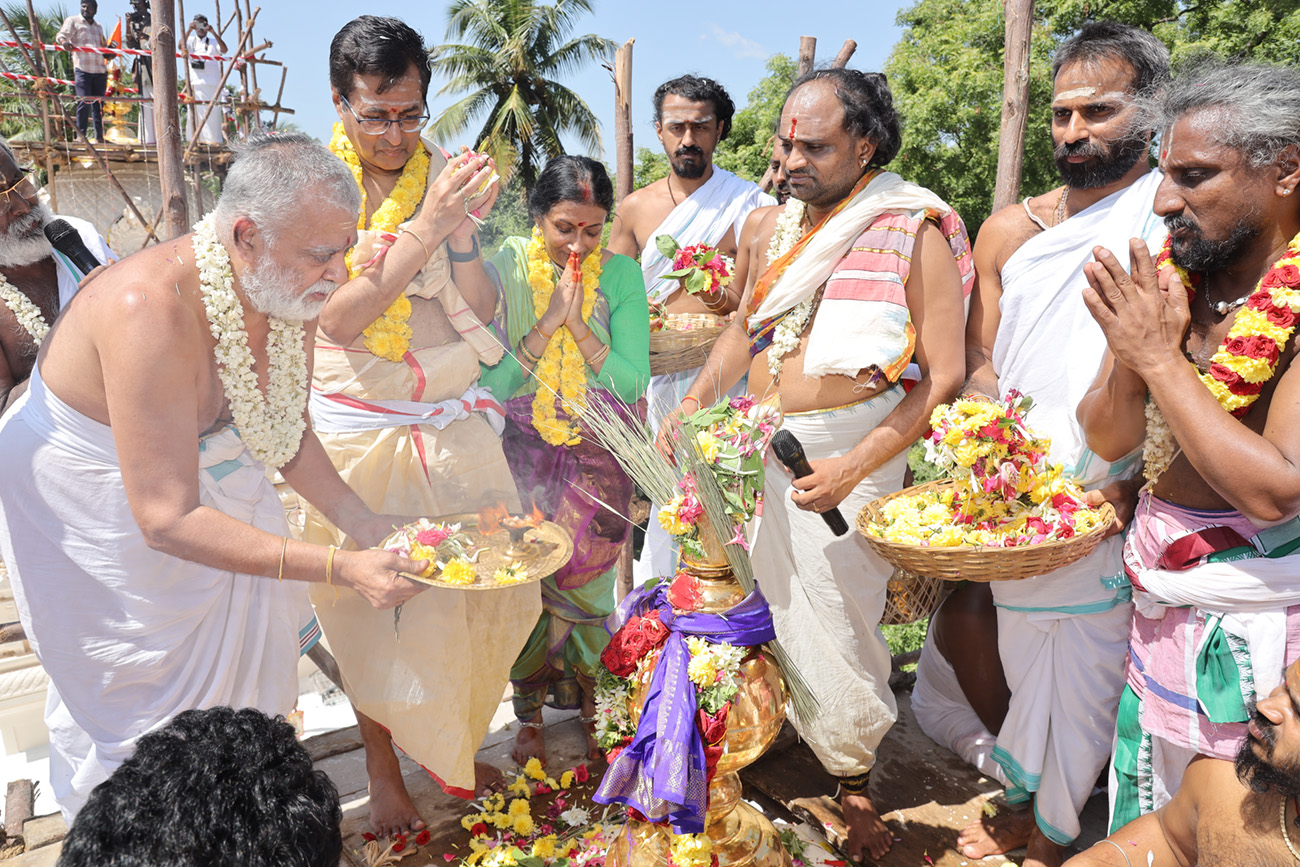
ASHRAM BULLETIN
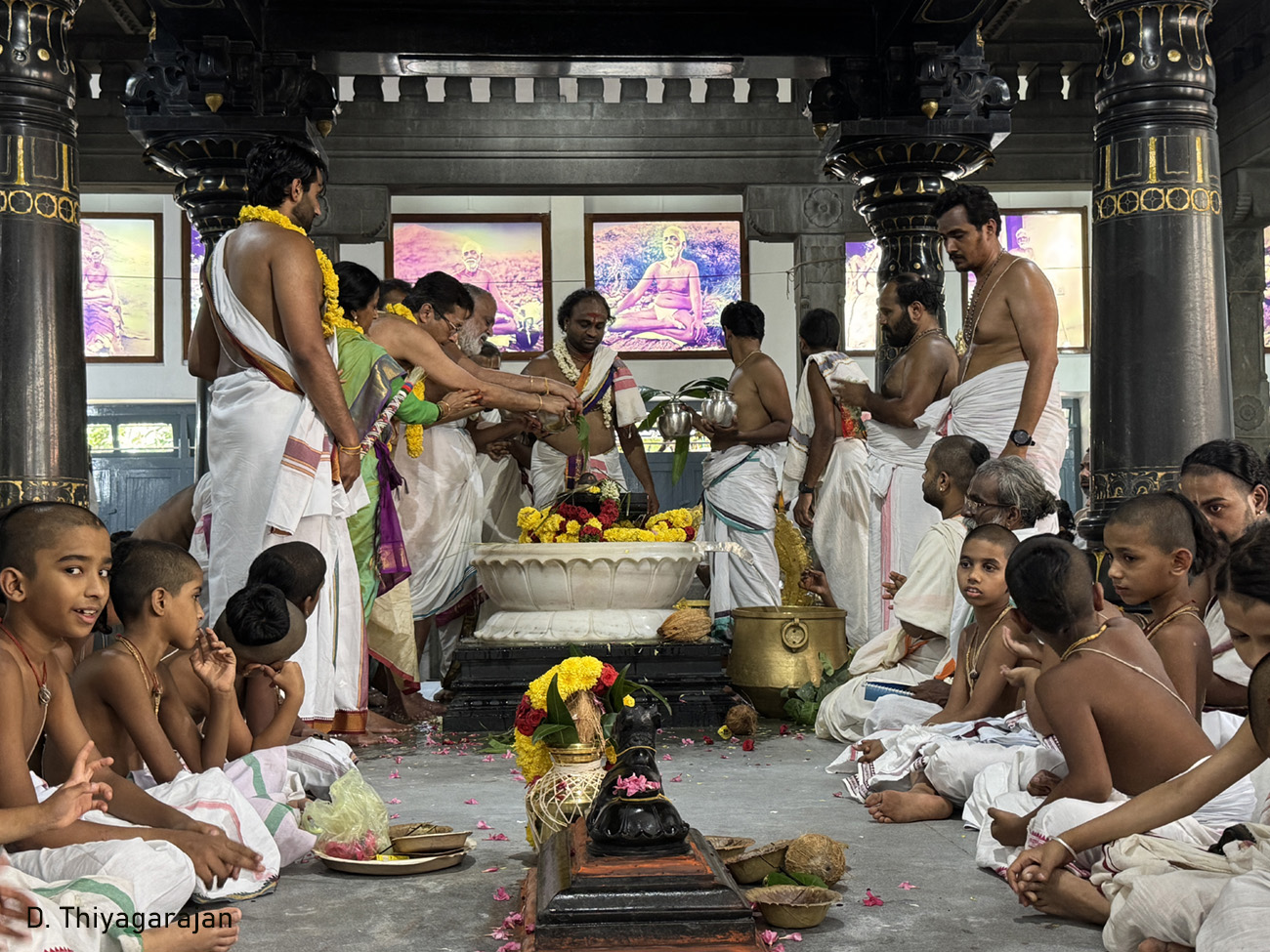
Cow Lakshmi Day
On 17 June 1948, when Lakshmi was ill, Bhagavan went near her, placed her drooping head on his lap, placed his hand on Lakshmi's head and then touched her heart. After her death, her body was buried inside the ashram premises with full rites. A statue of the cow Lakshmi was installed on the cow samadhi. A venba inscription composed by Bhagavan was inscribed on the tomb to mark the date of the samadhi of the cow Lakshmi. The anniversary of her mahasamadhi was held at her samadhi located inside the Sri Ramana Ashram on 7 July 2025. The shrine was decorated and the final aarthi was attended by a large number of devotees.
Guru Purnima
On the sacred day of Guru Purnima (10 July 2025), the ashram reverently honored its sannyasis, following a timeless tradition rooted in devotion and gratitude. In the sanctified silence of the Samadhi shrine of Bhagavan Sri Ramana Maharshi, new robes were offered to the renunciates—symbolic of spiritual renewal and surrender.
The profound wisdom of Bhagavan resounded: "The Guru is both 'external' and 'internal.' From the 'exterior,' he gives a push to the mind to turn inward; from the 'interior,' He pulls the mind towards the Self and helps in the quieting of the mind. That is Guru's grace. There is no difference between God, Guru, and the Self." These divine utterances remind us that the Guru is the guiding light that gently leads the aspirant into the radiant Heart of Being.
Aradhana of Sri Kavyakanta Ganapati Muni
On 25 July 2025, the ashram was resplendent with the divine vibrations of Ramana Gita, as devotees gathered in the New Hall to celebrate the Aradhana of Sri Kavyakanta Ganapati Muni and recited Ramana Gita. A sage of immense spiritual stature, Ganapati Muni shone brightly as a poetic seer and ardent disciple of Bhagavan. His departure from earthly realms on 25 July 1936 was observed with devotional fervor by those touched by his light.
Sri Kunju Swami Aradhana
On 7 August 2025, devotees observed the Aradhana day of Sri Kunju Swami. Sacred rituals, including abhisheka and the chanting of Aksharamanamalai, filled the air with devotion at his samadhi.
Independence Day
August 15th was observed at Sri Ramana Ashram with solemn patriotic fervor and deep spiritual resonance, echoing the timeless spirit of India's sacred freedom. The Indian tricolor was hoisted amid heartfelt singing of the national anthem.
As sweets were distributed and prayers offered for the welfare of the nation, memories rose unbidden of that poignant and hallowed morning in 1947. On that first Independence Day, it was none other than Bhagavan Sri Ramana Maharshi who, with profound emotion and childlike simplicity, raised the national flag—a flag he had tenderly stitched with his own hands. Devotees recall how Bhagavan's eyes brimmed with tears of joy, a silent testimony to the freedom not only of a nation, but of the soul itself, unshackled from centuries of bondage
Sri Muruganar Aradhana
On 22 August 2025, devotees observed the Aradhana of Sri Muruganar, the saint-poet whose soul blossomed in the presence of Bhagavan. Endowed with divine inspiration, Muruganar composed over thirty thousand verses steeped in love, wisdom, and the fragrance of the Self. His works, such as Guru Vachaka Kovai and Padamalai, remain spiritual treasures. On the Amavasya day in August 1973, he was lovingly absorbed into Arunachala's eternal embrace.
Advent Day
1 September 1896 marked the radiant Advent of Bhagavan Sri Ramana Maharshi to Arunachala. At just sixteen, Venkataraman's journey from Madurai culminated in union with the Hill of Light. Devotees gather in large numbers each year to celebrate this divine event.
Obituary: Smt. Lakshmi Venkataraman
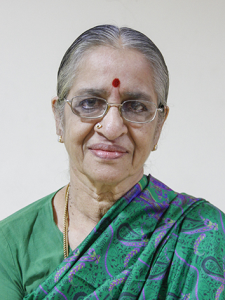 Smt. Lakshmi Venkataraman, the eldest daughter of the Ashram's former President, Sri T.N. Venkataraman (Swami Ramanananda), attained Ramanapadam on June 13, 2025.
Born on January 17, 1941, Smt. Lakshmi married Sri M. Venkataraman on February 7, 1960. After her marriage, she resided in Madurai and later settled in Chennai from 1966 onwards. She lived a life of immense devotion to Arunachala, regularly chanting Aksharamanamalai and walking the path of karma yoga. She had been living in Mumbai since 2018. Her husband passed away in 2019. She is survived by her two sons, Suresh and Ganesh.
Her lifelong connection with Bhagavan is evident from the following conversation, taken from Devaraja Mudaliar's Day by Day with Bhagavan: "When I (Devaraja Mudaliar) entered the hall, Bhagavan was conversing with five-year-old Lakshmi. I told Bhagavan that I didn't like the idea of Lakshmi being brought up in Erukkoor. I mentioned that if Polish children could be raised in the Ashram, it wasn't right to send our Lakshmi elsewhere. Bhagavan smiled and said that Lakshmi would only stay in Erukkoor if her grandfather (Pichu Iyer) was there."
Obituary: Major Parthasarathy
 Major P. Parthasarathy, born on April 24, 1940. After retiring as a Defence Officer from Indian Army he settled at Sri Ramanasramam in the mid-1990s, where he assisted in various capacities, including the Ratha Yatra project, Telugu
publications, Ashram room inspections, and the evening public English reading of Bhagavan's work.
With advancing age, he devoted himself wholeheartedly to spiritual practice. His days were spent in seated meditation on Bhagavan's path of atma-vichara, along with the daily recitation of Vedaparayanam. Despite a prostate cancer diagnosis in 2019, he remained dedicated to his path, visiting the Ashram daily and participating in the recent Mahakumbhabhishekam. The Major passed away peacefully on August 27, 2025.
From 1949 to 2025: A Legacy of Consecration at Sri Ramanasramam
From 1949 to 2025: A Legacy of Consecration at Sri Ramanasramam
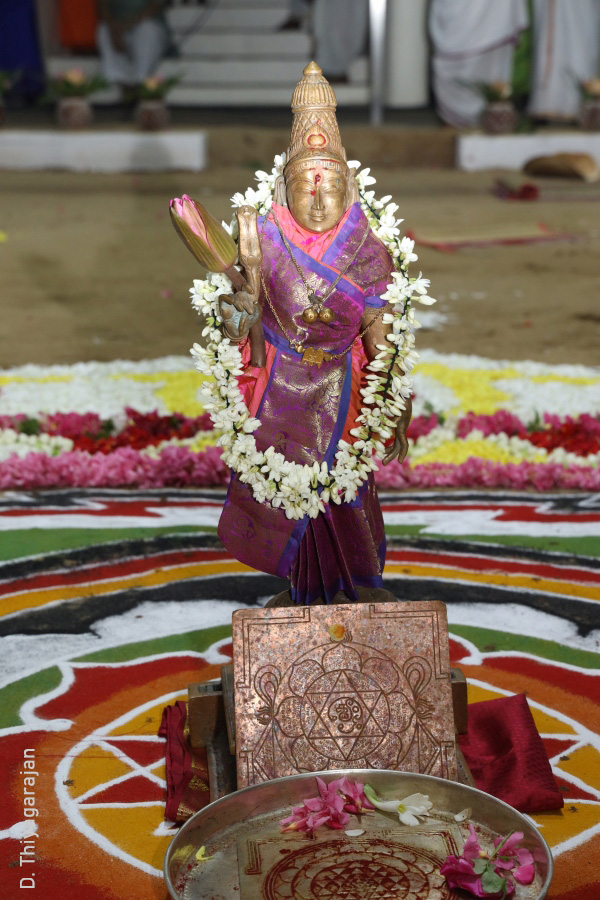 The sacred Kumbhābhiṣekam—the consecration of the shrines of Sri Matrubhuteswara and Sri Ramanaeswara, which ceaselessly radiate Bhagavan's grace to seekers —was celebrated with grandeur at Sri Ramanasramam on August 20, 2025. The day
fell under Punarvasu Nakshatra, the birth star of Bhagavan Sri Ramana Maharshi, adding divine significance to the occasion. This was not only a renewal of sacred structures but a living remembrance of a lineage of consecration
sanctified by Bhagavan himself.
Origins of the Shrine
In 1922, Bhagavan guided the liberation of his mother Azhagammal, dissolving her tendencies into the infinite Self. Her body was interred to the east of Pali Tirtham, and a lingam was installed on the samadhi ten days later. Soon after, Bhagavan descended from Skandasramam to this site, which would become his permanent abode.
Under the devoted care of Sri Niranjanananda Swami (Chinnaswami), the shrine rose slowly but surely. With Bhagavan's silent blessings, it was completed in 1948, preparing the way for its first consecration.
The 1949 Kumbhabhisekam
The first great Kumbhābhiṣekam of the Matrubhuteswara Temple was held from March 13–17, 1949. Hundreds of Vedic scholars filled the air with mantras, while Sri Bharati Krishna Tirtha, Shankaracharya of Puri Mutt, blessed the occasion. Thousands were fed daily in Bhagavan's very presence.
On the day of consecration, Bhagavan himself bore the purna kalasam into the Mother's shrine, sanctifying the moment for eternity. He then seated himself upon a black granite sofa, radiating silent benediction. Chinnaswami, who had carried the burden of the work, was garlanded but humbly refused personal worship, reminding devotees that such honors were due only to those beyond body-consciousness. The event became a living testament to Bhagavan's grace, Chinnaswami's tireless service and devotion.
A Sacred Lineage
That inaugural consecration was guided by the master sthapathi, Sri Vaidyanatha Sthapathi. In later years, his son Sri Ramachandra Sthapathi conducted the ceremonies in 1995 and 2004, and in 2013, his grandson Sri Selvanatha Sthapathi continued the lineage. Once again in 2025, he oversaw the Kumbhābhiṣekam.
The 2025 Kumbhabhisekam
The seventh Kumbhābhiṣekam was held from August 18–20, 2025, drawing devotees from far and near, all hearts uplifted by the remembrance of Bhagavan.
Preparations
From May, the gopurams and vimanams were lovingly restored according to śāstric injunctions. Roofs were resealed, fresh stone laid, and sanctums readied. A grand yagasala was constructed near Lakshmi the Cow's samadhi. Police, fire services, and volunteers were stationed, while the ashram itself bloomed with toranas, garlands, kolams, and festive lights.
Ceremonies
On the dawn of August 18, the yagasala puja commenced, setting the tone for days steeped in sacred observances. What followed was a ceaseless stream of rituals—Ganapati, Navagraha, and Vasthu homas; Rudra Trishati; Kanya and Suvasini pujas; Trimurthi Ashtabandhanam; and the chanting of Ramana and Lalitha Sahasranama archanas—performed with precision and devotion by hundreds of Vedic scholars and students. On the hallowed morning of August 20, the ceremonies blossomed in an atmosphere vibrant with faith and suffused with divine grace. At 8:15 a.m., the Kalasam was borne forth in solemn procession, reverently carried amidst the sonorous intonations of mantras and the uplifting strains of temple instruments. Devotees, hands folded in reverence, received the blessings that seemed to radiate from the sanctified vessels brimming with holy waters. From 8:30 to 9:15 a.m., sacred rites were conducted within the Mother's Shrine and Bhagavan's Shrine. Lamps flickered gently, casting a golden glow upon the sanctums, as though the living presence of the Mother and Bhagavan pervaded the space with their grace. Then, from 9:30 to 10:15 a.m., the Abhishekam of all the Vimanams was performed. Finally, between 10:30 and 11:00 a.m., the culminating Abhishekam was offered in Bhagavan's Shrine and the Mother's Shrine. The sanctums glistened with radiance as the deities, newly adorned after the ablutions, shone forth in resplendent beauty. Thus the ceremonies drew to a blissful close, leaving in their wake an atmosphere of sanctity and a deep, abiding impression of divine grace upon all who had gathered on that holy day.
Devotees and Celebration
Nearly 20,000 devotees received Bhagavan's grace during the festival. Meals were lovingly served thrice daily in multiple dining halls. Facilities were arranged with care so that all could have darshan and partake of prasadam peacefully.
The ashram resounded with Thevaram hymns, nadaswaram, Carnatic concerts, and Tamil discourses, blending devotion with music and scripture. For those afar, the events were live-streamed worldwide, with screens across the ashram ensuring all present physically could witness the event. In a gesture both traditional and modern, the sacred water was sprinkled over devotees by drone, carrying the blessing to every heart.
An Eternal Presence
Just as the 1949 consecration unfolded in Bhagavan's physical presence, so the 2025 Kumbhābhiṣekam was experienced as suffused with his eternal spirit. The shrines of Sri Matrubhuteswarar and Sri Ramanaeswar are not merely stone sanctums but living beacons of his grace, pouring blessings upon all who turn to him.
From the simple samadhi of 1922 to the radiant celebrations of 2025, the unbroken tradition of consecration at Sri Ramanasramam stands as witness to the continuity of devotion, the power of Vedic rites, and above all, the silent, boundless benevolence of Bhagavan Sri Ramana Maharshi with the great hill of Arunachala overseeing us all.
DIARY AND CALENDARS - 2026

Wall Calendar
The wall calendar has six sheets (12 pages) of the photographs of Bhagavan Ramana Maharshi. The special days of ashram are mentioned in the calendar. The calendar is approximately 16 inches in width and 23 inches in height. Price: ₹120.
Two Desktop Calendars
Two desktop calendars are available containing six sheets (12 pages) of the photographs of Arunachala and Bhagavan Sri Ramana Maharshi, respectively. Contain quotations for each month from Bhagavan’s teachings. Price: ₹150.
Sri Ramanasramam Diary 2026
Sri Ramanasramam Diary 2026 - The diary consists of 365 pages with quotations both in English and Tamil based on the teachings of Bhagavan Sri Ramana Maharshi and 12 full page photographs of Bhagavan. Price: ₹ 375.
NOW AVAILABLE
Commemorative Coin

On 15th May 2025, the Government of India announced a special ₹100 commemorative silver coin to honor the Centenary of Sri Ramanasramam—a sacred milestone marking 100 years since its founding in May 1922. This gesture by the nation stands as a tribute to the timeless presence of Bhagavan Sri Ramana Maharshi and to the Ashram’s century of service, guiding seekers from every corner of the world toward peace and self-realization.
The coin, crafted in 99.9% pure silver, weighs 40 grams and measures 44 mm in diameter, with 200 fine serrations along its edge. Its face bears the serene image of Bhagavan, adapted from the Wellings Bust, with the majestic outline of Arunachala above—an artistic union of Master and Mountain. Together, they embody the eternal silence and grace that lie at the heart of Sri Ramanasramam. On the reverse side shines the Lion Capital of Ashoka, flanked by the inscriptions Bharat in Devanagari and India, with the motto “Satyameva Jayate” beneath.
The coin will be sold at nearly its cost price for ₹ 10000 from October 2025 but can be pre-ordered now. This numismatic treasure is more than silver; it is a sacred keepsake—a token of devotion, history, and spiritual heritage— forever linking the devotee’s heart with the radiant presence of Bhagavan.

Engage yourself in the living present. The future will take
care of itself. Do not worry about the future.
— Talks with Sri Ramana Maharshi, Talk No. 238
Follow us Online
 |
Get connected - visit a satsang near you or start one! https://www.gururamana.org/Satsangh/satsangh-centres |
 |
https://www.facebook.com/sriramanamaharshi to visit Ashram’s Official Facebook page (also available in nine other languages) |
 |
https://www.youtube.com/sriramanasramam to visit Ashram’s Official YouTube Channel
|
 |
to visit Ashram’s Official Instagram page www.instagram.com/sriramanasramam |
 |
to subscribe to Ashram’s Official WhatsApp Channel https://whatsapp.com/channel/0029VaByrGSC1FuLjCG2fW2P |
 |
to buy books, audio/video & photos online https://bookstore.sriramanamaharshi.org |
 |
to listen “Voice of Arunachala” 24x7 radio station also available as Android & Iphone App for free download https://www.gururamana.org/Resources/radio-station |
 |
Mountain Path App - Iphone https://apps.apple.com/in/app/mountain-path/id1630751732 |
 |
Mountain Path App - Android https://play.google.com/store/apps/details?id=com.ramana.mountainpath&hl=en_IN&gl=US |
|
to download Ashram’s Tamil Parayana App – Iphone https://apps.apple.com/us/app/ramanasramam-parayana/id1644920339 |
|
to download Ashram’s Tamil Parayana App – Android https://play.google.com/store/apps/details?id=org.ramana.interactive_tamil_parayana |
to access past issues of ‘The Mountain Path
https://www.gururamana.org/Resources/mountain-path
to access past issues of ‘Saranagati’ e-magazine and subscribe
https://www.gururamana.org/Resources/saranagati-enewsletter
Published by Dr. Venkat S. Ramanan, President, Sri Ramanasramam on behalf of Sri Ramanasramam
from its office at Tiruvannamalai 606603 and printed by Sri. N. Subramanian at
Sudarsan Graphics Private Limited, 4/641, 3rd Street, 12th Link Street, Kottivakkam, Chennai 600 041.
Editor: Dr. Venkat S. Ramanan
Endnotes
- 1 Swami Venkatesananda, The Concise Yoga Vasistha, State University of New York Press (October 1984), pp. 32-35.
- 2 Day by Day with Bhagavan, 30-5-46.
- 3 Day by Day with Bhagavan, 12-3-46.
- 4 Talk 648, Talks with Sri Ramana Maharshi.
- 5 Talk 244, Talks with Sri Ramana Maharshi.
- 1 Ramana Ashtottara Namavali, v. 40.
- 2 ibid., 68.
- 3 Maravap Padhikam.
- 4 Dayashtakam, verses vi & vii.
- 5 śrītiṣu śiveti pratitaṁ daivaṁ, 998.
- 6 Ibid, 902.
- 7 anumavastu te karuṇayā satām, v. 562.
- 8 Words of Grace, p. 49.
- 9 cidagnikuṇḍa sambhūtā, Śrī Lalitā Sahasra Nāmāvalī, 4.
- 10 A dhyana sloka of Devi.
- 11 Śrī Lalitā Sahasra Nāmāvalī, 667.
- 12 Śrī Lalitā Sahasra Nāmāvalī, 668.
- 13 Ganapati Muni, Uma Sahasram, v. 573.
- 14 Thirumoolar, Tirumantiram, 270.
- 15 yakṣa svarūpāya jaṭādharāya, Siva Panchakshara Stotram, v. 5.
- 16 Arunachala Navamanimalai, v. 4.
- 17 Tiruvachakam, Thiru Andappaguthi, line 58.
- 18 Ganapati Muni, Uma Sahasram, verses 496, 498.
- 19 From decad 109 of Book VI.
- 20 Devi Bhujanga Stotra, v.4.
- 21 Uma Sahasram, v. 302.
- 22 Epistles of Light, 5-5-31.
- 23 Epistles of Light, 9-6-31.
- 24 Arunachala Navamanimalai, v.9.
- 25 Śrī Lalitā Sahasra Nāmāvalī, 603. guru mūrti.
- 26 guru mūrtidharāṁ guhyāṁ guhyavijñānadāyinīm | guhyamakajanaprītāṁ guhāyāṁ nihitāṁ namaḥ ||
- 27 Kabir 355--70.
- 28 Arunachala Shodasa Mulakshara Namaskara Stotram, verses 1 & 3.
- 29 Dhayashtakam, 8.
- 1 Maharshi's Gospel, Book 2, Chapter 3.
- 2 Sadhu Om, Maharshi Newsletter, Jan-Feb 2005; Mountain Path, October, 2019.
- 3 Guru Vachaka Kovai, v. 44, Muruganar, Translation by Prof K.Swaminathan.
- 4 Day by Day with Sri Bhagavan, 21st July, 1946, Devaraja Mudaliar.
- 1 Ulladu Narpadu, v.2.
- 2 T.M.P. Mahadevan, Ramana Maharshi and his Philosophy of Existence, p. 33.
- 3 Guru Vachaka Kovai, v. 125, Translated by Prof. K.Swaminathan.
- 4 Vivekachudamani, v. 58.
- 5 Ibid., v.59.
- 6 Ibid., v.60.
- 7 Talks with Sri Ramana Maharshi, Talk 502.
- 8 Guru Vachaka Kovai, v. 144, Translated by Prof K.Swaminathan.
- 9 Mundaka Upanishad, v. I.i.8
- 10 Ulladu Narpadu, v. 1.
- 11 Ramana Jnana Bodham, Padamalai 2614
- 12 David Godman, The Power of the Presence, Part 2, pages 91,93.
- 13 Ibid., page 159.
- 14 Guruvachaka Kovai, v. 991, Translated by Prof.K.Swaminathan.
- 15 David Godman, The Power of the Presence, Part 1, page 271.
- 16 Talks with Sri Ramana Maharshi, Talk 619.
- 17 Taittiriya Upanishad Bhriguvalli
- 18 Talks with Sri Ramana Maharshi, Talk 3.
- 19 Talks with Sri Ramana Maharshi, Talk 251.
- 20 Ibid., Talk 624.
- 21 Ibid., Talk 617.
- 1 Art and Illusion, Sir Erich Gombrich, Phaidon Press, 2004.
- 2 Vasistha's Yoga, translated by Swami Venkatesananda, State University of New York Press, 1993.
- 3 Ibid.
- 4 Dreams, Illusions and other Realities, Wendy Doniger, Speaking Tiger Books, 2023 p.288. (YV 5.44.39-40).
- 5 Talks with Sri Ramana Maharshi, Talk 396.
- 6 Dreams, Illusions and other Realities, Wendy Doniger, Speaking Tiger Books, 2023 p.288. (YV 3.106.61-65).
- 7 Ibid., pp.138, 139.
- 8 Talks with Ramana Maharshi, Talk 33.
- 1 Tiruvasagam poem reference
- 2 Thillai - ancient name for Chidambaram
- 3 The Kali Yuga is marked by the fourth and final age in the Hindu yuga cycle, preceded by the Dvapara Yuga, the Treta Yuga, and the Satya Yuga. It is marked by a decrease in virtue and an increase in vice, greed, and conflict. Materialism, self-interest, and a loss of spiritual connection are also prominent features.
- 4 Ananda Tandavam, the blissful dance of Lord Shiva performed at Chidambaram, symbolizes both the joyous celebration and the sustaining rhythm of the entire cosmos. Revered in Tamil tradition, this sacred dance has inspired many great poetic outpourings by ancient saints and poets, especially within the devotional masterpieces of the Tevaram and Tiruvasagam.
- 1 Question 24 in Who Am I? (translated by Dr. T.M.P. Mahadevan).
- 2 Maharshi's Gospel, Book II, Chapter 1.
- 3 11-1-46 in Day by Day with Bhagavan.
- 4 Talk 47 in Talks with Sri Ramana Maharshi.
- 1 Poṉṉai Yoththa Paththu, Śloka 6.
- 2 Devaraja Mudaliar, Day by Day with Bhagavan, 23-1-1946 Night
- 3 Subbaramayya, G.V, Sri Ramaṇa Reminiscences, p.94.
- 4 Subbaramayya, G.V, Sri Ramaṇa Reminiscences, p.127
- 5 Ibid., p.60.
- 6 Words-separated version of Śloka 701 in Guru Vachaka Kovai
- 7 Māṇḍūkyopaniṣad, Mantra 1.5
- 8 Who Am I, Page 12.
- 9 Tattvabodha, Section 2.
- 10 Upadeśa Sāra, Śloka 8
- 11 Bṛhadāraṇyaka upaniṣad 4.4.19
- 12 Suri Nagamma, Letters from Sri Ramanasramam, 23rd May, 1947.